Oura IPO Delay, Closing IPO Window as 10-Year Hits 5.3%


Oura, the Finnish smart ring maker that registered to go public in September, has delayed its planned listing in a move press reports tie to the sharpest rise in long-term Treasury yields in more than two decades. The Wall Street Journal and Fortune reported the delay on October 6 and 7. As of October 7, no withdrawal of the registration was filed on the Securities and Exchange Commission EDGAR system, so the offering remains technically live even as its window narrows.
The offering on the table
Oura's registration statement, filed September 3 and amended September 21 on EDGAR (CIK 2133022), sized the deal at 13.5 million primary shares plus 36.5 million shares from selling stockholders, at an estimated range of $40.00 to $44.00. The company applied to list on the Nasdaq Global Select Market under the symbol OURA. The prospectus discloses a company that grew revenue to $1,214.5 million in the nine months ended June 30, 2026, up 74% from $697.6 million a year earlier, with net income of $60.8 million for that period and roughly 5.0 million paid members.
Related reading: 2007-style repricing hits equities: yields and the ceiling.
None of that figures in a price yet. The stock has not priced, and the company has made no public statement withdrawing or postponing the deal. What exists is press reporting, attributed by name: The Wall Street Journal and Fortune variously describe the listing as pulled or delayed, tied to market conditions around long-dated yields.
Rates are the mechanism
The equity side of the story is the discount rate. The 10-year Treasury closed at 5.31% on October 5 and the 30-year at 5.66%, FRED data show, with the long bond at its highest level since July 2002, a span of more than 24 years. A 5% plus 10-year reprices the present value of growth that is expected years out, which is most of the valuation for a fast-growing hardware and subscription company like Oura. As the discount rate rises, two things happen at once: the fair multiple falls, and the discount investors demand for the illiquidity and execution risk of a new listing widens. The IPO price range, negotiated against a certain yield level, drifts stale.
For the broader framework, see our Fed policy coverage.
Related reading: Energy Leads the Rotation Into a 5% 10-Year and the FOMC.
Analytics firm ION Analytics said further delays are likely as bond-market turbulence rises, per reporting on October 7. The pattern read is not new. Echo Global Logistics, the transportation and logistics company backed by The Jordan Company, delayed its listing to next year, Axios reported October 7. When the reference rate moves this far between registration and pricing, issuers face a choice between repricing lower or waiting for calmer conditions, and the cheapest option is often to wait.
The calendar was already thin before October's turbulence. Renaissance Capital counted 112 U.S. IPOs through the end of September 2026, down from 202 in all of 2025, a decline of roughly 45%. The month-by-month count for 2026 shows the lull concentrated in the spring and late summer: 11 deals in January, 15 in February, 8 in March, 15 in April, 14 in May, 19 in June, 11 in July, 12 in August and 7 in September, the year's lightest month, per Renaissance Capital.
Related reading: Record Nasdaq hides thin breadth and a 5.28% yield ceiling.
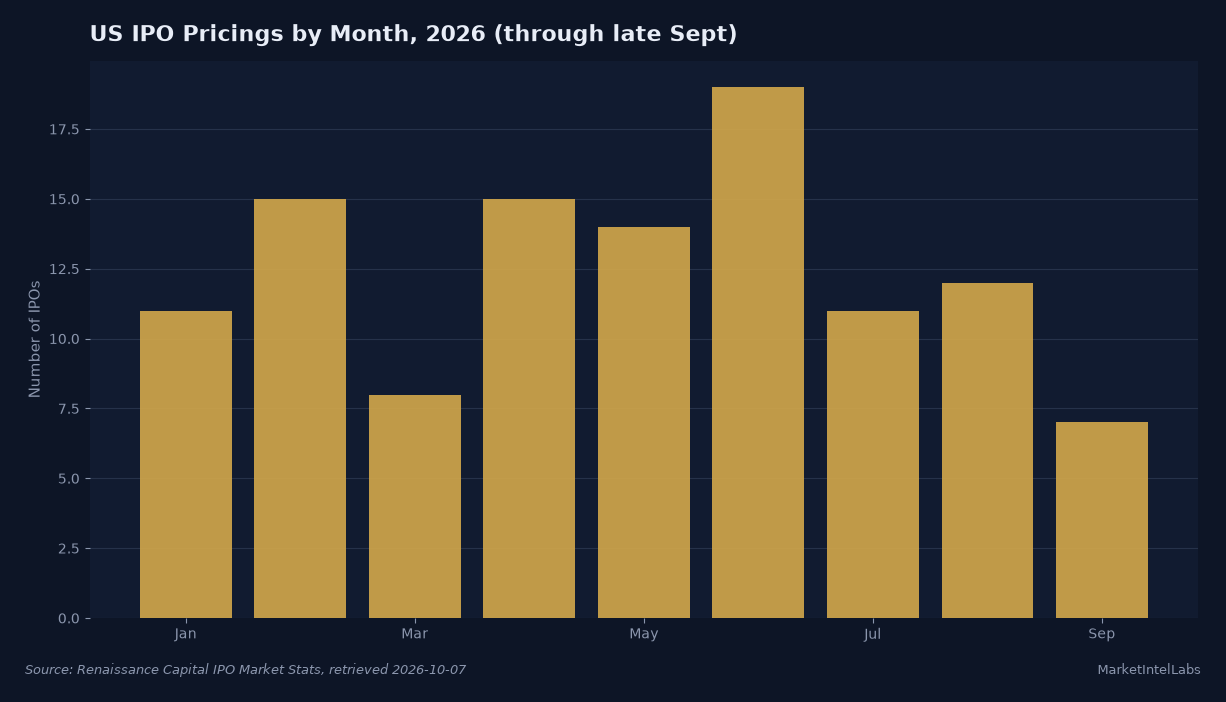
September's 7 deals is the telling data point for the current moment: volumes were already fading before the yield move accelerated, so the third-quarter window closed with fewer listings, not more.
Who is still on the calendar, and what to watch
The fourth quarter still holds names that filed or raised while conditions were friendlier. Lambda, the AI infrastructure company, is reported by business media to be raising a roughly $4 billion pre-IPO round as it works toward the public market. DayOne, a data center operator, filed publicly, and MarketIntelLabs covered that filing on October 6, including the 2.3 gigawatts in bookings disclosed in the registration.
Both are the kind of deals that were structured when growth multiples were priced for near-zero real rates. Whether they hold ranges, reprice, or follow Oura's reported path to a delay depends in large part on what the long end of the curve does next.
Three signals will tell the story. First, the 10-year and 30-year levels: a sustained settle above 5.31% and 5.66% keeps pressure on every outstanding registration. Second, the EDGAR filing queue for Form RW withdrawals, the formal step that turns a press-reported delay into a documented one; Oura had not filed as of October 7. Third, the December calendar, traditionally a quiet window, which now carries the reported Lambda and DayOne deals plus any names that chose to wait rather than price into current yields.
The broader equity takeaway is a rotation of risk: a 5% plus long end taxes the most duration-heavy growth stories first, and the IPO calendar is the visible casualty. Multiples that rely on cash flows a decade out shrink faster than those backed by current earnings. Until the yield curve stops moving, expect the door to stay half closed.
This content is for informational purposes only and does not constitute financial advice. Past performance is not indicative of future results. Consult a qualified financial advisor before making investment decisions.
Get daily intelligence delivered
Create a free account for the Daily Brief every weekday and The Week Ahead every Sunday. No card required.