Mortgage Rates Hit 7.30 Percent and Buyers Are Stepping Away

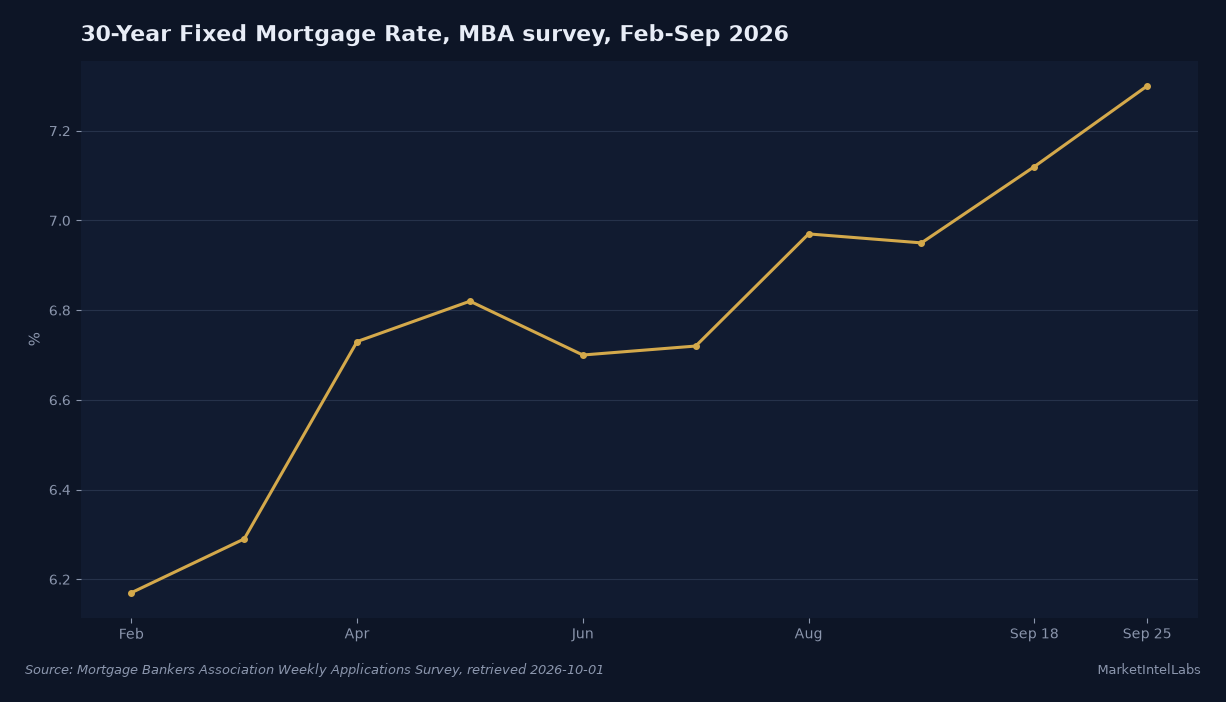
The Mortgage Bankers Association's weekly survey for the week ending September 25, 2026 put the average contract rate on the 30-year fixed conforming mortgage at 7.30 percent, up from 7.12 percent the week before and the highest reading since November 2023. Applications fell 6.0 percent on a seasonally adjusted basis, the survey released September 30 showed, and both purchase and refinance volume came in at their slowest weekly pace of 2025 or 2026. Six consecutive weekly increases have now added 59 basis points to the cost of a conforming loan since the September 11 survey.
The swing from August is stark. FRED's copy of the weekly Freddie Mac benchmark averaged 6.66 percent on August 27 and 6.95 percent on September 17, and the MBA series crossed 7.12 percent in the September 18 week before this week's 7.30 print, a climb we tracked in MBA: 7.12% Mortgage Rate Sends Refis to Slowest Since 2025. A borrower taking the median existing-home sales price of $410,700 as reported for April 2026 in Census Bureau data faces roughly $2,735 in monthly principal and interest on that loan at 7.30 percent, versus $2,560 at the 6.66 percent August reading, about $175 a month more in five weeks. Freddie Mac's own September 24 weekly survey put the 30-year fixed at 7.03 percent, and the two series have tracked each other within a few basis points all year.
The volume response is the story. Joel Kan, the MBA's Vice President and Deputy Chief Economist, said rates at their highest level in almost three years are pushing borrowers to the sidelines. The seasonally adjusted Purchase Index fell 4 percent on the week and stands 14 percent below the same week last year on an unadjusted basis. The Refinance Index dropped 9 percent and is 56 percent below its year-ago level, which shows how quickly the refi window that opened in the summer has shut. Government refinances led the decline, down 13 percent, with both FHA and VA applications off by double digits. The FHA share of all applications held at 16.7 percent while the VA share slipped to 11.9 percent from 12.0 percent.
Borrowers who must transact are restructuring instead of leaving. Adjustable-rate loans took 10.3 percent of applications this week, the highest share since October 2025, and Kan noted ARM rates run roughly 80 basis points below the fixed rate. On a $500,000 loan that gap is worth about $260 a month at current spreads. It is the same trade the desk described in Borrowers Are Trading Rate Risk for Payment Relief as Fixed Rates Hit 7.12 Percent: payment relief now in exchange for reset risk later, chosen by households whose alternative is not a cheaper loan but no loan at all.
Two readings from the same week explain why the pressure will not lift quickly. The 10-year Treasury yield that mortgage desks price against has been climbing since early September as markets repriced the path of Fed policy, and Goldman Sachs pushed its forecast for the next Fed move to December on September 30 after August PCE inflation data came in below expectations. Separately, Altos Research data cited by Calculated Risk showed active single-family inventory up 3.8 percent from the same week of 2025, the third straight weekly rise in that comparison. More houses on the market meeting fewer qualified buyers is the definition of a buyer's market in formation, but only for buyers with a 7.30 percent loan working.
The builder side has been running the same experiment with better tools. August new-home sales came in at a 684,000 annual pace per the Census Bureau release on September 25, the swing in New-Home Sales Climbed to 684,000 in August While Supply Thinned to 8.5, and months of supply thinned to 8.5 from 9.0 in July as builders used incentives to keep contracts moving while the resale market stalled. Homebuilder equities did not celebrate the 7.30 percent print: the iShares Home Construction ETF (ITB) closed September 30 at $87.02, down from $89.43 on September 25, and D.R. Horton (DHI) finished the session at $136.65 versus $141.51 a week earlier, per Yahoo Finance data. The sector has absorbed the rate climb with incentives so far; a sustained 7-plus percent world tests that arithmetic because each 25 basis points on a financed lot pipeline is margin a builder either eats or passes on.
What happens next is dated, not speculative. The September employment situation report lands Friday, October 2, and the September CPI follows on October 13. Both prints move the 10-year yield and therefore the mortgage rate, and the market's current expectation of a December Fed move means the next five weeks of data decide whether the 30-year fixed spends the fall above 7 percent or gets a second look at the high 6s. Inventory data suggests sellers are already adjusting: with active listings up 3.8 percent year over year and purchase demand down 14 percent, the price side of the affordability equation is doing work the rate side refuses to do. Watch the November 27-week MBA surveys for whether ARM share keeps climbing past 10.3 percent; it is the cleanest real-time read on how much payment stress the fixed rate is creating.
This content is for informational purposes only and does not constitute financial advice. Past performance is not indicative of future results. Consult a qualified financial advisor before making investment decisions.
Get daily intelligence delivered
Create a free account for the Daily Brief every weekday and The Week Ahead every Sunday. No card required.