Job Postings Just Turned Positive for the First Time in Four Years


For the first time in nearly four years, the number of job postings in the United States is higher than it was a year ago. The Indeed Job Postings Index stood 0.7 percent above its year-ago level as of September 18, the first positive annual reading since late 2022, according to the Indeed Hiring Lab's US Labor Market Snapshot published September 24. The index itself reached 103.5, its highest level since late March and about 3 percent above its pre-pandemic baseline. A line that had been falling, on and off, since the Federal Reserve began cooling the labor market has finally crossed zero.
The date on that number matters as much as the number itself. Annual declines in postings began in late 2022 and kept deepening through 2024 and most of 2025. Every prior month this year, the comparison to a year earlier was still negative. September 18 is the first observation where it is not. Hiring Lab's own framing is that the annual decline in labor demand "might have run its course," which is careful language, but the direction of the signal has plainly changed.
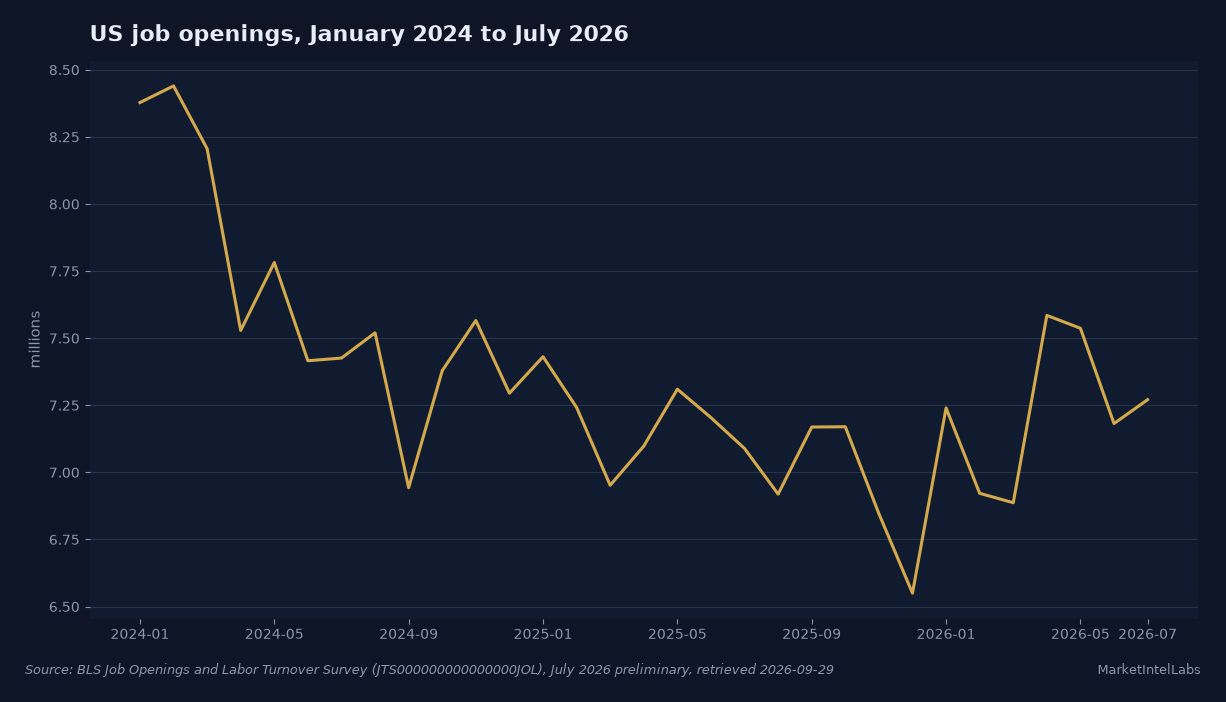
The official data agree on direction, if not on smoothness. Job openings in the BLS Job Openings and Labor Turnover Survey fell from 8.4 million in January 2024 to 6.6 million in December 2025, per BLS data, and have since recovered to 7.27 million in July 2026, a preliminary figure. That is back above where the series stood a year earlier, in July 2025, when openings ran 7.09 million. Monthly momentum on Indeed is stronger still: postings grew 1.5 percent over the month through September 18.
The widening underneath the headline
The more meaningful detail is how broad the recovery has become. As of September 18, 60 percent of the occupational sectors Indeed tracks had postings above their pre-pandemic baseline, up from 51 percent at the start of June, according to the Hiring Lab snapshot. A demand recovery carried by one or two hot categories is fragile. One that keeps widening across occupations, even at 0.7 percent annual growth, looks more like a turn.
The composition of the recovery is not even, though, and the wage data show it. Posted pay on Indeed rose 2.5 percent over the year ending August 2026. That is well below the 3.1 percent average hourly earnings growth in the September Employment Situation, per BLS data, and it is concentrated at the top: annual advertised wage growth in higher-paying occupations accelerated from 2.0 percent in January to 2.6 percent in August, while posted wage growth in low- and middle-wage occupations moved sideways. The postings recovery is adding listings faster than it is adding bidding power for most workers.
There is also a quieter tell inside the index. New postings, which count listings seven days old or newer, sat at 94.0 on September 18, about 6 percent below the pre-pandemic level, while the total index sat 3 percent above it. Employers are not flooding the market with fresh requisitions. They are keeping existing ones alive longer. That is consistent with a demand recovery that is real but cautious: companies posting roles they intend to fill eventually, not ones they need to staff this quarter.
Why this turn still feels frozen
None of this has changed the experience of looking for work. The JOLTS hires rate was 3.2 percent in July, a level that outside the pandemic lockdowns has only appeared during the slow recoveries of 2009 to 2011, per BLS data. The quits rate sat at 1.9 percent and the layoff rate at 1.0 percent. Employers are posting again, yet they are not converting those postings into hires, a split the July JOLTS report laid bare, so the constraint now sits with the decision to fill a role rather than with the decision to advertise one.
The household side explains part of the mismatch. The unemployment rate was 4.1 percent in July, down from 4.5 percent at the end of 2025, but the participation rate fell to 61.6 percent between May and August, as we covered last week. The pool of available workers is shrinking, so even a genuine pickup in postings takes longer to translate into hires. Hiring Lab makes the same point: a shrinking labor supply makes it mathematically harder for the unemployment rate to rise, so a 4.1 percent reading does not describe the same churn it did in earlier cycles.
For the Federal Reserve, the signal is awkward, a picture consistent with a labor market quietly firming. A labor demand inflection is the kind of thing the rate-setting committee worries about cutting off too early, and it lands in the same week that market pricing put October hike odds near 64 percent, per futures pricing reported Tuesday. If postings keep compounding positive, the case that labor demand needs more stimulus weakens. One monthly reading is not a trend, and Hiring Lab itself says the next two JOLTS prints will tell whether 0.7 percent becomes one.
The calendar gives us the next checks. The August JOLTS report is due this morning at 10 a.m. Eastern, and it will show whether the openings recovery held through August. Weekly initial claims arrive Thursday morning, and they have run near five-decade lows, at 197,000 for the week ended September 19, per the Department of Labor. Then the October Employment Situation lands Friday, October 2. If postings growth, openings and claims are all pointing the same way by Friday, the four-year contraction in labor demand is over, and the question shifts from how weak hiring is to how fast it can recover when employers finally start converting postings into payrolls.
This content is for informational purposes only and does not constitute financial advice. Past performance is not indicative of future results. Consult a qualified financial advisor before making investment decisions.
Get daily intelligence delivered
Create a free account for the Daily Brief every weekday and The Week Ahead every Sunday. No card required.