Hormuz at a Crawl: What Monday's Oil Open Is Pricing

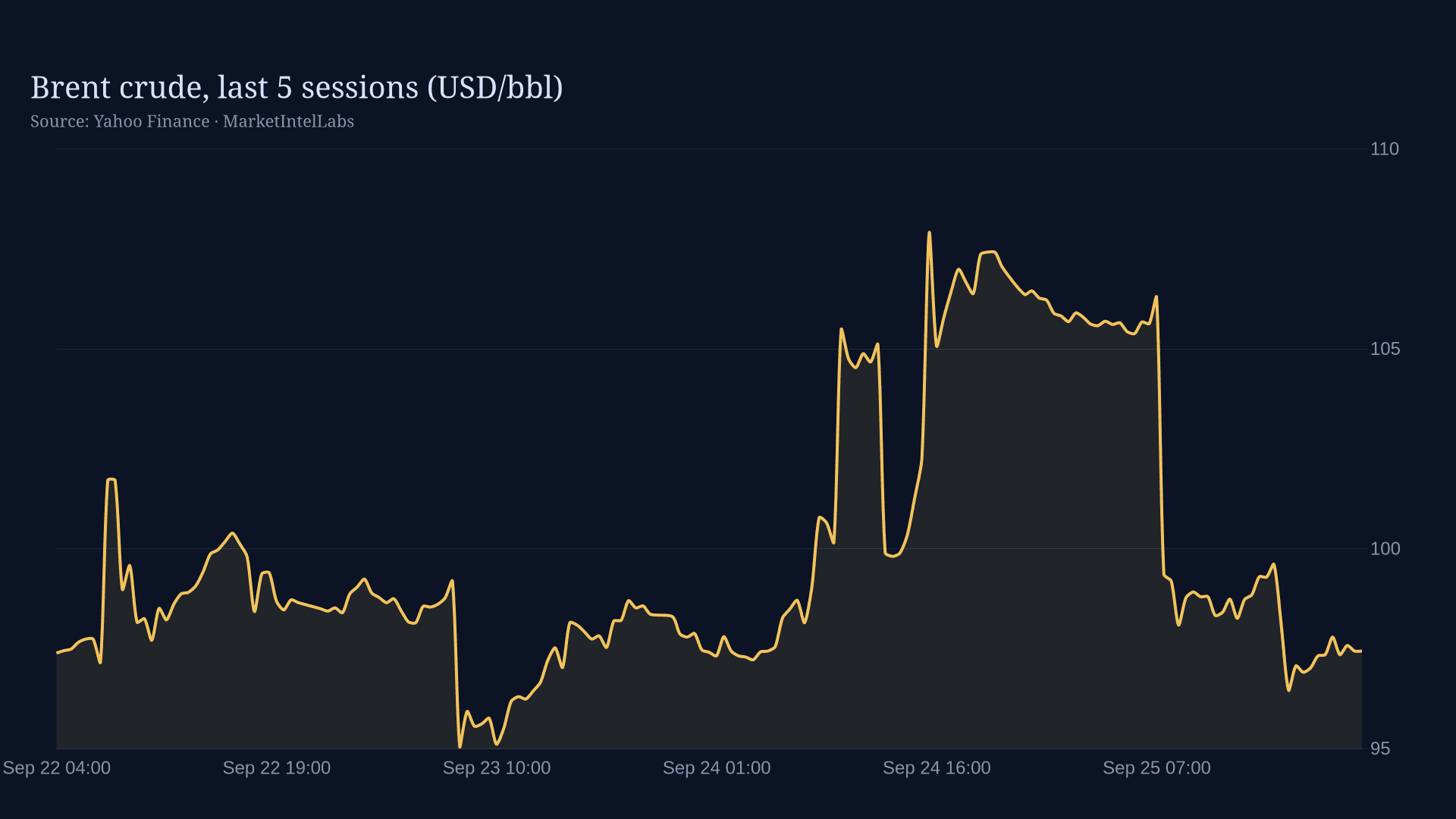
The deal that held crude through Friday's close was the hope of a fast reopening, and over the weekend that hope broke. The president rejected Iran's seven-day offer to reopen the Strait of Hormuz, according to a Saturday dispatch from Al Jazeera and ABC, and the strait stayed effectively closed into Sunday morning: one transit on September 20 against an 85-per-day baseline, per IMF PortWatch via the Straits Daily Brief, with 262 vessels holding at 02:49 UTC on Sunday. That is not a geopolitical sidebar. It is the supply line a third of the world's seaborne oil moves through, and it reprices the entire complex before the cash open.
Start with what actually moved. Brent had surged 5% intraday on Thursday, September 24, settling at $106.60 on the strike-and-closure risk, then gave some back to close Friday at $104.32, per Reuters. WTI settled $92.41 Friday, down 2.3% on the day and about 8% on the week. The spread between the two, $11.91, is the widest since May, and traders tie it to the very thing the weekend changed: diesel-export chatter and who can get product out of the Gulf.
One transit versus an 85-per-day baseline is effectively a closure. Strait traffic fell off a cliff because the going rate on war risk is too steep for most owners, and a ship that does run gets priced like a one-off trip, not part of a functioning lane. The market had been treating that as a phase that would end quickly, which is why the 09-24 spike faded into Friday. The rejection of the seven-day offer removes the specific off-ramp the bulls had been watching. Elsewhere on the chokepoint map, Suez Transits Jump 17% and Asia-Europe Rates Break First.
On the diplomacy, both sides have said the other is at fault, and the outlets reporting it attribute carefully. The Saturday Al Jazeera and ABC dispatch says the US rejected an Iranian proposal to reopen the strait within seven days, tied to a concession on nuclear inspections. Iran's state-linked accounts framed the offer as a good-faith step that Washington refused, per the same reporting.
There has been no White House statement confirming the account, so treat the rejection as press-reported rather than confirmed by a second official source. What matters for Monday is simpler than the spin: the reopening thread the market leaned on has no live outlet.
The product picture is where the risk is compounding. The ULSD crack versus Brent settled at $92.44 a barrel Friday, near three times where it was a year ago, on a complex where what is tight is not crude itself but the diesel, gasoil and jet fuel made from it. Russia's producer diesel, marine and gasoil export ban, government resolution 59723, expires Wednesday 09-30. The tightness in products, not crude, is the through-line in WTI gave back 7.9% while the $89.60 distillate crack held: the tightness is in products, not crude, part of our crude oil coverage.
European diesel prices run 38% higher year over year and jet fuel more than double, per European Commission data carried by The Guardian, while ARA gasoil stocks sit at 1.68 million tonnes, per Insights Global on September 18. A partial extension or a clean lapse on Wednesday moves cracks and pump prices in opposite directions from here, and Brent versus WTI already signals the market is pricing the ban staying sticky.
Wednesday is also the date the factsheet carries for Ukraine's payment cliff. Intellinews reports the government may run out of money for soldiers and social payments by October 1, against a $27 billion 2026 budget shortfall carried by NV and the New York Times, and a $32.6 billion uncovered gap for 2027 per Intellinews. The EU debate over what to do with roughly 210 billion euros of immobilised Russian central-bank assets is the obvious source of funding talk, but there is no settled deal, and this piece takes no position on it. The point for a portfolio is the timing: two hard deadlines cluster on 09-30, and a sovereign-payment squeeze in a war economy does not respect tidy market calendars.
Two-wars dashboard
Two-wars dashboard: Hormuz transits (daily) 1 vs 85/day baseline; Brent settle 104.32 $/bbl; ULSD (HO) crack vs Brent 92.44 $/bbl; EU diesel price y/y 38%; Russian refinery crude runs 3.8 mb/d (June; ~30% below year earlier); EU gas storage 70.6%; Ukraine agricultural exports, August (all routes) 1.48 Mt (-48.6% MoM; Odesa ports 152,126 t, -93.6%) (oldest figure as of 2026-09-11). On the other front, Russia's drone blockade has Odesa shut into January. Ukraine's grain exports just fell by half..
For the week ahead, the Friday data will squeeze an already fragile complex. August PCE, the Fed's preferred inflation gauge, lands 09-30 at 12:30 UTC, the week's top-tier release, with consensus around 3.4% on the core year-over-year print, per the Cleveland Fed nowcast carried in the events file. September nonfarm payrolls follow 10-02 at 12:30 UTC, consensus clustered near 50,000, with the unemployment rate near 4.1%.
In between lie the Q2 GDP third estimate on 09-30, August JOLTS openings on 09-29 forecast near 7.2 million, and four Fed speakers: Cook on 09-28, Barr and Waller on 09-29, and Cook again on 09-30. Earnings add Nike on 09-29 and Micron on 09-30 after the close, the semis bellwether setting the tone for the AI trade into the data.
What Monday's open is really pricing is sequence risk, not any single headline. A closing that is a pipeline and not a policy holds the oil bid firm at these levels. A diesel ban that extends on the same day the payment cliff bites, right before a hot PCE, is a Wednesday nobody wants to be surprised by, and the dashboard above is the single screen to keep open between now and then.
Sources
IMF PortWatch via Straits Daily Brief, 2026-09-27: Hormuz transits at 1 versus an 85/day baseline; 262 AIS vessels holding at 02:49 UTC.
Reuters, 2026-09-25: Brent and WTI settles; truce hopes and diesel-export-ban talk.
government.ru resolution 59723: producer diesel, marine and gasoil export ban running through 09-30.
Insights Global via Investing.com, 2026-09-18: ARA gasoil and diesel stocks at 1.68 million tonnes.
The Guardian / European Commission, 2026-09-18: EU diesel prices up 38% year over year, jet fuel more than double.
Intellinews: Ukraine payment cliff lands 10-01; $32.6bn uncovered 2027 gap; EUR 210bn immobilised assets.
NV / New York Times, 2026-09-15: $27bn 2026 budget shortfall.
Al Jazeera / ABC, 2026-09-26: US rejection of Iran's seven-day reopening offer (press-reported).
This content is for informational purposes only and does not constitute financial advice. Past performance is not indicative of future results. Consult a qualified financial advisor before making investment decisions.
Get daily intelligence delivered
Create a free account for the Daily Brief every weekday and The Week Ahead every Sunday. No card required.