Gold gives back the conflict bid: $4,303 and the support lines that matter

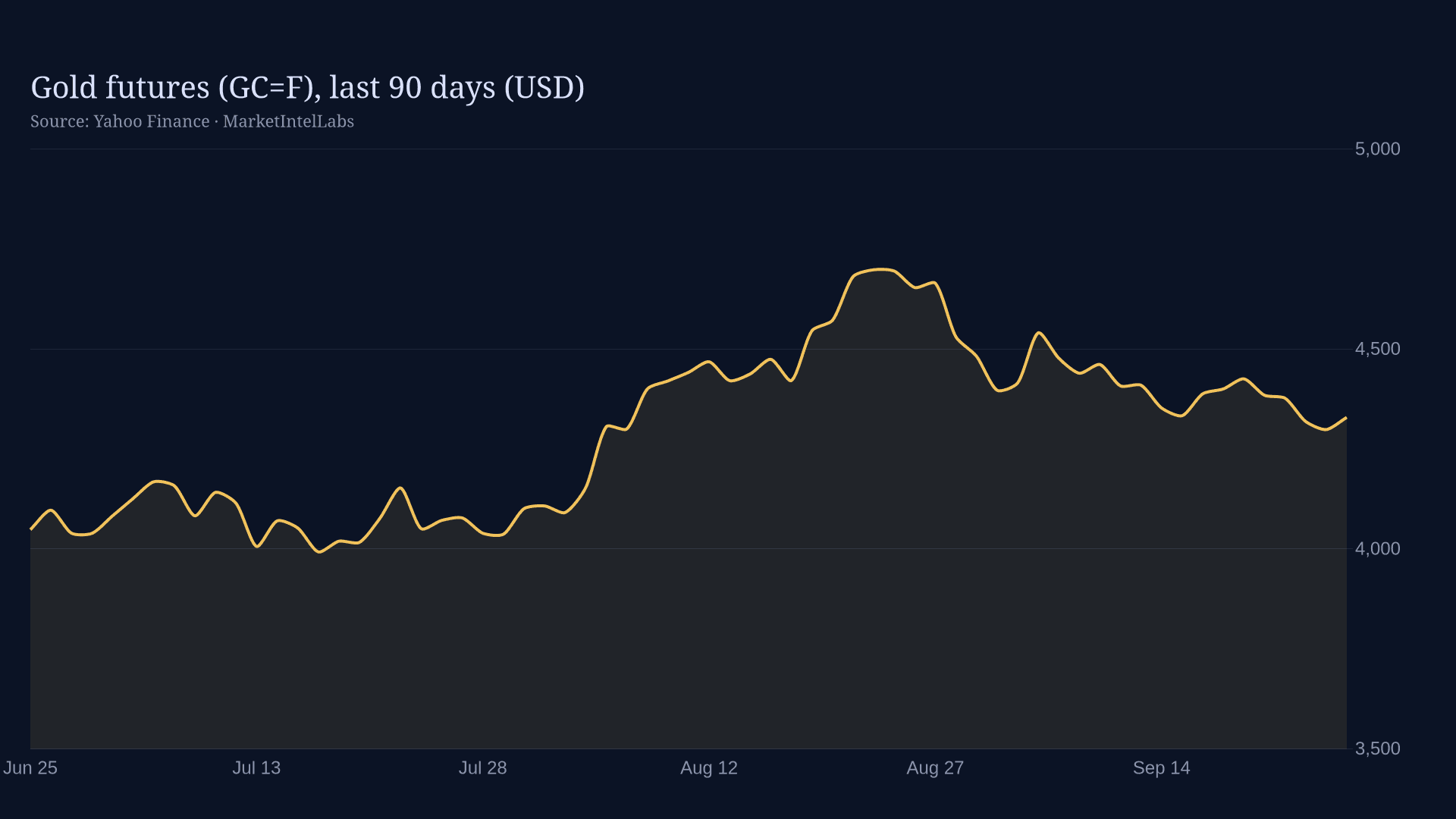
Gold sits at $4,303.10 heading into Friday, down 2.75% from last Friday's $4,424.90 close, as the conflict premium earned in the middle of September mostly unwound into a higher-for-longer rate repricing. Silver followed to $64.07, off 3.8%, and the gold/silver ratio firmed to about 67.2 as the industrial metal lagged its yellow cousin. The pullback reads as orderly rather than a flight: gold still sits several hundred dollars beneath its 52-week high of $5,586.20, leaving room for a fresh risk bid if the Hormuz or Odesa dislocation re-escalates. The pullback extends the fade we mapped when Gold tests its 20-day mean as the conflict bid fades into a higher-for-longer repricing.
The setup is support-buy, not breakout-chase. In gold's case the constructive entry runs from roughly $4,278 to $4,300, a band gold touched this week when it tagged a one-month low of $4,278.30 on Sept 24, the same zone we flagged when Gold and silver hold the line into the rate pullback; copper sits at the month high. A daily close below that $4,278 level would negate the near-term support read and open a test of the broader $4,200 area. Silver has the analogous line at its $63.00 low from the same session, a floor that held inside the metal's persistent $63.20 to $69.40 band even as momentum flagged.
Company strategy favors gold and silver longs on a medium-term horizon, and that view rests on a real floor: central-bank buying plus the liquidity backdrop, with M2 growth still feeding the bid even as the near-term tape argues otherwise. Present that honestly. The medium-term support is intact, but the momentum that carried the conflict bid into mid-month has broken to the downside this week so far, and the immediate path is defined by levels, not by the thesis.
The cross-asset input cuts against the story. A persistent distillate crack near $82 a barrel, versus roughly $30 a year ago, is an inflation input that works against the higher-for-longer narrative supporting gold, the stress behind Gold Holds Near $4,380 as the 10-Year Treasury Yield Pushes to 5%: tighter product costs push price pressure up even while gold's rate-sensitive case wants the opposite. Copper keeps its own thread, grinding to $6.76, up 2.3%, toward the $6.83 52-week high on industrial demand and the alternative-logistics bid that avoids Hormuz. The metals all sit in the same macro bind, but they are not moving in lockstep.
Here is the contrarian case to keep in view. If Hormuz reopened, the fuel-inflation fear that has been one leg of gold's macro support would ease quickly, and the calculus could turn more decisively negative than this week's 2.75% pullback so far suggests. The week's slide to date is the measured version of that risk; a diplomatic resolution would test whether the metal's floor is the central-bank bid or the conflict premium. Watch the PCE print on Sept 25 and the weekly CFTC positioning data for the first read on whether fund money is leaving the long side or merely consolidating.
For a metals investor the honest week-so-far read is simple. For the broader picture, see our gold coverage. The bull case from sovereign demand and liquidity is alive but is a medium-term story being traded against a near-term momentum break. Buy the $4,278 to $4,300 support zone with discipline, respect $4,278 as the invalidation line, and keep one eye on Hormuz, because the fastest way gold's macro calculus turns negative is not another rate hike but a reopening that takes the fear premium out of the barrel.
This content is for informational purposes only and does not constitute financial advice. Past performance is not indicative of future results. Consult a qualified financial advisor before making investment decisions.
Get daily intelligence delivered
Create a free account for the Daily Brief every weekday and The Week Ahead every Sunday. No card required.