Gas Hits $4.48 While Crude Falls. September CPI Books It.

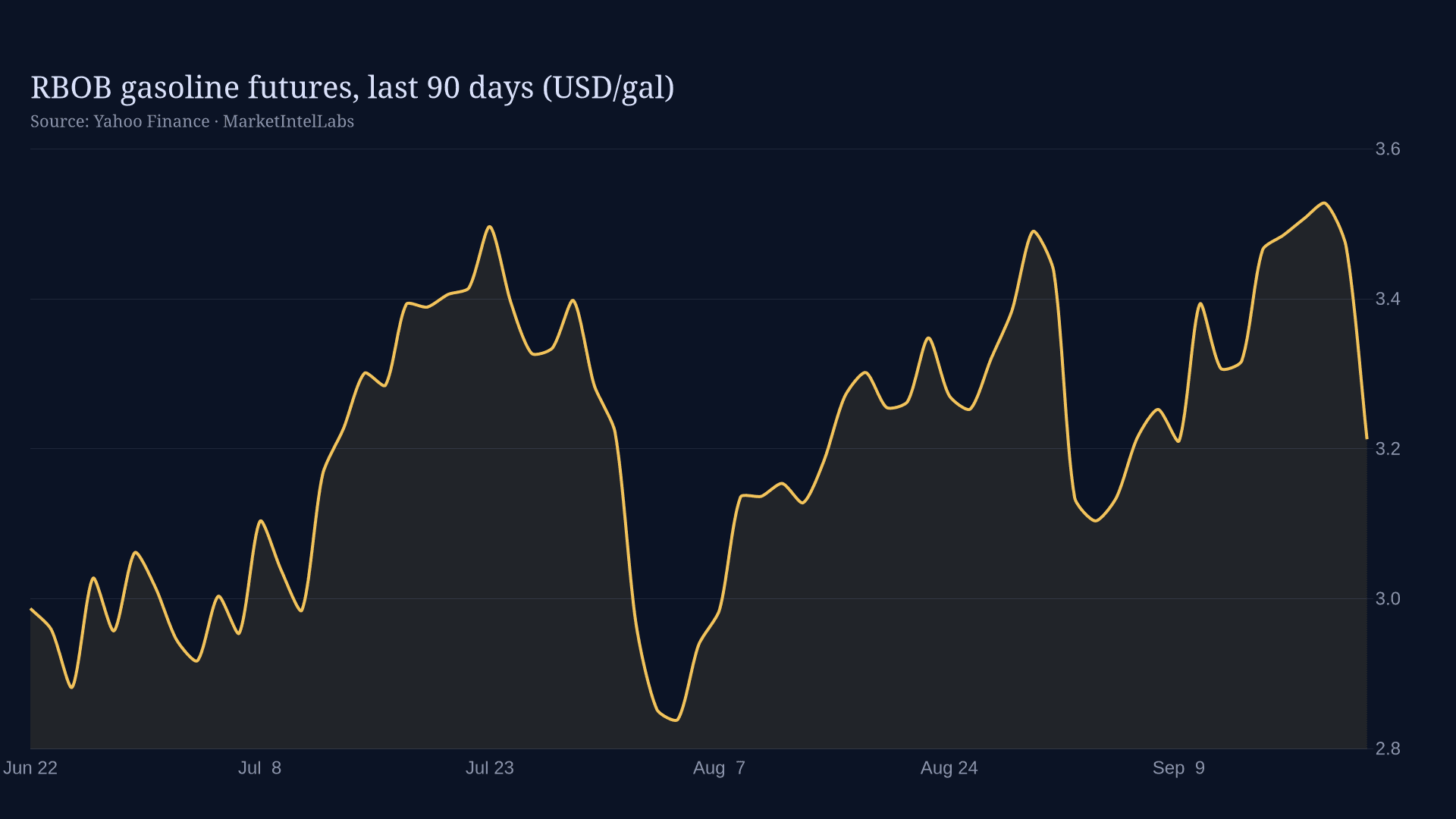
The national average for a gallon of regular gasoline hit $4.4786 on Monday, September 21, per AAA, up about 40 percent from $3.2003 a year ago. That is the freshest print on my beat and the one that will do the most damage to an October household budget. The strange part is what sits behind it: crude oil futures fell on Monday, per market reports carried by the Sacramento Bee and the Herald-Sun, yet pump prices kept climbing. September CPI, due October 14 at 8:30 a.m. Eastern per the BLS release schedule, will book most of this move, and it will land after most of the driving season has already paid for it.
Start with the pump, because that is where the household cash actually leaves. AAA put the national average at $4.4786 on September 21, up one and a half cents from Sunday and up 20 cents from the $4.2770 recorded a week earlier, per AAA data cited by WRNJ Radio. A month ago the average was $4.0636. Against last year's $3.2003, a driver filling 15 gallons a week pays $67.18 per fill now versus $48.00 then, roughly $19 a week or about $82 a month of found money gone the other way. Prices are approaching the 2026 high of $4.56 set May 21, per AAA, in what should be the cheap season for gasoline.
The divergence is the story. Light sweet crude fell in futures markets on Monday, September 21, as the Sacramento Bee and the Herald-Sun both reported, yet gasoline and diesel kept rising at the pump. The retail lag explains a few days of that, since stations price off replacement cost rather than the spot tape. It does not explain several straight weeks of gains while the barrel weakens. AAA attributed the pump pressure to crude that has averaged near $100 amid continued volatility in the Strait of Hormuz, and the war premium is priced into products even on days the front-month crude contract gives some of it back. Refiners, wholesalers and stations pass on the average risk they carry, not the day's close.
What August CPI already booked
The September report is a forecast right now, but August is fact. The consumer price index rose 3.4 percent over the 12 months through August, per BLS data released September 11, up from 3.3 percent in July. The energy index rose 16.1 percent over the year and 1.3 percent in the month. Gasoline at home in the CPI averaged $4.200 a gallon in August, per the BLS average price series, 27.5 percent above August 2025. Given that the pump average has risen another 7 percent since that month closed, September's energy index will be worse, not better.
The bill sides of energy are climbing just as fast. The electricity index rose 5.5 percent in August alone and sits 26.5 percent above last August on a seasonally adjusted basis, per BLS data. Utility gas service is up 52.0 percent over the year. Those two lines alone would have made this a hard month for the household budget even with a quiet pump. Shelter, the biggest line in the index, is up 3.0 percent over the year and still rising 0.26 percent a month, which is where the bulk of the 3.4 percent headline lives.
The offset, such as it is, comes from the grocery aisle. Food at home is up just 2.2 percent over the year, and the August real average hourly earnings series from the BLS came in at 11.30, 0.3 percent below August 2025. Real wages are roughly flat against a 3.4 percent headline, which means the household is not keeping up in aggregate. The squeeze concentrates in whatever a family cannot defer, and for most families that is the drive to work and the utility bill.
The credit side of the household ledger has not given relief either. Freddie Mac's 30 year fixed rate averaged 6.95 percent for the week of September 17, up from 6.66 at the end of August, per Freddie Mac's primary mortgage market survey. On a $400,000 loan that is roughly $200 a month more than the late August quote. Renters see the same pressure more slowly: the Zillow Observed Rent Index stood at $1,948 for August, 2.5 percent above a year earlier, per Zillow's public series, a pace that cools the CPI shelter line only gradually.
What to watch into October 14
The September CPI lands October 14 at 8:30 a.m. Eastern, per the BLS schedule, and it will carry a full month of $4.30 to $4.50 gasoline plus another month of the utility increases. My read is that the energy contribution alone adds a few tenths to the year-over-year rate, and the desk's Monday piece on producer prices already flagged the same pass-through from wholesale. The counterweight is crude: if the Monday pullback in oil extends through late September, pump prices peak a few weeks later, and October CPI could mark the top of this episode rather than September.
For the household budget, the honest framing is this. Gasoline near $4.48 and diesel at a record $6.31 are war-premium prices in a season that normally offers relief, and the data says the premium is not coming out quickly. The number to watch is the AAA weekly average each Monday, because pump prices lead the CPI print by roughly a month. If the national average breaks back under $4.20 by early October, the September CPI will be the worst of it. If it holds above $4.40, October books another round.
This content is for informational purposes only and does not constitute financial advice. Past performance is not indicative of future results. Consult a qualified financial advisor before making investment decisions.
Related reading: Gasoline Rises a Third Straight Week to $4.319 and September CPI Will Book It, Diesel at $6.31: AAA All-Time Record Hits the Household Bill, and Producer Prices Are Running 2 Points Ahead of Your Receipts.
Get daily intelligence delivered
Create a free account for the Daily Brief every weekday and The Week Ahead every Sunday. No card required.