FOMC Minutes Show a Unanimous September Hike, but No October Pledge


The September FOMC minutes answer the immediate question plainly: the Federal Reserve did not debate whether to raise rates at its September 15 and 16 meeting. All participants supported a quarter-point increase to a 3.75% to 4% target range, and the committee approved the decision 12 to 0. The real disagreement is about what follows. Most participants judged another increase likely appropriate by year-end, but explicitly kept subsequent meetings open to incoming data. That is a conditional case for more tightening, not a commitment to raise rates on October 28. The minutes released October 7 are a record of September's conversation, not an October vote.
That timing distinction matters for anyone trying to interpret a mortgage quote or bond yield. A policy rate that stays elevated through October can restrain short-term financing even if the Fed ultimately skips that meeting; a further increase in December would change the year-end level without validating a specific October forecast. The Fed's meeting calendar places the next scheduled decision on October 27 and 28 and the following one on December 8 and 9. No outcome is on that calendar.
How the Fed reached September's hike
To understand why a central bank that had been holding its policy rate steady changed course, start with the September 16 FOMC statement. It described solid economic growth, resilient domestic spending, and inflation still above the 2% objective. The statement says the committee lifted the target range a quarter point and maintained its ample-reserves framework. The minutes add the reasoning behind that compressed statement: participants generally saw upside inflation risks while judging risks to employment broadly balanced.
For the broader framework, see our Fed policy coverage.
Related reading: Fed's Hawkish Pause: 3.4% CPI Meets a 29K Payrolls Miss.
This is not the same as saying the labor market could not deteriorate. It says that at the September meeting most participants did not see the labor side of the mandate as sufficient to outweigh inflation. The distinction became harder to ignore after September payrolls were published. The Bureau of Labor Statistics' September employment release reported only 29,000 additional payroll jobs and a 4.2% unemployment rate, compared with the 4.1% rate discussed for July and August in the meeting record. These September results arrived after the Fed met. Treating the minutes as though they already incorporate those figures would be a chronology error.
For the inflation half of the mandate, the calendar creates the opposite complication. The minutes recount staff estimates made with information available at the meeting. Staff estimated August headline PCE inflation of 3.8% and core PCE inflation of 3.4% under the old methodology; it estimated 3.6% and 3.2% under the methodology BEA was about to introduce. The BEA's September 30 August PCE release subsequently reported 3.4% headline and 3.0% core inflation from a year earlier after the annual update. Those are the actual published data, not the meeting's preliminary estimates. They should not be mixed into a single uninterrupted time series.
BEA also reported August nominal consumer spending up 0.9% for the month, with real spending up 0.6%. Softer annual inflation after rebenchmarking did not automatically mean demand was collapsing. The minutes' description of sturdy activity was based on a different information set, while the later official releases offer evidence on both sides of the Fed's mandate. Our earlier reading of August PCE and spending explains why that release must be read as both an inflation revision and a demand print.
The Federal Reserve's September Summary of Economic Projections adds a useful cross-check. Participants' median 2026 forecasts were 3.7% for headline PCE inflation, 3.4% for core PCE, 4.1% for unemployment, and 2.3% for real GDP growth. These figures were conditional judgments of appropriate policy at the meeting, not a single staff forecast or a promise about the next decision. The 2026 median policy-rate projection was 4.1%, and the individual dots were more widely dispersed than that midpoint conveys.
Why a rate hike can coexist with a debate about timing
The target range is the first mechanism. When the FOMC raises its target, it adjusts the rates and tools used to keep overnight borrowing inside that band. The September implementation note set interest on reserve balances at 3.90%, the standing overnight repurchase operation at 4.00%, and the standing overnight reverse repurchase offering at 3.75%. Those administered rates support the policy range, but they are not forecasts of the 10-year Treasury yield, a bank's mortgage offer, or the level of stocks.
The second mechanism is expectations. A lender setting a multi-year rate cares about the path of expected short rates, inflation compensation, and a premium for bearing duration risk. The September minutes reported Treasury yields rising about 35 basis points across the two- to 10-year segment over the intermeeting period, attributing some of that to a higher expected policy path and stronger economic data. The record also cites commentary about geopolitical risk, Treasury buybacks, and heavy private borrowing for AI infrastructure. It would be wrong to assign that entire premeeting yield move to the October 7 release of the minutes.
The third mechanism is credibility. Many participants saw a higher path as insurance against inflation persisting because of demand or renewed supply shocks. Others saw it as warranted by their central forecast rather than just insurance. A few pointed to the possibility that sector-specific energy and AI-related cost increases could spread into wider inflation. None of these explanations requires every participant to expect an immediate next hike; each requires a judgment about what sustained inflation would cost if policy stayed too loose.
There is a countervailing risk. If slowing hiring becomes broader employment weakness, maintaining or increasing borrowing costs can suppress activity while doing little to repair an energy supply shock. The minutes themselves describe unusually low hiring and layoffs, plus a persistently elevated long-term unemployment rate. The later September jobs release makes that concern more relevant, even though it cannot retroactively change the vote. Our September payrolls analysis separates the low hiring rate from a wave of layoffs that the headline alone does not establish.
The monetary-policy dilemma is therefore asymmetric across time. The September committee was acting on evidence of persistent inflation and a labor market that still looked near full employment; the October committee must evaluate additional data that may weaken the labor premise. It cannot simply replay September's arguments. For readers tracking the next decision, the best question is not whether one line in the minutes sounds hawkish. It is whether the inflation risk remains sufficiently strong relative to newly observed hiring weakness.
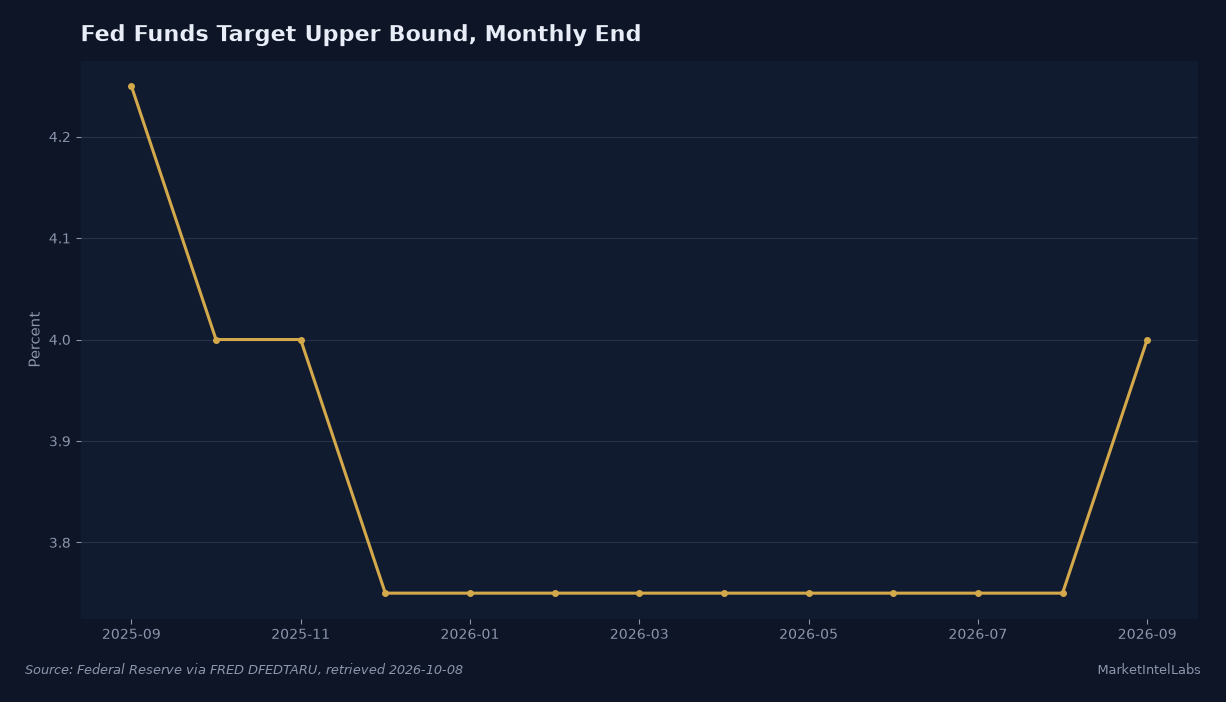
Our chart isolates the actual target-range upper bound. It is not a plot of futures probabilities or an invented record of minute-by-minute market reaction. Each point is the month-end observation returned by the Federal Reserve's DFEDTARU series on FRED, through September 2026; October had no month-end reading at retrieval. The path shows a long 3.75% upper bound followed by the September step to 4.00%, a simpler picture than the wide range of possible future meetings implied by policymakers' discussions.
What the documents actually say about division, reserves, and prices
The vote split is easy to misread. There were no dissents on the September rate increase: the minutes name 12 members voting for it and none against. They say all participants supported the quarter-point increase. Their different comments on the need for more tightening describe future-path uncertainty, not opposition to the action already taken. Anyone describing a divided September vote is contradicting the official voting record.
Nor does a reference to balance-sheet tools mean the Fed announced a new quantitative-easing program. The minutes say the Open Market Desk had paused reserve management purchases because reserves appeared within an ample range, with future purchase decisions made month by month. A few participants wanted more planning for possible Treasury-market stress while limiting the Fed's market footprint. The policy directive still permits purchases of short-dated Treasury securities when appropriate to maintain ample reserves and reinvestments of principal payments. Reserve management to implement an existing operating framework and discretionary asset purchases intended to stimulate the economy serve different purposes.
The September projection table supplies an even clearer measure of the future-path disagreement. Its dots show four of 18 participants at a 4.375% year-end 2026 midpoint, 12 at 4.125%, and two at 3.875%. The dots represent each person's view of appropriate policy, not votes cast on a specific December proposal. Compared with the newly established 3.75% to 4% range, a 4.125% midpoint corresponds to one further quarter-point increase. That arithmetic explains the minutes' phrase 'most participants' without pretending every policymaker chose October.
Governor Christopher Waller's October 8 speech helps with the chronology. He said 16 of the 18 participants projected at least one additional hike by the end of 2026, including four who expected two. He also said hikes need not occur at consecutive meetings. That statement is his own interpretation, which his speech says does not necessarily reflect colleagues' views. It supports the reading that an October pause and a year-end hike are logically compatible.
Waller gave a separate, dated market reference: using federal funds futures prices as of the previous day, he described an 85% chance of at least one hike by the December meeting and nearly 20% for two. Those are his reported October 7 market-implied figures, not probabilities we recalculated and not proof that the minutes alone moved pricing. An intraday before-and-after series for the October 7 release was not verified for this feature. The honest market-reaction answer is limited: the source documents establish policy and a dated outlook, but not a clean causal estimate of the minutes' immediate price impact.
There is another distinction between headline inflation and underlying persistence. The BEA's published August 3.0% core PCE rate was lower than the staff's pre-update estimate, but still exceeded the 2% objective. Its 3.4% headline rate was also higher than target, while consumer spending increased in both nominal and real terms. A lower revised rate is evidence to consider, not proof the inflation problem has ended. Conversely, the September payroll gain of 29,000 is a warning about labor demand, not by itself proof that unemployment will accelerate.
The projections' 2027 medians put headline PCE at 2.3% and core at 2.5%, with unemployment at 4.1%. That profile assumes price growth slows while labor conditions remain fairly steady. The bear case for economic growth is that the employment side deteriorates faster than those September projections anticipated. The bear case for a quick easing of rates is the opposite: persistent inflation forces the Fed to hold or tighten despite softer hiring. Both risks can be true enough to make a one-meeting forecast unusually fragile.
The next dates that can change the answer
October 27 and 28 are the next scheduled FOMC meeting dates, followed by December 8 and 9, according to the Fed calendar. The next scheduled BEA personal income and outlays release, covering September, is October 29 at 8:30 a.m. Eastern, according to BEA's published release schedule. That PCE report therefore comes after the October decision, not before it. Officials have other inflation and labor readings to assess beforehand, but this particular September PCE release cannot inform the October vote in real time.
This scheduling wrinkle limits the certainty of any October call. A policymaker who thinks inflation is persistent can reasonably favor another increase without being certain that October is the right meeting. A policymaker worried about the jobs print can favor waiting for more evidence without endorsing an imminent cut. The minutes expressly reserve judgment on future meetings, while Waller's account makes clear that even supporters of further hikes see flexibility in timing. The Fed's next action depends on how it weights data released since September, not on what an October reader wishes the September record had said.
Frequently Asked Questions
What did the September 2026 FOMC minutes say about the next rate hike?
Most participants said one more increase would likely be appropriate by year-end, while future decisions would depend on incoming data. The minutes do not commit the committee to an October hike. The September hike itself was approved unanimously at a target range of 3.75% to 4%, as the meeting record states.
Did anyone dissent from the September Fed rate decision?
No. The published minutes record a 12 to 0 vote for a quarter-point increase and list no opposing votes. Differences in participants' forecasts for the next move should not be mistaken for a dissent on the September decision.
When is the next FOMC meeting after the September minutes?
The official FOMC calendar lists October 27 and 28, 2026, with a December 8 and 9 meeting afterward. Those are meeting dates, not a timetable of guaranteed policy changes.
Do FOMC minutes show how markets reacted on October 7?
No. The minutes discuss trading and yields over the period before the September meeting; they do not measure their own release-day effect. Waller's October 8 speech reports futures-implied odds as of the previous day, but that snapshot alone does not establish how much the minutes changed pricing. A verified, timestamped before-and-after data set is needed for that narrower claim.
Why was August PCE inflation different from the Fed staff estimate?
The Fed staff estimated August inflation before BEA implemented an annual update. BEA's September 30 published release reported year-over-year August headline PCE inflation of 3.4% and core inflation of 3.0%. The minutes also supplied estimates under the coming methodology, but neither estimate should be passed off as the subsequent official release. Compare like with like and note the dates.
The immediate test is whether fresh evidence of weaker hiring outweighs still-high measured inflation in the October deliberation. The longer test comes after October: BEA's September PCE release lands the next day, giving policymakers a new inflation reading to assess before December. A unanimous past vote and a conditional future majority are both true; confusing them is the fastest way to mistake a projection for a promise.
This content is for informational purposes only and does not constitute financial advice. Past performance is not indicative of future results. Consult a qualified financial advisor before making investment decisions.
Get daily intelligence delivered
Create a free account for the Daily Brief every weekday and The Week Ahead every Sunday. No card required.