Why is Europe container freight firm as Transpacific slides

The global container market split into two stories this week. Drewry's World Container Index (WCI) fell 3% to $4,176 per 40-foot container in the assessment for Thursday 19 November, a fourth consecutive weekly decline, led by softer Transpacific demand. Yet the same index showed rates on the Asia-Europe leg firming as carriers prepared peak-season increases before the December contract season and Chinese New Year. The direction of a container rate now depends on which ocean you are crossing.
Read the weekly drawdown as a capacity file more than a demand collapse. Drewry's transpacific assessment has now declined for seven straight weeks, while the composite has fallen for four, and the blanking schedule is the tell: lines have announced ten cancelled sailings for the coming week, up from four, in the week just closed. Blanking is lines protecting rate by shrinking supply, and it caps how far spot rates can fall even as booking softness does the work. The shipper reading the 3% headline as an invitation to wait out lower rates should weigh that the shipping lines are actively managing the floor.
Related reading: Drewry World Container Index: what it is and how to read it.
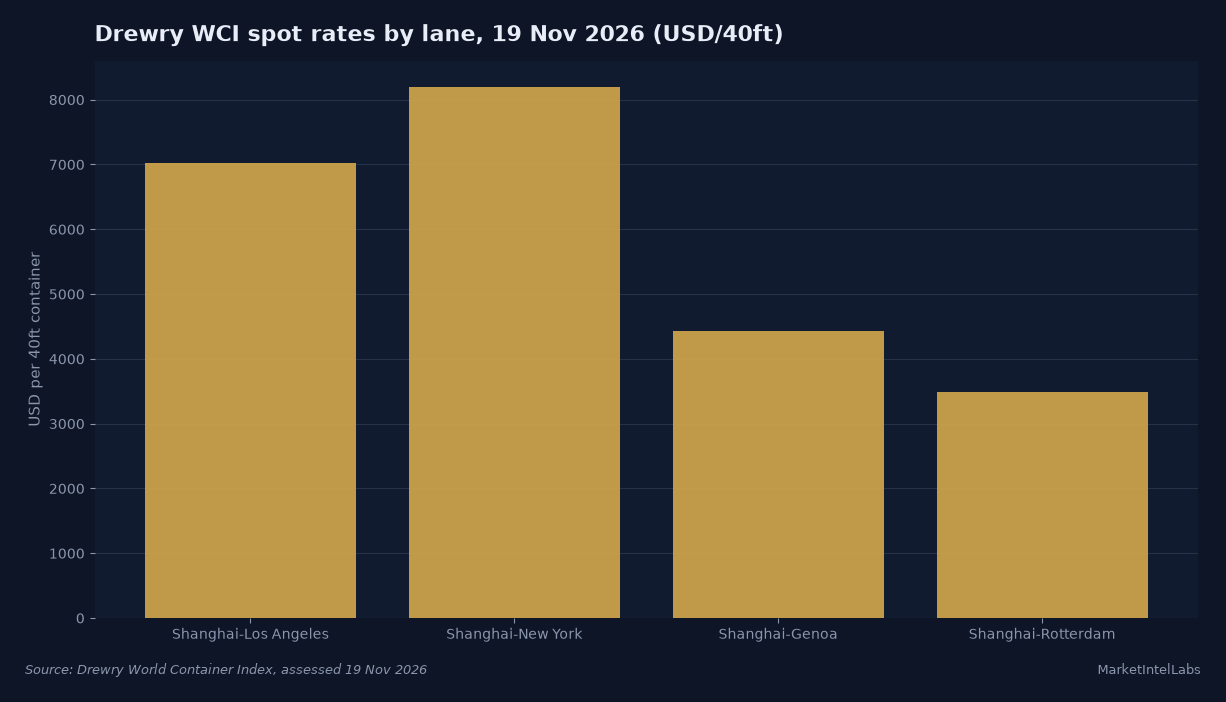
The yearly comparison frames the ceiling instead. At $4,176 the composite is still 126% above the same week a year ago, and on the two lanes that matter most to U.S. and European importers the levels are far from normalized: Shanghai to Los Angeles at $7,026 and Shanghai to New York at $8,194 remain well above their own recent lows, which is why lines can bank on contract-season leverage. Contract renewals in December will test how much of that elevated base carries forward, and carriers have already telegraphed their Asia-Europe intent with peak-season surcharges in the $1,000 to $1,600 range.
Transpacific was the drag. Rates from Shanghai to Los Angeles dropped 5% to $7,026 per 40ft container, their lowest level in 12 weeks, while Shanghai to New York fell 9% to $8,194, the cheapest in 15 weeks. Drewry, which publishes the index, attributed the pressure to weaker demand and said Transpacific rates slid for a seventh consecutive week. Carriers answered by pulling capacity: Drewry counts ten blank sailings announced for the coming week, against four in the current one.
For the container freight picture across both oceans, see our container freight rates coverage.
Related reading: Container rates snap back: Drewry WCI composite jumps 3% to $4,485 as Asia-Europe legs reprice.
The Asia-Europe leg went the other way. Shanghai to Genoa rose 6% to $4,436 per 40ft container, while Shanghai to Rotterdam held flat at $3,496. Drewry expects demand to strengthen in December heading into the new contract season and Chinese New Year, and lines have started announcing peak-season surcharges of $1,000 to $1,600 per 40ft container on that trade. The consultancy said it anticipates rate increases on Asia-Europe routes in the coming weeks.
The divergence carries a practical warning for importers on both sides. A United States buyer watching spot rates slide may assume the freight bill is firmly headed down, but the drawdown is capacity-led as much as demand-led: blanked sailings cut available space, and a demand uptick into the holiday season can push spot rates back up quickly. An importer on the Europe leg faces the opposite risk, with surcharges layered on top of rising base rates before contract negotiations.
Related reading: Container spot rates ease as SCFI slips to 3,572, down 1.7% for the week to Nov 13.
Two operational risks sit underneath this week's print. Drewry flagged worsening congestion at North European ports, which is delaying the return of empty containers to Asia and raising the prospect of equipment shortages. The consultancy also repeated labour disruption at Los Angeles and Long Beach as a risk to the U.S. leg, a reminder that the port pair that cleared so much of last year's cargo book can tighten again on a labour event.
For the supply chain, the takeaway is a market that reads in directions rather than a single number. The composite index is down 3%, but that masks a 6% rise to Genoa and an unchanged Rotterdam print. Anyone planning landed cost around the headline index alone is missing the legs that actually serve their goods. The next check is the weekly WCI print on Thursday, followed by the December contract season that sets the lane rates many shippers will pay through the first half of the year.
Related reading: Container Freight Rates: Drewry WCI Falls 2% to $4,351.
The freight market remains well above where it sat a year ago, notwithstanding the four-week decline. At $4,176, the composite is still 126% higher year on year, so the easing is coming off an elevated base rather than returning to pre-2026 norms. That gap between a falling weekly print and a still-high annual level is worth holding in mind: it is why forwarders talk about rate stability in ranges, not a return to old benchmarks.
This content is for informational purposes only and does not constitute financial advice.
Get daily intelligence delivered
Create a free account for the Daily Brief every weekday and The Week Ahead every Sunday. No card required.