Clarity Act SEC CFTC: House Bill Splits Crypto Oversight


The Digital Asset Market Clarity Act, H.R. 3633, would give the Commodity Futures Trading Commission a new federal role over spot trading in qualifying digital commodities and leave the Securities and Exchange Commission in charge of securities transactions and important issuer disclosures. It does not hand every token to one regulator. The House-passed bill text distinguishes a transferable token from an investment contract used to sell it, then sets separate rules for the companies that issue, trade and custody assets. For a U.S. retail holder, the immediate change is none: Congress has not enacted the bill.
The Congress.gov legislative record lists the measure as Passed House, not law. The House roll call was 294 to 134 on July 17, 2025. On September 15, 2026, the Senate roll call rejected cloture on a motion to proceed, 49 to 50. That vote did not reject the bill on final passage. No enactment date is public. Until Congress and the president act, the proposed exchange registration, token classification and issuer rules in H.R. 3633 do not govern a reader’s wallet or exchange account.
Related reading: Regulation's Two Lanes Split a Volatile Crypto Week.
This is the mechanism behind this week’s regulatory news, not a second report on that news. Our report on the CFTC retail crypto rulemaking follows the agency’s current process. The CFTC’s October 5 notice addresses retail commodity transactions under existing law, while the SEC’s proposed Regulation Crypto Assets has comments due October 20. Neither agency proceeding enacts the Clarity Act. A holder should separate three questions: what the token is, how it was sold, and what the venue does.
Why the two agencies both appear in the same trade
A simple example helps. Suppose an issuer sells a network token together with promises about what its team will build. The sale can involve an investment contract even if the token can later move independently between users. If a retail customer buys that token from another customer on a spot venue, the transaction and the venue raise different questions from the original fundraising. The House text expressly deals with that separation in its provisions on investment contract assets and secondary transactions, particularly sections 201 and 203. It is not a declaration that every resale of every crypto asset is outside securities law.
For the broader framework, see our bitcoin coverage.
Related reading: Senate kills the CLARITY Act 49-50. SEC and CFTC write crypto rules anyway.
The bill defines a digital commodity by its link to a blockchain system and its expected value from use of that system. It describes links including payment for transactions, access to network services and participation in governance. That language is a test, not a government list of blessed ticker symbols. Readers looking for a statutory list assigning bitcoin, ether or every other named token to a specific agency will not find one in the House-passed text. Classification depends on the asset and the circumstances of a sale; regulators would still need to write implementing rules.
For comparison, a security remains in the SEC’s remit. The bill’s section 301 proposes to exclude digital commodities and permitted payment stablecoins from specified definitions of security, but sections 201 through 205 address how an investment-contract offering involving a digital commodity is treated and what issuer obligations may survive. The distinction prevents an issuer from treating the word “commodity” as an escape from disclosure. It also prevents every later transfer from automatically inheriting all the legal features of the original financing deal.
Related reading: Bitcoin Slides to $63,200 as South Korea Crashes and Senate Shelves Crypto Bill.
That distinction is contested in practice. The House Financial Services Committee report describes its proposed securities-side framework, while the House Agriculture Committee report addresses the commodity-market side. These are two parts of House Report 119-168, not independent regulatory approvals. They document the House committees’ reasoning and competing views. The enacted law, if any, would depend on the text Congress eventually passes, not the most expansive reading of a committee explanation.
Who would supervise exchanges, brokers, issuers and custody?
For a spot market in a digital commodity, section 404 would require a covered trading facility to register with the CFTC as a digital commodity exchange, subject to the bill’s exceptions, including an amount of activity the agency would define as de minimis. Section 406 would require digital commodity brokers and dealers to register with the CFTC. This is the market-structure change that answers the search question most directly. Today the CFTC’s established derivatives authority does not amount to a blanket federal licensing regime for every ordinary spot crypto marketplace. H.R. 3633 proposes a new one for the covered commodity market.
The label on a venue does not settle every transaction on it. Securities trades remain under securities law. The bill provides for coordination and specific routes for entities that handle more than one asset type; it does not say a platform can register once under the CFTC and trade securities without the SEC. The House text in titles III and IV is organized around separate securities-side intermediary provisions and CFTC digital commodity market provisions. A customer seeing both tokenized securities and digital commodities on one app should ask what legal entity handles each trade, not rely on the app’s brand name.
Issuers are another boundary. Section 202 proposes an exemption for certain primary investment-contract sales involving digital commodity units if statutory conditions are met. That is not a blanket exemption for initial token fundraising. Section 204 separately addresses sales by affiliated and related persons, and section 205 sets out a process to certify that a blockchain system is mature. These conditions matter because an insider sale can carry informational asymmetry long after a token begins trading in a secondary market.
The maturity process is not a magical date at which a token “becomes a commodity.” Under section 205, eligible parties could submit a certification to the SEC with information about control of the system. A token can be technologically transferable without its issuer having met a disclosure condition or its network having satisfied a maturity test. Investors who reduce the proposal to “decentralized means CFTC” would miss the filing process and the role left to the SEC.
Custody also resists a neat SEC-versus-CFTC slogan. Section 405 describes a qualified digital asset custodian through custody and safekeeping supervision that can come from a federal banking agency, the National Credit Union Administration, the CFTC or the SEC, or from qualifying other supervision. It does not say all crypto custodians switch to the CFTC. For a retail holder, identifying the actual custodian and the way client property is held would still matter more than the regulator named in a headline.
Payment stablecoins are another carve-out. Section 301 excludes permitted payment stablecoins from specified securities definitions alongside digital commodities; the bill also limits the CFTC’s authority over such stablecoins in section 401. That does not convert every dollar-linked token into a digital commodity. Readers should keep a stablecoin’s issuer and payment-law treatment separate from an exchange’s authority to facilitate a digital commodity trade. The classification question attaches to the specific product, not a single label for an entire account.
The House Agriculture Committee’s Part I report emphasizes CFTC supervision of digital commodity spot markets and new registration for venues and intermediaries. The Financial Services Committee’s Part II report centers the SEC’s securities framework and issuer disclosure rules. Their division of labor explains why the House bill has interlocking titles rather than a single sentence transferring crypto to the CFTC. It also leaves real implementation choices to rulemakers, including how registrations interact when a business serves both kinds of asset.
The votes show progress, not a law
The source table below counts yes and no votes on two different procedural questions. The House decided whether to pass H.R. 3633; the Senate decided whether to end debate on the motion to take it up. Comparing their vote totals as if they were two final passage votes would give a false impression. Both dates and counts are taken from the House vote record and Senate vote record.
| Date | Chamber and question | Yes | No | Result |
|---|---|---|---|---|
| July 17, 2025 | House, final passage | 294 | 134 | Passed House |
| September 15, 2026 | Senate, cloture on motion to proceed | 49 | 50 | Cloture rejected |
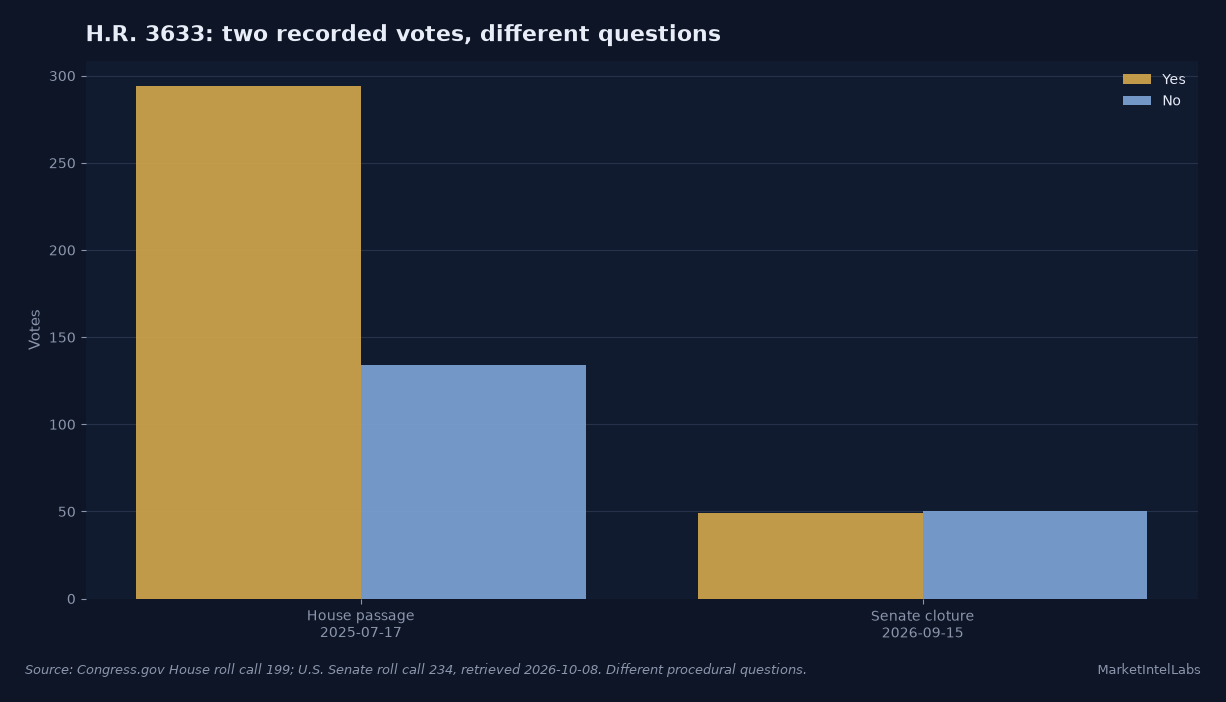
A cloture failure is a procedural barrier, not proof that the Senate voted down every provision. Congress.gov’s latest action as checked October 8 records a September 15 motion to reconsider the cloture vote. It also records a Senate Banking Committee report with a substitute amendment on June 1, 2026. The chart plots the votes we can verify, not a projected date for final passage, a signing date or the Senate’s likely policy choice. None of those future outcomes is public.
For a holder considering whether a new federal rule is in force, a vote timeline is more useful than a forecast. The House bill contains provisions that would take effect only after enactment and, for certain sections, after implementing rules. Section 206, for example, sets a 360-day post-enactment baseline for title II with later dates where final rules are required. Since there has been no enactment, converting that formula into a calendar date would be false precision. An exchange cannot claim this pending bill already authorizes its spot venue.
What this week’s CFTC and SEC notices actually do
The CFTC advanced notice approved for publication concerns section 2(c)(2)(D) of the existing Commodity Exchange Act, a provision covering specified retail commodity transactions. Its date field says comments are due 60 days after publication in the Federal Register; the prepublication document does not give a calendar deadline. The agency announcement dated October 5 says it wants comment on abuses, market practices and a possible crypto-asset-market form of registration. That is an invitation to comment on possible rules, not a final rule and not the Clarity Act’s proposed general spot-market registration system.
At the time of this check, we could verify the approved CFTC notice and release but not a corresponding dated Federal Register publication of that notice. Therefore the notice’s final Federal Register citation and the exact comment deadline are not public in the sources we verified. The reader should use the posted Federal Register version when it appears rather than calculate a deadline from the CFTC press release. Our separate October 8 news report follows that procedural story as it develops.
The SEC process is distinct. Its Regulation Crypto Assets proposal, published August 21 solicits comments through October 20, 2026, on a tailored offering regime for certain crypto-related investment contracts. The published proposal describes two exemptions, one for offerings of up to $5 million during four years and another for up to $75 million during each 12-month period, with disclosure conditions. It also proposes a conditional safe harbor concerning when an investment contract involving a crypto asset would cease to be treated as a security. Those are proposed SEC rules, not provisions that Congress has already enacted in H.R. 3633.
Why compare them at all? Both agencies are trying to define the edges of their existing authority while Congress debates a new division. The CFTC asks how its retail-commodity authority might work for crypto transactions. The SEC asks what issuer disclosures and investment-contract treatment might look like under securities law. A future statute could change what each regulator can do, but the present comment processes cannot substitute for Senate passage and a presidential signature. Treat the clocks independently: October 20 is the SEC proposal’s comment deadline, not a Clarity Act vote.
The SEC proposal describes investment-contract offerings as a route to capital formation and investor disclosures as a condition of relief. The CFTC’s release places greater weight on conduct rules for retail commodity transactions and market supervision. The documents do not settle the same question. That is why claims that one agency has “won crypto” overread both rulemakings. Both are statements of proposed or exploratory policy under current authority, while H.R. 3633 remains legislation.
What a U.S. holder can and cannot infer
The case for the House framework is understandable. A national spot registration regime could make it easier to identify which supervisor has rules for a covered exchange, broker or dealer, and the securities-side provisions could distinguish fundraising disclosures from ordinary secondary transfers. In its Agriculture report, the committee lays out a spot-market oversight model, while the Financial Services report describes issuer and intermediary provisions. Clearer lines might make it easier for a retail customer to compare venues. That is an argument about the proposal’s design, not a finding that any particular token or venue is safe.
The opposing risk is also concrete. If a purchaser depends on the promoter to build the network, shifting the token’s later trades out of a securities framework can leave less issuer information available to that purchaser. The Financial Services Committee report includes minority views, and the bill itself retains issuer-sale conditions and SEC processes precisely because the original investment contract cannot be ignored. Whether the proposed maturity certification and disclosure requirements would be sufficient depends on the eventual rules and on enforcement, not on calling an asset a commodity.
There is a second operational risk in a mixed venue. A platform can present one balance, one custody interface and one order book to customers while different products trigger different legal obligations. Under the proposal a digital commodity spot exchange would face CFTC rules, but a security or securities transaction would not become a digital commodity merely because the same corporate group handles it. The bill’s section 107 preserves existing treatment for futures, swaps and specified securities instruments. A reader should not infer that spot, derivatives and tokenized shares fall under one new registration simply because they appear in the same trading app.
For now, a U.S. retail customer’s practical checklist is a set of questions, not a portfolio instruction. What entity is the customer contracting with? Is the transaction a direct token transfer, an issuer fundraising sale, a security or a financed retail commodity transaction? Who holds the asset, and on what terms? A pending congressional bill does not answer those contract-level questions for an existing account. The House text is a map of proposed duties; the platform’s current disclosures and the laws already in effect determine today’s customer position.
The absence of a statutory named-token list matters. An online claim that a specific token “gets CFTC approval under Clarity” is not supported by the House text alone. Nor does a proposed SEC safe harbor automatically erase earlier investment-contract facts. The cleanest way to read a disputed token is to separate the asset’s characteristics, the original offer’s promises, the identity of the seller and the structure of the later trade. That four-part inquiry explains more than a binary SEC or CFTC label.
Watch for a new Senate vote or amended text on the official bill record, the Federal Register publication and deadline for the CFTC notice, and comments by October 20 on the SEC proposal. A Senate-passed version could differ from the House text analyzed here. Until then, the one change already observable is the regulatory debate itself, not a new federal authorization for an exchange or a newly protected retail account.
Frequently Asked Questions
How would the Clarity Act divide authority between the SEC and the CFTC?
Under the House-passed H.R. 3633, the CFTC would supervise registered spot digital commodity exchanges, brokers and dealers; the SEC would retain securities jurisdiction and specified oversight of investment-contract offerings, issuer disclosures and network maturity certifications. The token, the sale and the intermediary are separate legal questions. The proposal is not law as of October 8, 2026.
Has the Clarity Act passed the Senate in 2026?
No. The official bill tracker still says Passed House. A September 15, 2026 Senate vote rejected cloture on a motion to proceed by 49 to 50, which is not final passage or final rejection of the bill. The last action recorded there was a motion to reconsider that procedural vote.
Does the Clarity Act make bitcoin and ether CFTC-regulated securities?
That wording mixes different categories. The House bill proposes definitions for digital commodities and excludes qualifying digital commodities from specified securities definitions. It does not publish a list that assigns named tokens to the CFTC or calls them CFTC-regulated securities. A particular offer or sale can still raise investment-contract issues, and the bill is not in force.
What changes for a U.S. crypto holder if the Clarity Act becomes law?
If a version of the bill becomes law, covered spot venues and intermediaries could face a new CFTC registration regime, while issuer sales and securities would retain SEC-related duties. The exact timing and customer-facing protections would depend on the enacted text and implementing rules. Today, nothing changes solely because the House passed H.R. 3633 or the agencies requested comments.
When is the SEC crypto proposal comment deadline, and is it a Clarity Act deadline?
The SEC Regulation Crypto Assets notice gives October 20, 2026 as its comment deadline. It is an agency proposal on investment-contract offerings, not a deadline for Senate action on the Clarity Act. The CFTC advanced notice has its own 60-day period measured from Federal Register publication; its exact calendar deadline was not public in the prepublication notice checked here.
This content is for informational purposes only and does not constitute financial advice. Past performance is not indicative of future results. Consult a qualified financial advisor before making investment decisions.
Get daily intelligence delivered
Create a free account for the Daily Brief every weekday and The Week Ahead every Sunday. No card required.