$150 Oil Forecast: Citi's Hormuz Scenario and the IEA Option


Oil prices are holding near the top of a range even as Gulf shipping recovers, and the reason is that the market is now trading the forecast, not the spot. Brent crude traded near $101.82 a barrel at 14:28 UTC on October 7 (up 1.23 percent on the day, Yahoo Finance data), with West Texas Intermediate at $89.83. The most aggressive scenario setting the tone is Citigroup's.
What Citi assumes and why it can sit above recovering flows
Citi's higher 2026 Brent forecast and its $150 tail scenario are conditional, according to the note as reported by EnergyNow on October 7. The number only materializes if the Hormuz disruption persists, and the assumption is about duration more than barrels. A prolonged closure changes the math from a shipping cost spike into a supply loss that the market must price against strategic reserves and spare capacity, not freight.
Related reading: Mideast Crude Tops 12.8 mb/d as Hormuz Crawls.
The scenario collides with the flow data our desk covered yesterday. In our October 6 analysis of Strait of Hormuz oil shipping, crude shipments averaged about 10.3 million barrels a day in the week ended October 3, roughly 23 percent below a prewar baseline of 13.5 million. That is a real shortfall, but it is recovering, not collapsing. Citi's $150 case is effectively the market's answer to whether that recovery sticks or stalls. We also published this morning that a Gulf storm is threatening about 15 percent of U.S. crude output with Brent near $102, layering a separate outage risk on top of the Gulf flow picture.
The IEA release mechanism and the record it has already set
The oil that would blunt Citi's scenario sits in emergency reserves, and the rulebook for releasing it is the IEA's. The agency requires member countries to hold stocks equivalent to at least 90 days of net oil imports, and it has coordinated six collective responses to major supply disruptions since 1991, according to the IEA. The prior actions came in 1991, 2005, 2011, and twice in 2022, with the spring 2022 release after the invasion the template most markets still watch. The current episode has already produced the largest in the agency's history: on March 11, 2026, the IEA's 32 member countries unanimously agreed to make 400 million barrels available to address disruptions stemming from the war in the Middle East, per the IEA's record.
For the broader framework, see our crude oil coverage.
Related reading: Brent Holds $101 as the 100M-Barrel G7 Release Meets a $20-25 War Premium.
A fresh release addresses crude first, and that is the lever on Citi's forecast. Adding barrels widens the gap between the market's assumption of a persistent closure and actual deliverable supply, which is how a release pulls the price forecast back toward the futures strip. The harder problem is products. Refining margins are at record levels, with Shell saying October 7 that it expects record refining results, per Reuters, because the bottleneck is conversion, not crude supply.
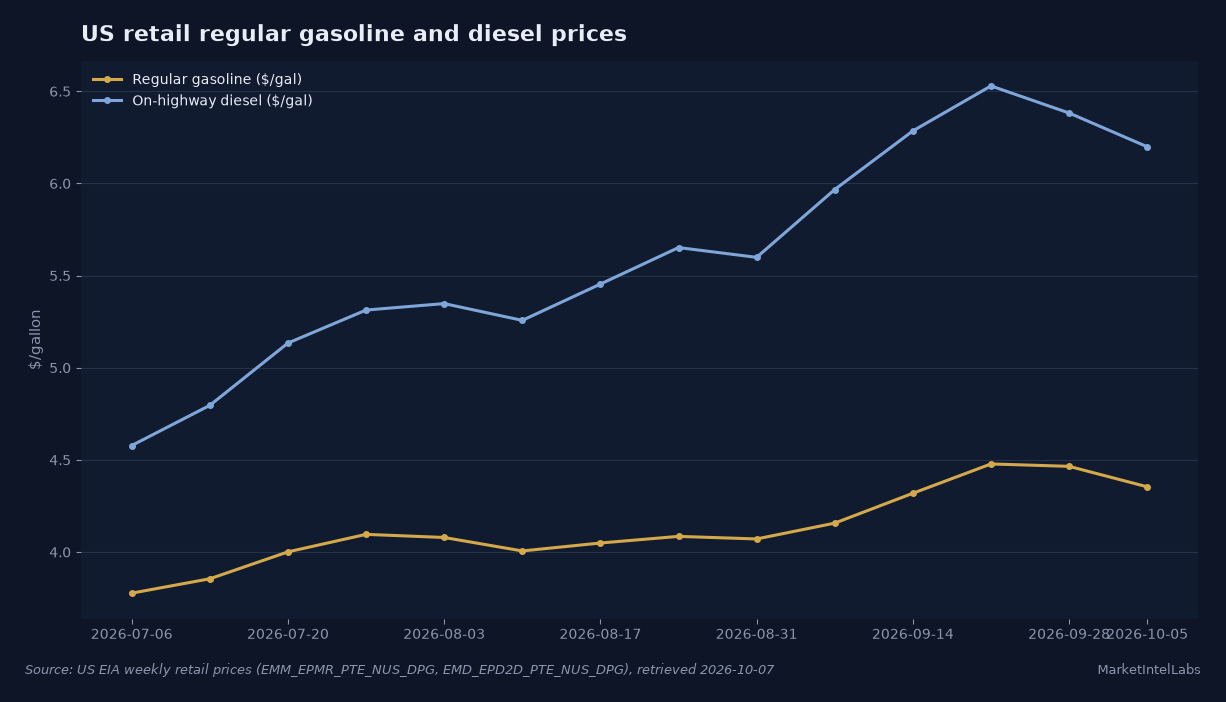
Retail diesel confirms crude is not the product price driver. On-highway diesel hit $6.53 a gallon in the week ended September 21 and was still $6.20 a gallon as of October 5, per EIA weekly data, even as crude softened. Regular gasoline peaked at $4.48 a gallon in late September. In early July, gasoline was about $3.78 a gallon and diesel about $4.58, so gasoline has climbed roughly 19 percent and diesel roughly 43 percent against a crude market whose Gulf flows were recovering toward 10 million barrels a day. Releasing crude to a system starved for refining capacity adds feedstock into a bottleneck; only a diesel-specific release, or a sustained drop in product demand, would meaningfully compress the diesel crack and the pump price consumers feel.
The divergence is the most important detail in this market right now. The Forbes framing, that crude is flowing again but gasoline and diesel prices are not cooperating, is the mechanics in practice: products price the bottleneck that crude releases do not directly touch. Crude can pull back on a flow recovery headline while diesel holds, because what clears the market is refining output, not the upstream barrel count.
The EIA's weekly retail series on our chart shows the asymmetry. Gasoline climbed from about $3.78 a gallon on July 6 to a late-September peak of $4.48, then eased to $4.35 as of October 5. Diesel ran from $4.58 on July 6 to $6.53 on September 21, a 43 percent move, and had only come off to $6.20 by October 5. The diesel crack is what the market is paying for: a refining and middle-distillate shortage that a pure crude release does not resolve.
What to watch
Two catalysts. First is the IEA meeting Wednesday over a proposed coordinated release of oil and diesel stocks, reported by Reuters on October 7 citing two EU diplomats. A release that includes diesel, not just crude, is the only lever that would attack the crack directly. Second is the EIA weekly product data due 14:30 UTC Wednesday, which will show whether retail diesel is finally rolling over from its $6.53 peak or holding at these elevated levels.
The bull case for products rests on a genuine refining bottleneck plus a Gulf flow recovery that stays partial. The bear case is that a combined crude and diesel release, together with WTI at $89.83, finally lets product prices follow crude's lead down. Both are live until the IEA acts.
This content is for informational purposes only and does not constitute financial advice. Past performance is not indicative of future results. Consult a qualified financial advisor before making investment decisions.
Get daily intelligence delivered
Create a free account for the Daily Brief every weekday and The Week Ahead every Sunday. No card required.