Capesize Owners Are Earning $52,457 a Day, the Best Since December


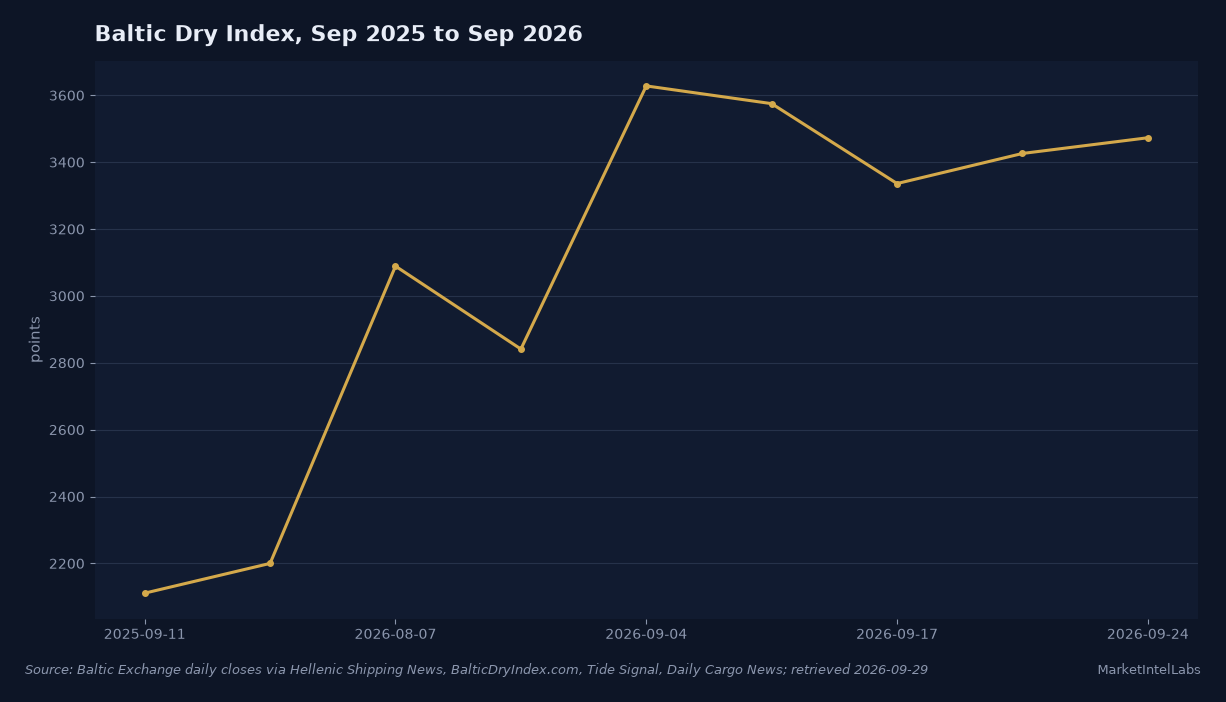
The Baltic Dry Index closed at 3,473 points on Wednesday 24 September, up 1.3 percent on the day, and the capesize segment underneath it is earning more than at any point since early December 2025. Capesize owners pulled a $52,457 timecharter average out of Week 39, and the trans-Atlantic route assessment touched $62,938 a day before easing back, its strongest level since December. For a cargo class the desk has mostly left alone while container rates flatlined, dry bulk is now the loudest freight story of the month, and it is built on iron ore moving farther, not more.
The rate, the route, the cargo
Start with what the Baltic Exchange actually assessed on 24 September. The composite rose 43 points to 3,473. Capesize gained 1.3 percent to 5,939, worth $53,864 a day in average earnings. Panamax rose 2.1 percent to 2,382, supramax edged up 0.2 percent to 1,782, and handysize was flat at 1,003. The headline number is firm but not spectacular; the earnings line is where the story sits, because a capesize owner earning $53,864 a day on a five-year-old vessel is covering her costs several times over.
The weekly commentary in the Daily Cargo News report of 25 September fills in the routes. In the Atlantic, trans-Atlantic and fronthaul rates surged on Thursday of that week on reports of tightening tonnage availability in the North Atlantic and a growing cargo book, then softened into Friday, leaving the C8 route at $62,938 after retreating more than $1,000. The C9 fronthaul index finished at $91,494. Both sit above anything seen since early December last year. In the Pacific the story is different: the C5 route from West Australia to Qingdao slipped from $16.685 to $15.625 per tonne over the week as miners and operators worked through a run of fixtures. Atlantic tightness, Pacific churn.
Why the biggest ships are winning
The structural answer comes from Korea Ocean Business Corp's mid-year research note, published 3 September and reported by The Herald Business. Average capesize rates from January through mid-August rose 64.0 percent year over year, panamax 52.1 percent, supramax 45.9 percent and handysize 38.3 percent. Strip out the weak 2025 base and capesize still ran 31.6 percent above 2024 levels, more than twice its long-term average. No other class comes close.
The mechanism is ton-miles, not tonnage. Maritime iron ore volumes rose 2.0 percent year over year and China-bound cargo volumes 2.8 percent, but distances lengthened, lifting ton-miles 3.6 percent. A ship tied up longer on the same cargo is, from the charterer's side, a ship in short supply. The capesize fleet grew 1.4 percent over the period, the slowest of any major class, against 5.4 percent for panamax and 4.2 percent for supramax. Big vessels pulled away from the mid-size fleet for a reason the orderbook can undo: panamax and supramax deliveries are accelerating, and mid-size rates are already feeling it.
The container side points the other way
Worth holding the two markets side by side, because they are telling opposite stories from the same Chinese export machine. Drewry's World Container Index fell 1 percent to $4,468 per 40ft container on 24 September, its first dip in three weeks, as Shanghai to Genoa fell 5 percent to $3,835 and Shanghai to Rotterdam 4 percent to $3,485. The cause is capacity returning to the market: Suez Canal transits rose from 41 in Week 37 to 48 in Week 38, adding effective capacity faster than carriers can blank sailings. Transpacific held up better, with Shanghai to Los Angeles up 2 percent to $7,838 per FEU, and Drewry still expects container rates to decline into China's Golden Week, which starts 1 October.
Dry bulk has no Suez release valve of the same kind. Its constraint is vessel supply on long-haul routes, and KOBC sees that constraint persisting through 2026, with rates above 2025 levels, before 13 to 18 percent declines next year as new ships deliver into a softer demand picture.
For anyone buying steel, alumina, grain or coal into Europe or the US East Coast, the Atlantic capesize numbers are the line item to watch. A capesize timecharter near $53,000 a day and a C8 route above $62,000 feed directly into freight components of landed cost on Atlantic-basin raw materials. Buyers in the Pacific have more room: C5 under $16 a tonne from West Australia to Qingdao is a buyers' market relative to the Atlantic, and Golden Week will thin fixture activity in the first days of October.
The dated events ahead are the Baltic Exchange weekly report due Friday 3 October, the next ISM Manufacturing PMI on 1 October, whose supplier-deliveries sub-index will show whether the raw-material price spike is reaching US manufacturers' order books, and Golden Week itself. If the North Atlantic tonnage squeeze reported in the Baltic commentary carries into October, expect the capesize earnings line, not the headline index, to keep doing the talking.
This content is for informational purposes only and does not constitute financial advice. Past performance is not indicative of future results. Consult a qualified financial advisor before making investment decisions.
Get daily intelligence delivered
Create a free account for the Daily Brief every weekday and The Week Ahead every Sunday. No card required.