China's Survey of Broadcom Switches Puts a Number on the Networking Monopoly Beijing Wants Gone

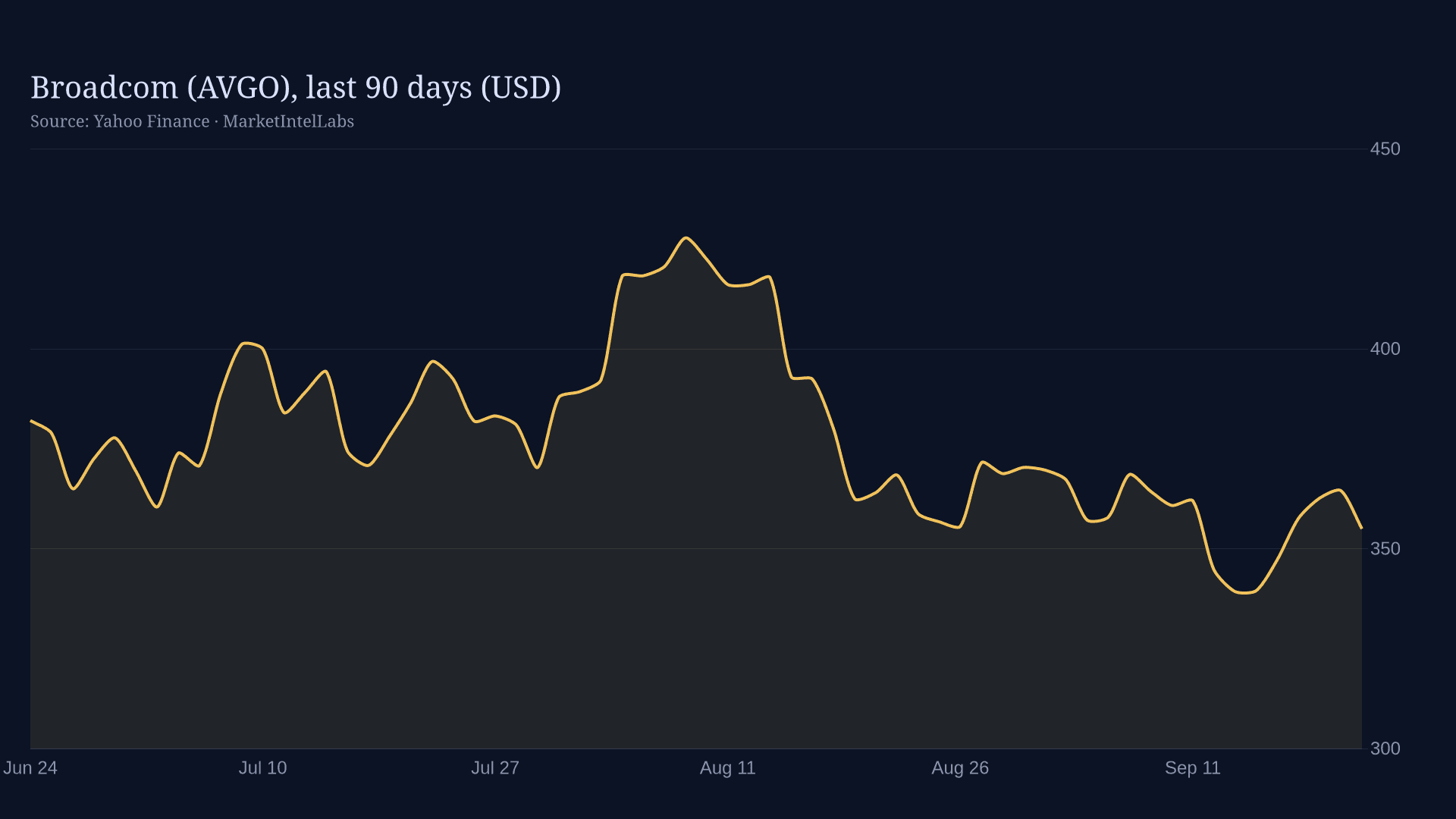
China's state-asset regulator has spent recent weeks counting how much of its datacenter networking runs on American silicon, and the answer was as high as 90 percent. The State-owned Assets Supervision and Administration Commission, which oversees the country's state-owned enterprises, surveyed Broadcom switch deployments across state-controlled datacenters, the Financial Times reported on September 23, citing people familiar with the matter. The survey found Broadcom's switches could account for as much as 90 percent of the installed equipment, and SASAC may follow with informal guidance telling state-run datacenters to scale the hardware back as part of Beijing's "domestic chips for domestic use" campaign. Reuters could not independently verify the report, and neither Broadcom nor SASAC commented.
Below the headline, the market read it as a policy signal rather than an earnings event. Broadcom closed September 23 at $354.99, down 2.6 percent from the prior close of $364.54 (Yahoo Finance daily chart, retrieved September 24), after a five-session run through September 22 that had added roughly 7 percent. A 2.6 percent move is a shrug by this stock's standards. The market cap still sits above $1.6 trillion, and the shares trade near 40 times forward earnings, which means the price already carries a lot of assumption about unbroken demand for the company's custom AI accelerators and its networking silicon.
The important number sits one layer deeper than the 90 percent headline. China accounted for roughly 30 percent of Broadcom's total revenue in fiscal 2024, but most of that is custom AI accelerators built for ByteDance and other commercial customers, not switches. Networking is a mid-single-digit share of Broadcom's China business according to company filings, so even a full state-sector switch ban would strip out a low-single-digit percentage of group revenue. That is why the stock barely moved. The arithmetic of a revenue hit is small; the strategic message is not.
The strategic message matters because of who is on the other side of the order book. Broadcom's Tomahawk and Trident switch chip families hold an estimated 70 to 80 percent of the global merchant switch-silicon market, according to Dell'Oro Group, a position built over a decade of design wins at Cisco, Arista Networks and every hyperscaler that matters. Those chips are the fabric underneath AI training clusters at Microsoft and Meta. The financing behind that buildout is the subject of Who Pays for the Datacenters: Debt, Leases and the Hidden Cost of AI Capex. If Beijing's SASAC recommendation lands, the displaced volume goes to Huawei, H3C and other domestic suppliers, which is a subsidy of exactly the companies Nvidia and Broadcom already compete against at the edge of the China market. Huawei unveiled its own chip technologies last week, and Alibaba used its annual conference on September 23 to show what its CEO Eddie Wu called the most powerful AI chip in China today, the Zhenwu V900, alongside a 20GW datacenter target for 2032. We broke down the economics of that target in Alibaba's 20GW Promise Is a 2027 Bet on One Chip. The survey is one more data point in the same direction of travel.
The pattern echoes what already happened to Nvidia. Nvidia's most powerful AI chips are already barred from state-backed datacenters in China, while Broadcom's switches remained widely present, per the FT report. Beijing is now working through the stack. First the GPUs, then the networking layer, next probably the optical and interconnect suppliers. A company with a dominant installed base inside Chinese state infrastructure should read that as a countdown, not a consultation.
The counterargument deserves a fair hearing. Informal guidance is not a ban, and China's regulators have issued similar signals before without following through at full force. State-run datacenters cannot simply rip out Tomahawk-based fabrics overnight, because operational switching gear is deeply embedded in production networks and domestic alternatives do not yet match the feature set at the top end. The FT's sources described a survey and possible informal guidance, not a published procurement directive. If the guidance never hardens, the revenue impact stays close to zero and the story fades.
But three things keep this from fading. First, the trade meeting between President Trump and President Xi was scheduled against exactly this backdrop, and technology dependency is the centerpiece of the agenda, so the political incentive to make a visible gesture in this direction is high. Second, the "domestic chips for domestic use" campaign is a stated policy with a track record, not a trial balloon. Third, Broadcom's valuation leaves no margin for the narrative turning: near 40 times forward earnings, the stock prices in years of share gains in custom accelerators and networking without a structural China setback. A low-single-digit revenue dent is not the risk. The risk is that investors reprice what "global" means for a company whose merchant silicon holds three quarters of the world's switch market.
What to watch next is concrete. Broadcom reports fiscal fourth quarter results on December 11, 2025 was the last such print; the next scheduled report for fiscal 2026 lands in December, and management commentary on China networking demand will be the line to parse. Micron reports September 30 and will carry its own China exposure data, a read we put in context in AI Capex Hits $998 Billion in 2026, and Memory Is Why, but the cleaner test is whether SASAC's informal guidance surfaces in procurement documents over the next quarter. If Huawei and H3C start appearing in state datacenter tenders where Tomahawk previously sat, the survey will have been the first public marker of a real rotation. This content is for informational purposes only and does not constitute financial advice. Past performance is not indicative of future results. Consult a qualified financial advisor before making investment decisions.
Get daily intelligence delivered
Create a free account for the Daily Brief every weekday and The Week Ahead every Sunday. No card required.