AI Capex Hits $998 Billion in 2026, and Memory Is Why

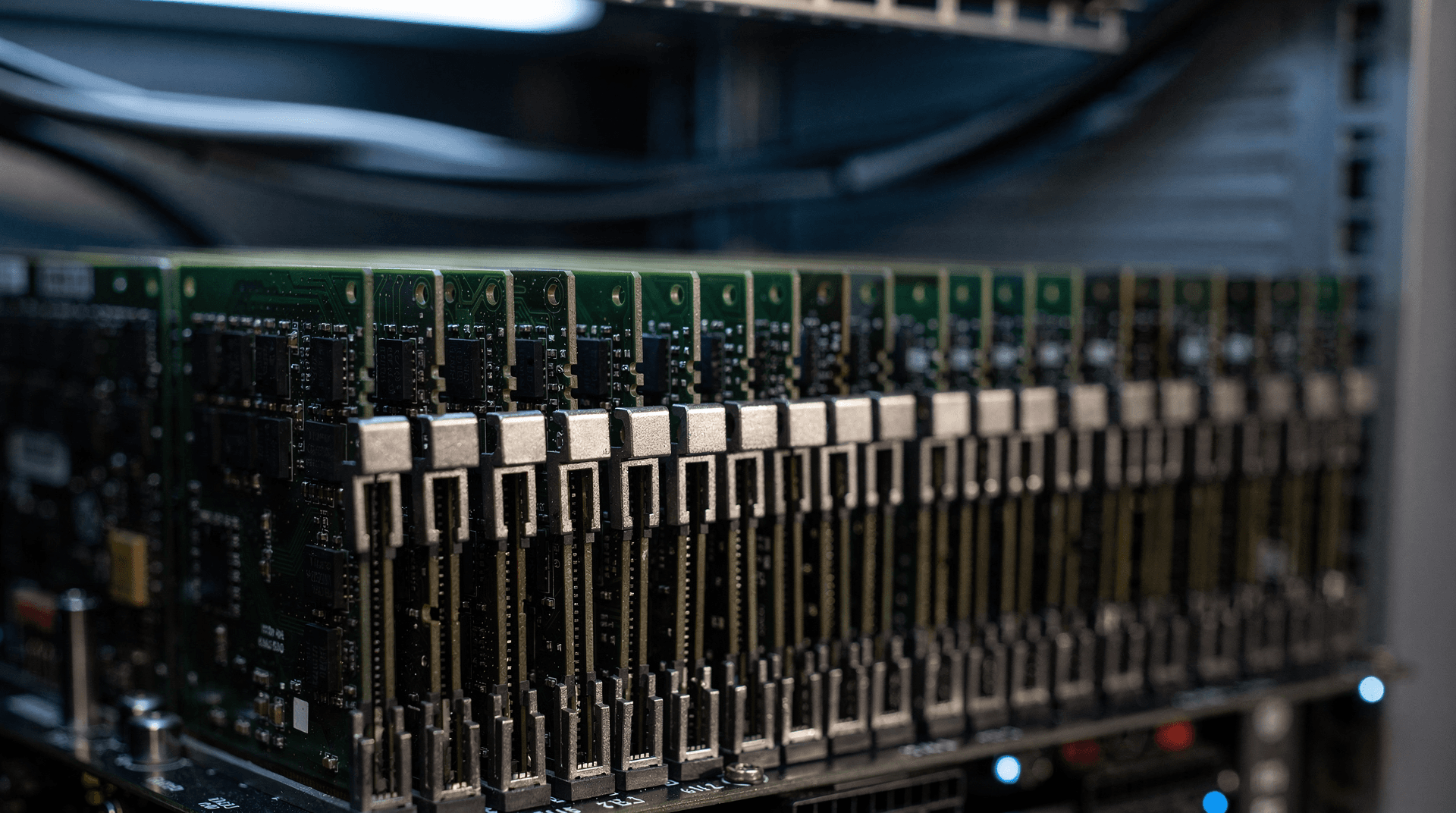
UBS raised its forecast for global AI capital spending this week to $998 billion for 2026, nearly double the $506 billion recorded in 2025, and to $1.447 trillion for 2027. The bank's Sept. 19 revision carries a detail that matters more than the headline number itself: roughly 90% of the roughly $1 trillion added to AI capex between 2025 and 2027 comes from higher memory costs, not from more datacenters being built.
Read the composition and the story changes. UBS puts memory capex at $71 billion in 2025, $367 billion in 2026, and $923 billion in 2027. That takes memory from 14% of total AI spending to 37%, then to 64% in two years. Meanwhile the non-memory components of AI investment actually shrink, from $631 billion in 2026 to $525 billion in 2027. The trillion-dollar boom, on the bank's math, is mostly the same hardware getting more expensive.
This is a price effect masquerading as a volume effect, and the distinction has real consequences for who earns the money. Intel's chief executive Lip-Bu Tan said on Sept. 15 that memory prices have already climbed fivefold to sevenfold, per remarks reported by TrendForce (citing SeDaily), and warned the shortage will deepen. When DRAM and HBM contract prices reprice that fast, every hyperscaler's bill rises without a single additional gigawatt coming online. We broke down why memory now dominates the bill of an AI server last week in Memory Is Now the Most Expensive Part of an AI Server.
Micron's own filings show what that repricing does to a supplier's income statement. Its fiscal third quarter, ended May 28 and reported June 24, delivered revenue of $41.46 billion against $23.86 billion the prior quarter and $9.30 billion a year earlier. Data center revenue alone exceeded $25 billion in the quarter, split between the Cloud Memory business unit at $13.77 billion and the Core Data Center unit at $11.52 billion. Management guided fiscal Q4 to $50 billion, plus or minus $1 billion, at roughly 86% gross margin, which would make a single quarter larger than the company's entire fiscal 2025.
But the volume numbers under the revenue reveal the nature of the move. Micron's DRAM revenue in that quarter rose 67% sequentially, driven mainly by average selling prices climbing in the low-60% range, while bit shipments grew only in the low single digits. The company is not shipping vastly more memory. It is selling roughly the same bits for multiples of last year's price. UBS's forecast is the aggregate version of that same fact.
Who captures the trillion
The geography follows the prices. UBS notes that the major memory manufacturers are concentrated in Asia, so a capex boom driven by memory costs transfers income and profits toward Korean and Taiwanese suppliers rather than into US construction payrolls and domestic equipment orders. A price-driven spending increase adds relatively little to real US GDP, in the bank's assessment. The headline capex figure that investors read as American infrastructure buildout is, increasingly, a payments stream to three Asian firms.
That reframes the bear case too. Spending driven by volume, like poured concrete and installed transformers, is hard to unwind once contracted. Spending driven by price reverses the moment supply catches demand. If memory prices flatten or fall in 2027, the $1.447 trillion projection compresses automatically, because the growth was never in units. UBS's own numbers hint at this: non-memory AI capex declines in 2027, which means the bank already expects the physical buildout side of the cycle to cool while the component bill keeps climbing.
There is a sustainability question embedded here that the bull case tends to skip. Flat bit growth at Micron alongside 60%-plus price gains tells you customers are paying up because they have no choice, not because they are expanding. Datacenter operators are absorbing a cost shock that shows up in their own margins before it shows up in any revenue line. The macro rate backdrop compounds the pressure, a dynamic we mapped in The Fed’s 4.1% Dot Puts AI’s Cheap-Money Math to the Test. At some point either memory supply responds, in which case the price driver fades, or buyers balk, in which case the capex forecasts compress. Both paths end the same dynamic that produced the current numbers.
What to watch next
The next dated catalyst lands on Sept. 30, when Micron reports fiscal fourth quarter results against its own guidance of $50 billion in revenue, plus or minus $1 billion, at approximately 86% gross margin. Watch two things in the print: the split between price and bit growth in DRAM, and any sign that guidance stops assuming further price gains. Samsung's and SK Hynix's capacity reallocation decisions over the following quarter are the second signal, since new wafer capacity is what ends a price cycle. Demand signals remain firm for now. Nvidia Expects Chip Sales to Double: The Filings Back It, though supply response, not demand, is what ultimately ends the repricing.
The UBS revision is best read not as another bullish headline about AI spending but as a map of where the money actually goes. Nine tenths of the next trillion flows to component suppliers, mostly in Asia, on prices that only persist while supply stays tight. Investors pricing the AI trade off headline capex totals are tracking a number whose composition, on the bank's own arithmetic, is 64% memory by next year.
This content is for informational purposes only and does not constitute financial advice. Past performance is not indicative of future results. Consult a qualified financial advisor before making investment decisions.
Sources: UBS estimates as reported by Investing.com and Yahoo Finance, Sept. 19-20, 2026; Intel executive remarks of Sept. 15, 2026, as reported by TrendForce (citing SeDaily), Sept. 16, 2026; Micron fiscal Q3 2026 press release, June 24, 2026, via GlobeNewswire and the Micron investor relations site; Micron fiscal Q4 reporting date, Aug. 26, 2026, via Micron IR.
Get daily intelligence delivered
Create a free account for the Daily Brief every weekday and The Week Ahead every Sunday. No card required.