Brazil First Round Puts Flávio at 81% to Win, Though Runoff Is Still a Contest

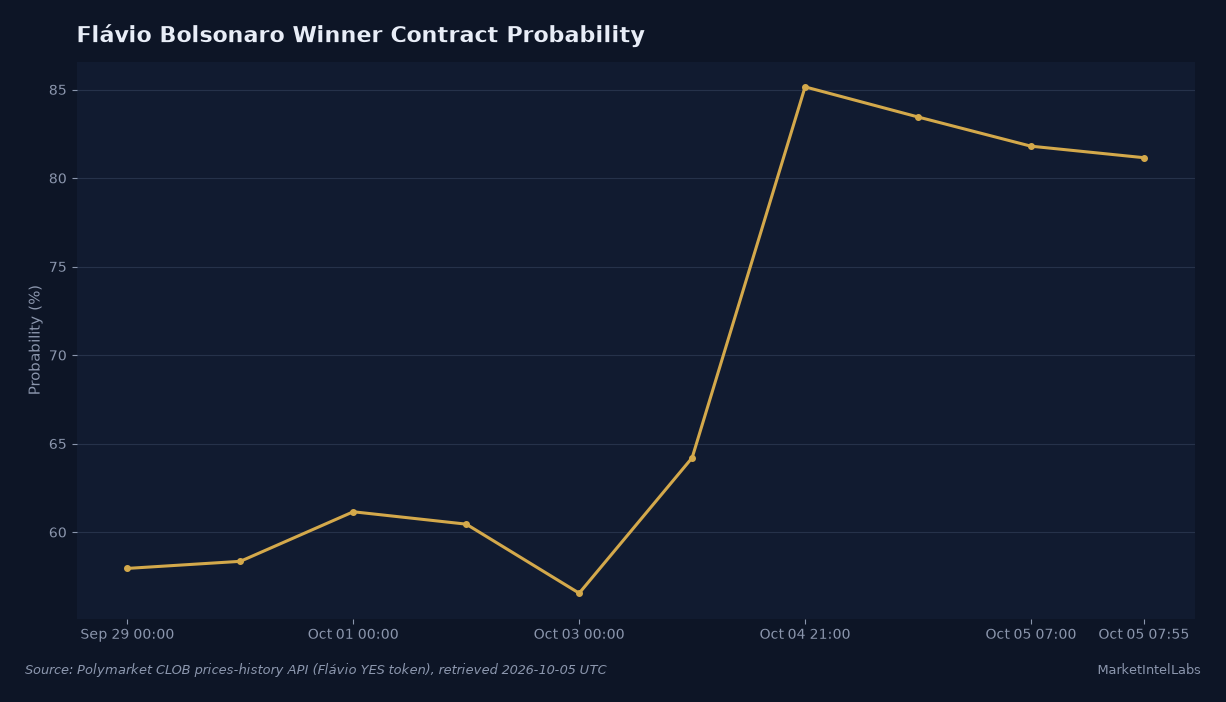
Brazil's October 4 first round turned a crowded field into a two-candidate runoff, and Polymarket's winner market repriced sharply as results arrived. At 07:41 UTC on October 5, Polymarket priced Flávio Bolsonaro at 81.15% and Luiz Inácio Lula da Silva at 19.5% for the eventual winner, even though the official vote now points to a close contest on October 25. The market is expressing a pronounced expectation, not a result.
The move is a direct response to a primary print: the vote count, rather than another poll. The Brazilian Senate reported at 23:02 local time on October 4 that 99.97% of ballots had been counted. Flávio led with 47.04% of valid votes, while Lula had 45.15%. These are preliminary figures from the Senate report; the TSE results portal says its 2026 election results are available through its live results site. Brazil requires a runoff if no candidate exceeds half of valid votes, and the Senate report dates the second round for October 25.
That gives the market a new focal point. Before voting, the Polymarket event page had been pricing a first-round contest; after the count became clear, a substantial Flávio probability is best read as an assessment of the runoff stage. It is not simply a forecast that his first-round lead persists, because the first-round ballot is over and both candidates now face a separate vote.
What the market is pricing
The venue's Gamma API showed the Lula winner contract at 19.5 cents and the Flávio contract at 81.1 cents at 07:41 UTC on October 5. They do not sum to exactly 100%. That difference can arise from spread, fees, timing, and the multi-outcome market structure; it should not be described as a clean two-way probability without qualification. The displayed quotes are a snapshot, not a continuously executable consensus.
Activity was substantial by the platform's own measures. At the same retrieval time, the Brazil event page reported $6.19 million of 24-hour volume and $26.25 million of liquidity. The Lula contract itself showed roughly $2.25 million of 24-hour volume, while the Flávio contract showed about $2.07 million. These are platform-reported dollar measures, not independently audited measures of unique capital or voter information.
Those figures help explain why the shift deserves attention, but liquidity does not eliminate model risk. The market can process a rapidly arriving count and still misread how first-round support transfers, whether turnout changes, or how late campaign events affect a runoff. With only one national first round behind it, the main uncertainty is now conversion of votes between rounds rather than the accuracy of the count. That pattern, where a single official print rescales a venue's odds, is a recurring one on this desk; this week's jobs contracts moved the same way after the ADP release (September Jobs Odds Slide as ADP Clears 90,000).
Flávio's first-place finish establishes an advantage in the first round, not a majority. The Senate's October 4 report put him 1.89 percentage points ahead of Lula among valid votes, based on the 99.97% count then available. A first-round lead can influence the market's starting point, but the gap is narrow relative to the electorate that supported other candidates and to the possibility that voters abstain or change preferences.
The competing interpretation is that the result validates the market's late first-round repricing. The prior desk article on October 1 described Polymarket's pre-vote move toward Flávio, so this piece does not revisit that polling angle. Earlier venue work from this desk framed the same funnel, flagging how the Kalshi ladder had begun pricing a runoff against public polling and reading it as a market signal rather than a poll result: Kalshi's Brazil Ladder Prices a Runoff the Polls Don't. The distinct new information is the official first-round outcome and the market's post-count valuation of the runoff. The count supports Flávio as the first-round leader; it does not establish an 81% chance by any electoral method.
There is also a resolution distinction. Polymarket's event rules state that the winner market includes any potential second round and refers first to credible reporting, with official Brazilian election results as a fallback if there is ambiguity. The contract therefore remains open after the first round. A user reading 81.15% should understand it as the venue's current price for the eventual winner under those rules, not a settled claim about who won October 4.
What to watch before October 25
The next useful evidence will be new public polling, campaign developments that change voter alignment, and the venue's price and liquidity as the runoff approaches. The contract feed showed October 5, 2026 as each candidate market's end date when retrieved at 07:41 UTC; that differs from the official October 25 runoff calendar, a mismatch worth tracking in the market's eventual resolution process. The official calendar points to October 25, 2026 for the second vote. For continuing read-through on how venue prices track these prints, see the desk's ongoing prediction-market coverage (prediction markets). Any subsequent movement should be dated to its own print or event rather than narrated as an uninterrupted trend from the first round.
For now, the cleanest comparison is between a close first-round count and a much more decisive market price. That gap is not evidence by itself that either source is wrong. It shows that contract holders are assigning considerable weight to how a 1.89-point first-round lead might translate into a runoff. The October 25 count will test that expectation against the ballot box.
Resolutions
No markets were due at the October 5, 2026 ledger check. Two Polymarket election contracts were discussed and registered at the October 5 venue print: Flávio Bolsonaro market ID 601826 at 81.15% and Lula market ID 601819 at 19.5%. The API also generated duplicate slug-key records for both, which were marked void as duplicate cleanup. The numeric-ID ledger records themselves remain open; this cleanup did not resolve either underlying election contract. The markets report October 5, 2026 as their end-date field, while the official election calendar identifies an October 25 runoff, so resolution should be monitored against venue rules and official results.
Brazilian Senate, “Flávio Bolsonaro e Lula disputam o segundo turno das eleições para presidente,” published October 4, 2026, Senado Notícias. The TSE portal links to its 2026 live results service at Resultados TSE. Polymarket Gamma market data retrieved October 5, 2026 at 07:41 UTC. The market contracts identify their resolution source as consensus credible reporting, falling back to official TSE results if reporting is ambiguous. At retrieval both contracts were open and their API end-date field was October 5, 2026, although the public event page described an October 25 runoff. That calendar mismatch matters for resolution risk and should not be mistaken for a completed settlement. Market records: Lula market, Flávio market, and Brazil Presidential Election event. Prior desk coverage: October 1 pre-vote market article.
This content is for informational purposes only and does not constitute financial advice. Past performance is not indicative of future results. Consult a qualified financial advisor before making investment decisions.
Get daily intelligence delivered
Create a free account for the Daily Brief every weekday and The Week Ahead every Sunday. No card required.