Brazil Election Odds: Flávio Leads, October 25 Runoff Ahead


Brazil election odds favor Flávio Bolsonaro after the October 4 first round, but the presidency is not decided. The Superior Electoral Court, or TSE, reported 56,104,268 valid votes for Bolsonaro, 47.03%, and 53,876,617 for President Luiz Inácio Lula da Silva, 45.16%, with 99.99% of voting machines counted at 00:11 on October 5. The candidates meet again on October 25. At 10:01 UTC on October 6, the Kalshi contract on Bolsonaro winning had a 83-cent bid and an 85-cent ask, while its Lula counterpart stood at 16 to 17 cents. Those are market prices for an eventual outcome, not percentages of votes already counted.
Our read is narrow: the first-round margin explains why a market might favor Bolsonaro, but it cannot by itself justify treating his contract price as an election result. Voters whose first choice was neither finalist still have a decision to make. Contract terms, trading depth and new information between the two rounds can also move an odds screen without a comparable change in public voting data.
How the vote became a runoff
Brazil's electoral calendar put the first round on October 4 and, where required, the second on October 25. That sequence is set out in the TSE's 2026 calendar explanation and in Article 2 of its election-procedure resolution. An election-night lead of less than half the valid vote does not settle the contest. The runoff exists precisely because the first round did not produce a winner under the governing rules.
The TSE's report is the right starting point, not the markets. It gives Bolsonaro 56,104,268 votes and Lula 53,876,617. The arithmetic difference is 2,227,651 votes and 1.87 percentage points of the reported valid-vote shares. The same report lists 125,272,513 valid votes overall, as well as 2,300,781 blank ballots and 3,674,149 invalid ballots. Its published valid-vote total does not reconcile with the two candidate counts and percentages, so we do not derive a third-candidate count from it. The reported leader totals are a provisional count at the stated 99.99% stage; they are not a certified second-round result.
The unassigned first-round votes matter to the second round. The two leading vote counts add up to 109,980,885, while their stated shares sum to 92.19%. The inconsistency in the TSE release prevents a reliable calculation of how many valid ballots went elsewhere from its total. What is clear is that some first-round voters preferred neither finalist. They are not a bloc that can be mechanically transferred to either finalist. Nor are the blank and invalid ballots a reservoir of candidate votes: they are separate categories in the TSE release, and a future electorate can change its participation or preferences.
There is also an important denominator issue. Bolsonaro's 47.03% and Lula's 45.16% are shares of valid votes, not of every person registered to vote and not of all ballots including blanks and invalids. Contract screens express an outcome price between zero and one. Comparing 47.03 with an 84-cent contract as if both measured the same thing creates a false puzzle. The first measures a share of ballots in one round; the second reflects what participants are willing to exchange for a claim on a later result.
MarketIntelLabs has covered the immediate repricing in its first-round Brazil market report. That piece captures a point in time. A feature published before the runoff needs a second layer: what the contract actually resolves on, why a small vote lead can coexist with a much larger odds gap, and what would falsify the market's current expectation.
What an 84-cent contract measures
Kalshi's Bolsonaro contract states that it resolves to Yes if Flávio Bolsonaro wins the 2026 Brazilian presidential election. Its Lula contract uses the corresponding condition for Lula. Each is an event claim, not a vote-share future or a forecast of a candidate's margin. On October 6 around 10:01 UTC, the retrieved Kalshi data showed Bolsonaro's Yes bid at 0.83 and ask at 0.85; the bid-ask midpoint was 0.84. Lula's Yes bid was 0.16 and ask 0.17, a midpoint of 0.165. A midpoint is our arithmetic summary of quoted orders, not a trade print or a certified forecast.
A further caution comes from the exchange metadata: the inspected Kalshi contract showed a close time in October 2027, although the TSE schedules the runoff for October 25, 2026. We cannot reconcile that displayed close-time field with the official election schedule from the public record we checked. The contract's listed win condition is the useful part for interpreting its price; readers should not use that anomalous metadata as a source for the voting date or a promise about when a contract pays out.
On Polymarket's Brazil presidential event, the Flávio Bolsonaro Yes outcome was displayed at 0.8375 in the October 6 snapshot, and Lula's at 0.165. Those are close to the Kalshi midpoints but not identical, and their near-sum is not a reason to infer a perfectly calibrated election model. The underlying contracts, access restrictions, fees, liquidity and settlement procedures need not match. A venue price can also be stale or temporarily dominated by one side of the order book.
The Polymarket market records inspected at 10:00 UTC on October 6 marked the Bolsonaro and Lula outcomes as active and not closed, yet displayed an endDate field of October 5. That is another metadata inconsistency, not evidence the presidential election already ended. For the voting date we use the TSE. For the price, we use the live outcome-price field in a timestamped API response. Keeping those sources in their own lanes prevents a machine field from silently replacing an official election record.
Why is the quoted winning probability so much higher than 47.03%? Think in branches. One branch asks which finalist receives more votes on October 25. The other asks how likely each branch appears today given the first-round result and information available to participants. A narrow lead in the first question can be assigned a much higher probability in the second. It can also be overturned. We have not modeled geographic transfers, turnout or a probability distribution from polls; presenting a single calculated election probability on that basis would manufacture precision.
For another look at how a market price differs from an underlying number, our Dow threshold market explainer shows why the contract's settlement definition must come before interpretation. The Brazil case is harder: a national electorate votes again, and first-round candidate rankings are inputs to a new decision rather than the value the contract pays on.
The distinction matters beyond election-watchers. A near-term change in odds can follow a vote update, a campaign development, changed participation on one venue, or revised interpretation of settlement wording. Without matched timestamped quotes before and after a specific news item, it is not defensible to attribute a precise probability-point jump to that item. Our October 6 snapshot is a level, not a full time series. Earlier coverage of the first-round setup is available in our pre-vote market note; its quote should not be treated as an identical-contract historical observation without checking the market and time.
The currency chart tests a different question
The runoff is also a macro story, but the most easily verified market series here is not another odds screen. The Central Bank of Brazil's PTAX dollar data give a four-observation comparison: 5.1809 reais per dollar on September 30, 5.2079 on October 1, 5.2238 on October 2 and 4.9859 on October 5. Those are selling rates in reais per dollar at each day's official fixing. A lower number means fewer reais per dollar at that fixing, not a weaker real.
Between the last pre-vote business-day observation on October 2 and October 5, the quoted dollar rate fell 0.2379 real, or 4.55% relative to the October 2 rate. The dates matter: there is no weekend PTAX fixing in this four-point series. The chart marks the official observations rather than filling the intervening days with imaginary prices. It records a move across the election weekend, but does not establish that election expectations alone caused it. Global dollar conditions and local rates could also contribute; this dataset does not separate them.
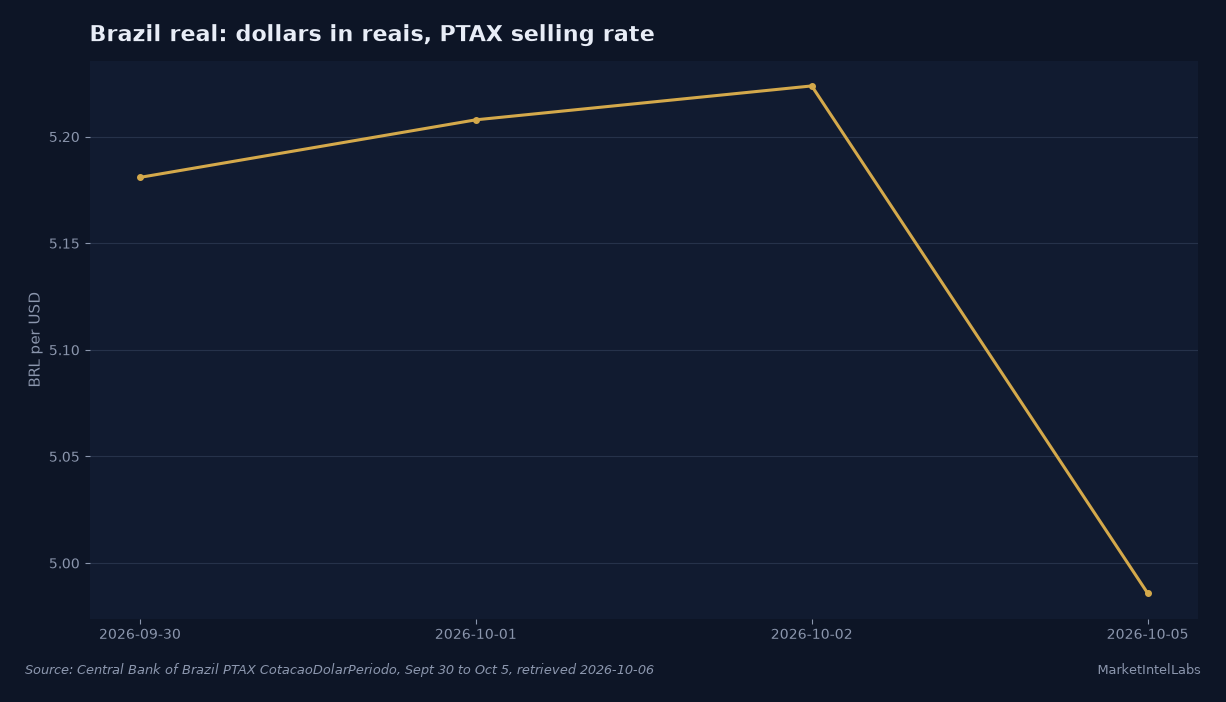
For a reader holding dollar assets, the quote direction is the immediate mechanical effect: fewer reais buy a dollar at the October 5 official fixing than at the October 2 fixing. That says nothing by itself about what a Brazilian equity, bond or household bill will do next. Currency translation depends on the asset's actual cash flows, hedge and trading time. A PTAX fixing is an official reference observation, not a real-time, executable quote available to a retail investor.
There is an analytical temptation to place the odds and currency lines on the same chart and imply one explains the other. We did not do that. The election-contract snapshot was taken October 6, whereas the last central-bank fixing in the series is October 5. Different timestamps, different units, and no controlled comparison. Instead the chart does one job: establish the scale and direction of a sourced foreign-exchange move that readers can monitor separately as the runoff approaches.
The central bank's description of the PTAX dataset explains that the dollar rate comes from four daily quotes supplied by foreign-exchange dealers. That methodology is another reason to distinguish the official reference rate from a continuously traded market price. The visible change is substantial; treating its entire size as a referendum on one candidate would exceed what the underlying data can prove.
What the primary documents establish, and what they do not
Five kinds of primary records anchor this story. The TSE vote report names the finalists and gives their first-round totals. The TSE calendar gives the October 4 and October 25 dates. Its election-procedure resolution sets out the voting process and confirms the dates in the operative rules. The two Kalshi contract records give the quoted prices and their candidate-specific win conditions. Polymarket's event and outcome records provide an independent venue's displayed prices. The central bank gives a dated currency series and its method. Each source answers a different question; none should be made to answer all of them.
The TSE report's biggest limitation for a market reader is not that it is unofficial chatter. It is that a completed first-round count cannot measure second-round voter transfers. The report shows who advanced. It does not poll voters for October 25, guarantee identical turnout, or tell us how supporters of eliminated candidates will vote. Even a 2,227,651-vote first-round lead is not a substitute for the later count. That is the strongest counterweight to interpreting an 84-cent quote as certainty.
The market records have the inverse limitation. They update expectations, but do not confer electoral authority. At the snapshot, Kalshi's two midpoints summed to 1.005, or 100.5 cents, before considering any other outcome, spread, fee or venue-rule distinction. Treating both contracts as clean components of a single probability table would gloss over their separate order books. Polymarket's displayed outcome prices also should not be added across records to reconstruct official vote shares. They are claims on named outcomes, not ballot measurements.
One can still use the screens carefully. If both venues show Bolsonaro as the favorite at roughly 84 cents while the TSE gives him 47.03% of valid first-round votes, the story is that traders expect him to be more likely than not to win the second vote. The case for that expectation starts with the lead, not with a claim that the lead is insurmountable. The case against it is the unallocated first-round vote, possible changes in turnout and the interval until October 25. Those are competing explanations to watch, not invitations to choose a contract.
The venue disagreement is modest at the moment sampled: Polymarket showed Bolsonaro at 83.75 cents, and the Kalshi bid-ask midpoint was 84 cents. That 0.25-point difference is smaller than Kalshi's two-cent quoted spread and should not be sold as a cross-venue opportunity. The Lula prices, 16.5 cents on Polymarket and a 16.5-cent Kalshi midpoint, were equal at the precision shown. A later divergence would first require checking whether the quotes, market rules and timestamps still line up.
Public odds have a further blind spot. They summarize trading by participants willing and able to use a particular venue. They do not sample the entire electorate and do not report the preferences of those who do not trade. The TSE data, meanwhile, record ballots already cast, not an attitudinal survey. A sober reading keeps both: actual first-round votes are evidence about the past; market prices are a noisy expression of expectations about the future.
October 25 is the test
The next dated political event is the October 25 runoff under the TSE calendar. Before then, updates to official vote tabulations and any verifiable new primary information should be read alongside timestamped contracts rather than after the fact. On election night the first check will again be the TSE's reported vote count, including how much of the count is complete. The final resolution question for an event market is who wins under its own contract terms, not which candidate led an interim screen.
A useful threshold is already in the record. Bolsonaro needs a second-round majority under the applicable voting rules; his reported 47.03% of valid first-round votes is not one. Lula's 45.16% is not either. If the remaining voters split differently than the market anticipates, or participation changes, the market's favorite can lose. If the runoff confirms Bolsonaro's lead, the odds screen will have anticipated the outcome, but a correct call in one election will not establish that every 84-cent political contract is well calibrated.
For the currency, the dated check is simpler: compare each later official PTAX fixing with 4.9859 reais per dollar on October 5, while resisting single-cause stories. If the rate reverses, that would change the description of the post-vote FX move, not retroactively change the ballot totals. Our interpretation will change if verified second-round information challenges the first-round lead or the two venues materially reprice on comparable terms. Until then, the honest headline remains a favorite, a runoff and an uncounted future vote.
Frequently Asked Questions
Who won the first round of Brazil's 2026 presidential election?
Flávio Bolsonaro led the October 4 first round with 56,104,268 valid votes, or 47.03%, while Lula had 53,876,617, or 45.16%, in the TSE report issued with 99.99% of voting machines counted at 00:11 on October 5. Leading the first round did not decide the presidency; the two candidates advanced to a second round.
When is the Brazil presidential runoff in 2026?
The second-round vote is scheduled for October 25, 2026, according to the TSE electoral calendar and its election-procedure resolution. A prediction-market metadata field displaying a later close time is not a substitute for the TSE's voting calendar.
What are the Brazil election odds for Flávio Bolsonaro and Lula?
In our October 6 snapshot, Kalshi showed the Flávio Bolsonaro win contract at an 83-cent bid and 85-cent ask and Lula at 16 and 17 cents, respectively. The corresponding bid-ask midpoints are 84 cents and 16.5 cents. Polymarket showed Yes prices of 83.75 cents for Bolsonaro and 16.5 cents for Lula. These are timestamped contract prices, not official forecasts or election results.
Why are Brazil election odds different from the first-round vote shares?
The first-round shares describe valid votes cast on October 4. Election contracts pay based on a future winner under their specified rules. Participants can assign a high chance of winning the runoff to a candidate who fell short of a majority in the first round. That assignment is an expectation and can change when new information arrives.
What happened to the Brazilian real after the first round?
The Central Bank of Brazil's official PTAX dollar selling rate moved from 5.2238 reais per dollar on October 2 to 4.9859 on October 5, a 4.55% fall in the dollars-in-reais quote. That is consistent with a stronger real at those fixings, but the two observations alone cannot isolate an election effect from other market drivers.
This content is for informational purposes only and does not constitute financial advice. Past performance is not indicative of future results. Consult a qualified financial advisor before making investment decisions.
Get daily intelligence delivered
Create a free account for the Daily Brief every weekday and The Week Ahead every Sunday. No card required.