August Jobs Report: 162,000 Hires Mask a Quarter of Slow Hiring


Nonfarm payrolls rose 162,000 in August, the largest monthly gain since December, and the unemployment rate held at 4.1 percent. That is the headline from the August Employment Situation. The more honest number is the three-month average: 71,300 jobs a month from June through August, against 38,300 in the May-through-July window before it. One good month does not erase a soft quarter. It barely interrupts it.
The week of September 21 opens with the labor market in an unusual state. Hiring is slow. Firing is slower. Initial jobless claims fell to 196,000 in the week ended September 12, the lowest reading since midsummer, and continuing claims dropped to 1.73 million for the week ended September 5. Companies are not shedding workers at anything like recession pace, a pattern we laid out in Continuing Claims Just Hit Their Lowest Since January 2024. Nobody Is Getting Fired.. They are also not replacing the ones who leave, which is why payroll growth has averaged well under 100,000 a month since spring while claims sit near historic lows.
The monthly churn data say the same thing from the other direction. Job openings rose to 7.74 million in July, up from 6.95 million in June, and the quits rate climbed to 2.2 percent from 2.1 percent in May. Quits are the confident workers' indicator: people rarely quit a job they cannot replace. Our read of the flows in Labor Flows Point to Slack Ahead of September Payrolls Print points the same way. A 2.2 percent quits rate is not the 3.0 percent of the tight 2022 market, but it has drifted up from the 1.5 to 1.7 percent range of the winter. Workers with the option to move are using it.
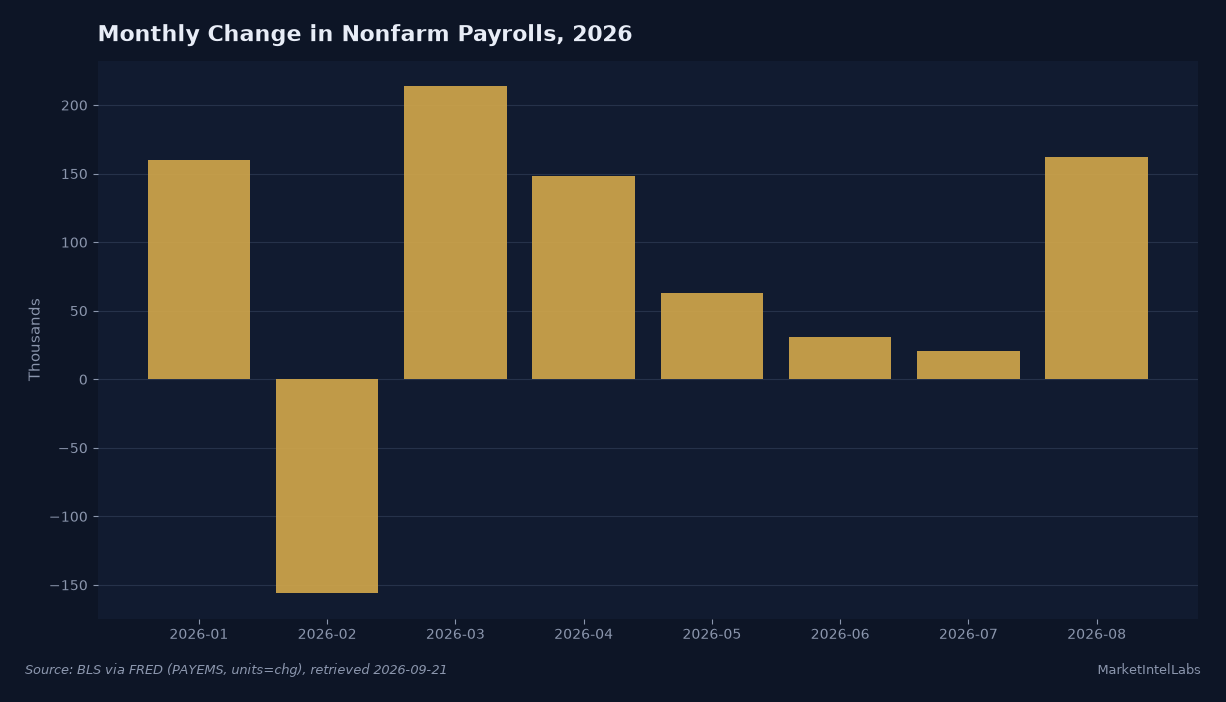
The 2026 payroll path on the chart above is choppy in a way that matters. A 214,000 print in March and a 162,000 print in August sit on either side of four consecutive months, May through July, that summed to 115,000 jobs. The private survey month-to-month noise is large, and the February figure of minus 156,000 was itself the product of seasonal adjustment distortions and strike reversals rather than mass layoffs. Read the three-month average, not the single month. That average says the economy is adding roughly 70,000 jobs a month, about half the pace needed to hold the unemployment rate steady with today's participation.
Which brings up the participation wrinkle. The labor force participation rate fell to 61.6 percent in August from 62.1 percent in January. Some of that drop is demographics; some of it is discouraged workers timing out of the count. A shrinking labor supply does part of the Fed's cooling work for it. With fewer people competing for each opening, wage growth stays contained without layoffs. If participation stabilizes where it is, payroll growth near 70,000 to 100,000 a month is enough to keep the unemployment rate near 4 percent rather than pushing it up.
Wages are running hot enough to matter for policy. The switcher premium, as Job Switchers Just Pulled Wage Growth Back Above 4 Percent showed, is part of that picture. Average hourly earnings were $37.75 in August, up 0.3 percent on the month and 3.1 percent from a year ago, when the level was $36.62. With inflation running below that pace for most of 2026, real wages have been growing, real earnings per the St. Louis Fed series have held near $378 since early 2025 and ticked up to $378 in the second quarter, and consumer spending has had a wage tailwind rather than a hiring tailwind. That combination, slow hiring but rising real pay, is one reason the economy has avoided recession talk despite the weak payroll streak.
For the Federal Reserve, the August package cuts both ways. It lands a month after The Fed Hiked Into a Labor Market That Is Quietly Firming. The weak three-month hiring average argues for cutting. The 3.1 percent wage growth, the 2.2 percent quits rate and the rebound in openings argue that labor demand is not collapsing, which removes some urgency. Committee members have been describing the labor market as being in balance, and the data this month support the description. Balance is what lets the Fed move on inflation alone, and inflation has been the less troubling half of the mandate this year.
Two caveats belong in any honest read of this data. First, August payroll figures have been revised substantially in both directions over the past two years, and the three-month average will move when the September release arrives. Second, claims data in early September are seasonally messy around the Labor Day holiday, so the 196,000 print flatters the picture a little. The level is low either way; the precise number is not reliable.
The calendar tells the rest of the story. Weekly initial claims arrive Thursday, September 24. The August JOLTS report, the first look at whether July's opening surge was a one-month bounce, is due at the end of the month. The September Employment Situation lands the first Friday of October, and it carries the benchmark-seasonal revisions that will reframe the whole spring hiring slowdown.
The implication is straightforward. This is a labor market that is slowing through reduced hiring, not through layoffs, and that distinction has held for three straight quarters. Watch the claims level for the first sign that the distinction is failing. As long as continuing claims stay below 1.8 million and quits stay above 2 percent, the soft-landing case for employment remains the data-supported one. If claims break higher while quits fall, the next quarter looks very different.
Get daily intelligence delivered
Create a free account for the Daily Brief every weekday and The Week Ahead every Sunday. No card required.