AMD pays $8.2 billion in stock for Fei-Fei Li's World Labs, and the model lab era starts


AMD said on Monday, September 28, 2026 that it agreed to acquire World Labs, the spatial-intelligence lab founded by Stanford professor Fei-Fei Li, in an all-stock deal valued at approximately $8.2 billion. The agreement was signed September 26 and disclosed through an 8-K filed with the SEC on September 28. Deal close is expected by the end of 2026, subject to regulatory approvals. Li will join AMD as executive vice president and chief scientist, reporting to chair and CEO Lisa Su. The week of September 28, this is the most consequential print on the AI markets beat, not because of the size, which is modest by 2026 standards, but because of what it says about who buys model labs and why. (The pattern, a chipmaker wiring its fate to a model maker, is the same shape as the Anthropic-Akamai CPU-turn deal we covered in August.)
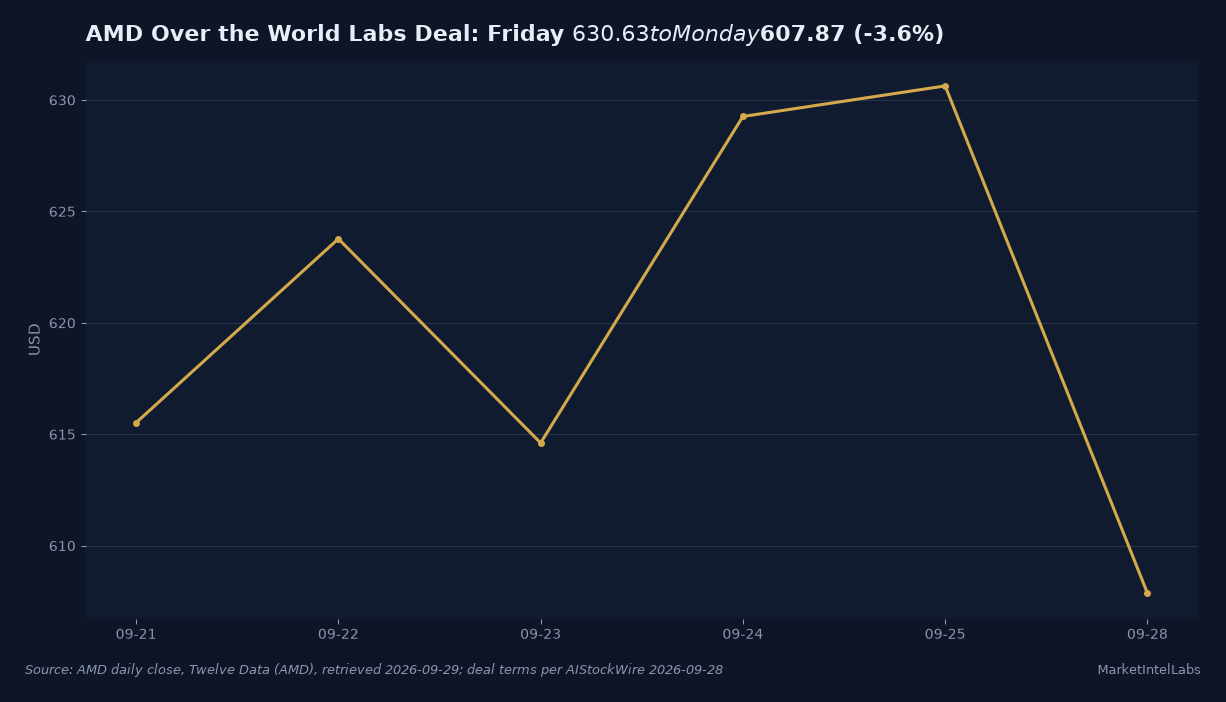
The deal mechanics matter first, because the price is not what it looks like. The 8-K states the number of AMD shares will be set by the volume-weighted average price over the 10 trading days ending two trading days before closing. At AMD's Monday close of $607.87, that consideration works out to roughly 13.5 million new AMD shares, about 0.8 percent of the 1.63 billion shares outstanding, per arithmetic reported by AIStockWire on September 28. AMD shares closed down 3.6 percent on the day, from $630.63 on Friday. A 0.8 percent dilution for a premier research team is a small check by the standards of a company that crossed $1 trillion in market value last week. The real price is paid in conviction: AMD is betting that the next compute platform gets shaped by world models, models that generate, reconstruct and simulate interactive 3D environments from text, images and video, and it wants the person who defined the field designing its silicon roadmap.
The valuation comparison is where the market signal sits. World Labs came out of stealth in 2024 with a $230 million financing, and Bloomberg reported on January 23, 2026 that the company was in funding talks at a $5 billion valuation. In that same January round, World Labs announced $1 billion in new funding with AMD, Nvidia, Autodesk and Fidelity among the investors, per the company's own announcement. So AMD, already an investor through AMD Ventures, has agreed to buy the whole company in stock at roughly $8.2 billion, about 60 percent above the valuation it helped set at the start of the year. That is not a distress sale and it is not a hype print either. It is a strategic buyer paying a premium over the last private mark for control of a research asset, in its own equity, at the top of the chip cycle. Investors should note the asymmetry: AMD shareholders absorb the dilution, and the $8.2 billion headline is a paper number that will move with AMD's own share price before close.
The strategic logic follows a pattern the desk has tracked all year. AMD signed its 6 gigawatt Instinct MI450 agreement with OpenAI on October 6, 2025, a deal that included a warrant for up to 160 million AMD shares at $0.01 per share, vesting in tranches tied to deployment milestones and share-price targets escalating to $600 for the final tranche, according to AMD's 8-K filed October 6, 2025. AMD closed at $607.87 on September 28, above that final target. Su has spent the past year wiring AMD's fate to model makers, first as a supplier with equity kickers, now as an owner of a model lab itself. Owning the lab changes the information position rather than just the product position: AMD's own statement on September 28 says the acquisition brings model-development expertise close to its hardware, software and systems business, and Su's quoted rationale is that building compute platforms for the next generation of AI requires a deep understanding of how models are evolving. That is a roadmap argument. The lab's research on next-generation models tells AMD what its AI chips need to handle years in advance, as CNBC reported on September 28. This is the second major AI-markets acquisition in a week of heavy AI financing, a backdrop Goldman’s $1.4 trillion AI-capex projection for 2027 frames in dollar terms.
The competitive read-through runs straight to Nvidia. Nvidia has been pushing physical AI as its next revenue curve, and per its own September 2026 guidance it expects physical AI revenue to grow from $10 billion to $100 billion over a decade. Nvidia has been buying too: CNBC put the combined value of its Groq asset purchase in December and its proposed Hugging Face acquisition, agreed this month, at roughly $33 billion. AMD buying World Labs is the same move at one quarter the price, aimed at the same workload class, robotics, simulation and physical AI, where World Labs' Atlas architecture, introduced September 4, 2026, predicts new camera views from 2D images by combining generative AI with multiview geometry, per World Labs. Li has said interest in Atlas spans robotics reinforcement-learning environments, entertainment and therapy scene generation, and real-world reconstruction for design and construction. This is the second-largest acquisition in AMD's history after the roughly $50 billion Xilinx deal in 2022, per AIStockWire across the sector’s funding web: SoftBank’s 9.75% price to close its OpenAI position is the other big close of the quarter.
What the market priced on Monday versus what the filing says is a gap worth watching. The 3.6 percent decline in AMD shares prices the deal as neutral-to-negative, consistent with dilution math and the general skepticism that follows any chipmaker spending stock near record levels. The filing says something different: that AMD believes world models are a workload worth owning rather than merely serving, and that it is willing to spend equity to internalize a research voice that will shape its silicon roadmap. For context on the era, Nvidia's investment web in labs and neoclouds now runs to hundreds of billions in announced commitments, which is why an $8.2 billion purchase of an actual model lab looks cheap. The risk is execution: research labs do not reliably convert into product revenue, and World Labs has no disclosed revenue line. The market for world models is a bet on robotics and simulation demand that is still mostly in demos.
The next dated catalysts: the deal close window runs through the end of 2026, regulatory approvals permitting, and the share count will be set by the 10-day VWAP shortly before that. AMD's next earnings report, where management will be asked directly about the dilution and the roadmap integration, is the checkpoint. Investors watching the physical AI theme should track whether Nvidia answers this deal with a competing lab purchase, and whether World Labs' models start appearing in AMD's Instinct roadmap disclosures within the next two quarters Oracle’s own buildout has already tripped a first delay clause, per Oracle’s force-majeure notice on Project Jupiter.
This content is for informational purposes only and does not constitute financial advice. Past performance is not indicative of future results. Consult a qualified financial advisor before making investment decisions.
Get daily intelligence delivered
Create a free account for the Daily Brief every weekday and The Week Ahead every Sunday. No card required.