Warren Buffett Stock Market Warning: Filings Show Net Buying


The phrase “Warren Buffett stock market warning” is drawing searches this week, but we could not verify a new, dated Buffett statement warning that the market will crash. The latest available Berkshire Hathaway quarterly report, for June 30, 2026, is a record of what the company owned and spent, not a forecast from Buffett. It shows $360.0 billion of gross cash and short-term U.S. Treasury bills in its insurance and other businesses, down from $390.7 billion at March 31. More awkward for the warning narrative, Berkshire bought $19.8 billion more equities than it sold during the second quarter and resumed substantial repurchases of its own shares. Those numbers come from the June 2026 10-Q.
The distinction matters. A cash pile can reflect an insurer's obligations, an acquisition pipeline, Treasury yields and the absence of sufficiently attractive individual investments. It cannot, by itself, establish a prediction about the entire S&P 500. The 2013 shareholder letter also contains Buffett's often-recited advice on a low-cost index fund. Reading the investment policy of a corporation and the advice to a household as if they were identical turns two different decisions into a false contradiction.
We checked Berkshire's recent reports, including the 2025 annual report and its two 2026 quarterly reports, alongside the older letters. None of those documents supplies a newly dated warning in Buffett's own words corresponding to the current search phrase. We cannot rule out an interview or remark elsewhere that was not in these records; nor can a search trend establish what individual readers saw. This is an examination of disclosed actions and written advice, not an attempt to infer his private outlook. For background on how the wider equity tape can diverge from a headline index, see our report on narrow S&P 500 breadth.
What Berkshire's cash actually measures
The headline number has a boundary that matters. Berkshire's balance sheet separates its insurance and other businesses from its railroad, utilities and energy operations. At June 30, the insurance and other column reported $35.096 billion in cash and cash equivalents and $324.905 billion in short-term U.S. Treasury bills. Adding those two reported lines gives $360.001 billion. It is a gross balance-sheet sum, not a count of currency sitting idle in a bank account.
Elsewhere in the same June 10-Q, management describes $359.2 billion of cash, cash equivalents and T-bills net of payables for unsettled purchases. The $0.8 billion gap between that narrative measure and our gross chart number reflects the differing definitions. Do not add the two figures together. The June balance sheet also reports $5.513 billion of cash in the railroad, utilities and energy column, which our chart deliberately excludes for a consistent insurance-and-other series.
At March 31, the comparable gross pair was $51.478 billion of cash and $339.261 billion of bills, or $390.739 billion combined, in the first-quarter 2026 10-Q. The decline to $360.001 billion in the second quarter is $30.738 billion. The first-quarter figure was a high point in this 18-quarter table, not an everlasting ceiling. At year-end 2025, the 10-K listed $47.719 billion cash and $321.434 billion bills, a combined $369.153 billion. That three-date comparison alone defeats the claim that the cash balance rose in every quarter.
The longer path is still striking. The March 2022 10-Q reported $35.542 billion cash and $67.145 billion short-term bills in insurance and other, giving $102.687 billion. The 2022 10-K put the sum at $125.034 billion that December. By December 2023, the 2023 annual filing showed $163.291 billion. The acceleration followed in 2024: $271.502 billion in June, per its second-quarter report, and $330.805 billion by December, per its 2024 annual report. Those are observations about a balance sheet, not measured probabilities of a correction.
The chart plots every quarter from March 2022 through June 2026 using those same two balance-sheet lines from each SEC-listed Berkshire filing. Our June 2025 filing, for example, shows $96.193 billion cash and $243.605 billion bills, a $339.798 billion sum. That mix differs greatly from June 2026 even though the combined total is in the same broad range. Short-term bills are interest-bearing investments with maturities; treating every dollar as an abandoned equity order misstates the instrument.
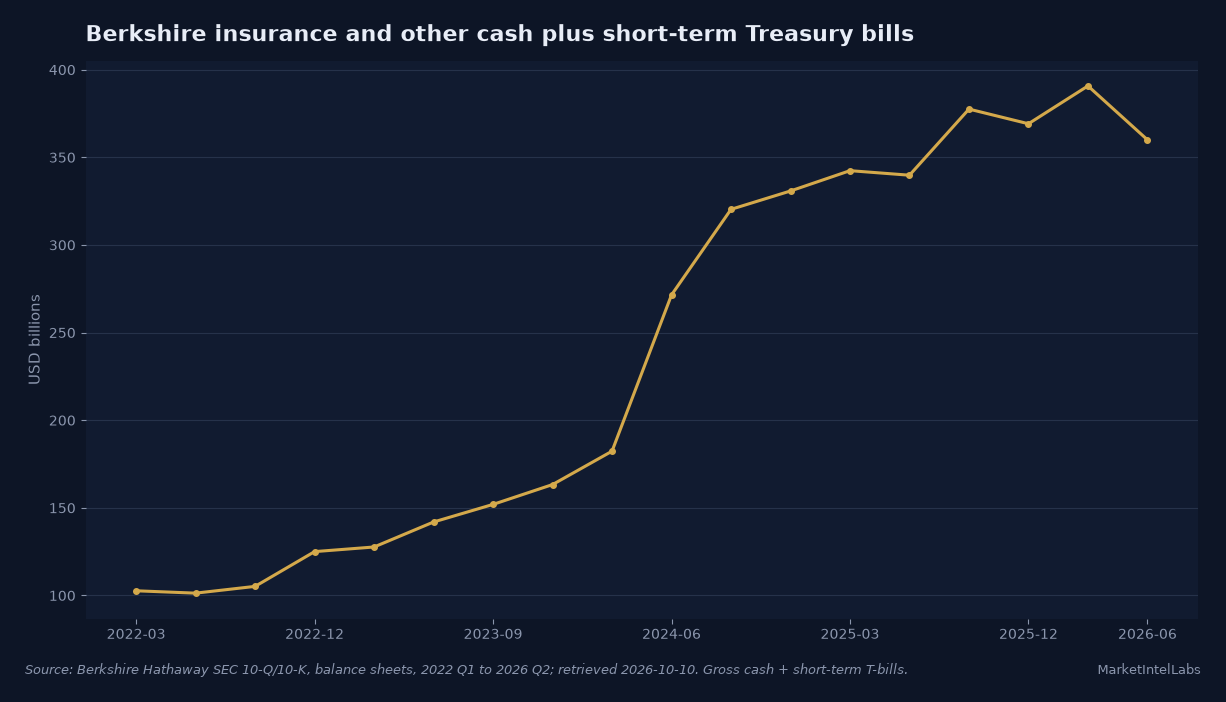
This is a gross liquidity measure for a particular segment, and it excludes Berkshire's other assets and liabilities. Changes can come from operating cash flow, purchases or maturities of bills, acquisitions, investment activity and share repurchases. The filings disclose the components; they do not apportion the entire rise since 2022 to one explanation. The correct question is what the equity and repurchase cash flows did alongside the cash balance.
Equity sales turned into purchases
For equities, the relevant lines are purchases and sales of equity securities in the consolidated cash-flow statements, not the period-end fair value of the stock portfolio. Berkshire sold $143.359 billion of equities and bought $9.237 billion during all of 2024, a net $134.122 billion of sales on that cash-flow definition, according to its 2024 10-K. This was a substantial retreat from listed shares. Yet even then, the filing recorded activity by the company, not a Buffett sentence announcing an imminent decline in the broad market.
The quarterly arithmetic gives the scale of that retreat. In the first quarter of 2024, sales less purchases were $17.281 billion. The second quarter accounted for $75.536 billion of net sales, followed by $34.592 billion in the third and $6.713 billion in the fourth. We calculated each standalone quarter by subtracting the prior year-to-date cash-flow figures in Berkshire's March 2024, June 2024 and September 2024 filings, then using the year-end total. Quarterly figures here are cash flows, not mark-to-market changes in portfolio value.
The pace changed in 2025. The 2025 10-K reports $30.686 billion of equity sales against $16.923 billion of purchases, or $13.763 billion of net sales for the year. By quarter, the net-sales amounts were $1.494 billion, $3.006 billion, $6.099 billion and $3.164 billion, calculated from the March, June, September and December filings. That is still selling on balance, but nowhere near 2024's amount.
The most recent two quarters are especially important for a reader arriving on a 2026 “warning” search. The March 2026 filing shows $24.087 billion of equity sales and $15.938 billion of purchases, a net $8.149 billion sold. The June 2026 filing reports six-month totals of $27.780 billion sold and $39.405 billion bought. Subtract the first quarter from each cumulative figure: second-quarter sales were $3.693 billion, purchases $23.467 billion, and purchases exceeded sales by $19.774 billion. Describing that latest quarter as Berkshire “dumping stocks” would reverse the sign of the cash flow.
There are limits to this calculation. Gross purchases and sales do not show which security was attractive at a particular price, and reported cash flow differs from the change in the portfolio's market value. The June 2026 13F-HR is a separate, quarter-end disclosure of reportable U.S.-listed holdings. It is a holdings snapshot, not the company's complete consolidated balance sheet, and it cannot replace the 10-Q's purchase and sale totals. Securities outside the 13F's scope and the timing of transactions also complicate inferences drawn from differences between two holdings lists.
That distinction also protects against a convenient but misleading story: cash rose, therefore Buffett must be betting against every stock. The company's disclosed activity changed direction between the first and second quarters of 2026. Berkshire has not stated that the company's cash target is an S&P 500 price forecast, and Buffett has not stated a new crash timetable in the primary documents reviewed. If a dated interview surfaces, its exact words would need to be checked against this transaction record rather than retrofitted to it.
The buyback pause ended
Berkshire's own shares offer another check. Its 2024 annual report recorded $2.918 billion of repurchases for the year. The company made no further common-stock repurchases in the last two quarters of 2024 according to its cumulative cash-flow figures; its 2025 cash-flow statement has no repurchase outflow. That pause is relevant evidence about whether management regarded its own stock as attractively priced under its repurchase framework. It is not a direct valuation statement on every other listed company.
The pause did not continue unchanged. The first-quarter 2026 report records $235 million of common-share repurchases. The six-month report lists $4.444 billion, making the second-quarter increment $4.209 billion. Its share-repurchase table identifies purchases of both Class A and Class B stock in May and June, with none listed for April. Thus an article that calls the buyback pause a current, uninterrupted policy is using stale data.
The policy remains conditional. Berkshire says repurchases are permitted when its chief executive officer, after consultation with the chairman, believes the price is below conservatively determined intrinsic value. Its report also describes a $30 billion minimum for consolidated cash, cash equivalents and T-bills after repurchases. There is no required monthly pace and no fixed maximum number of shares. Since the 2026 shareholder letter is signed by CEO Gregory Abel, a new buyback authorized under the policy should not automatically be narrated as a fresh public warning from Buffett. Individual accountability matters as much as the transaction.
There is a legitimate cautious reading. Berkshire had far more liquidity in June 2026 than in March 2022, and its 2024 net equity sales were large. Maintaining optionality for a sprawling insurer and investor can make sense when the acquisition and equity opportunities it evaluates do not clear its own price test. The opposing evidence is recent and concrete: net equity purchases and renewed buybacks in the second quarter. The balance of those observations supports selective deployment, not a categorical call to leave stocks. The company has not disclosed an intent to time a broad-market collapse.
What Buffett wrote about the S&P 500
Buffett's advice about the index has its own date and audience. In his 2013 letter to Berkshire shareholders, published with the annual report in 2014, he discussed a trust for his wife. His instruction to its trustee was: “Put 10% of the cash in short-term government bonds and 90% in a very low-cost S&P 500 index fund.” That is a stated plan for a particular long-horizon beneficiary, not a newly issued 2026 recommendation from our publication and not a description of how Berkshire must allocate its own corporate treasury.
The same letter explains the reasoning. He wrote that a nonprofessional's aim should be to own a cross-section of businesses and that “A low-cost S&P 500 index fund will achieve this goal.” He also warned that a beginning investor might enter at a moment of exuberance and become disillusioned by paper losses. The juxtaposition is useful: his warning about behavior and price paid did not amount to a command to abandon diversified stock ownership. Investors searching for a current stock-market warning can encounter the older caution while missing its original context.
Buffett returned to the case for low fees in his 2017 shareholder letter, published in 2018. Discussing his 10-year wager involving an unmanaged S&P 500 index fund and funds of hedge funds, he described the index position as a “virtually cost-free investment” and explained why layers of fees burdened the alternatives. That comparison was about costs and long holding periods. It did not promise an index gain in every year or state that valuations never matter. The S&P 500 index fund in his 2013 trust instruction is a diversified investment vehicle, while Berkshire's pile of T-bills belongs to a corporation with insurance claims, acquisitions and operating subsidiaries.
The S&P Dow Jones Indices description of the S&P 500 identifies the benchmark as a large-cap U.S. equity index. We do not attach an unsourced current index level or price-to-earnings multiple to this piece. Neither an index level nor a valuation alone turns Berkshire's liquidity figure into Buffett's stated forecast. A meaningful valuation argument would need a dated index observation, a defined earnings measure and a rule linking the two. Berkshire's 10-Q supplies none of those ingredients as a broad-market sell signal.
Another oft-cited shortcut is the “Buffett indicator,” broadly the value of U.S. equities relative to economic output. A reproducible version needs a dated numerator from the Federal Reserve's Financial Accounts of the United States, Z.1 and a matching GDP denominator. The measure is not reported in Berkshire's 10-Q and is not a quote from Buffett this week. Numerator coverage, revisions to GDP and the presence of multinational profits all matter. We do not calculate a current ratio without retrieving aligned, dated component observations; labeling an unspecified market-cap-to-GDP number “Buffett's warning” would import an unsupported claim into the filing story.
What would change the reading
For Berkshire's behavior, the next decisive public test is its next quarterly filing: its balance-sheet cash and short-term bills, equity purchases and sales, and repurchase table will show whether second-quarter deployment continued. We do not assign a release date before the company announces one. The latest SEC filing index for Berkshire is the place to check the actual submission, and the annual shareholder letters are available from Berkshire's own archive.
There are two ways this thesis could fail. A verifiable, dated new Buffett statement might indeed contain a broad-market warning; we would quote its words and distinguish it from Berkshire's transactions. Or subsequent filings might show a renewed stretch of net equity sales, no buybacks and a rising liquidity balance, making the cautious interpretation stronger. Conversely, further net buying would weaken a simple “cash means crash” reading. For broader equity context, our sector-rotation coverage and VIX report examine market behavior rather than assigning motives to one investor.
On the verified record today, the sharpest fact is a change of direction: 2024 brought $134.1 billion of net equity sales, but the latest disclosed quarter brought $19.8 billion of net purchases. Buffett's written index-fund advice predates both. A useful next check is the sign of equity cash flow in the next 10-Q, not a viral paraphrase of a warning that has no dated primary citation.
Frequently Asked Questions
Did Warren Buffett warn of a stock market crash in 2026?
We found no new, dated Buffett crash warning in Berkshire's 2025 annual report, its March and June 2026 quarterly reports or the shareholder letters examined here. The June 2026 10-Q instead reports second-quarter net equity purchases of $19.8 billion. This does not prove Buffett said nothing in every possible venue; a claim about a speech or interview needs a dated, checkable transcript.
How much cash and Treasury bills did Berkshire Hathaway hold in June 2026?
Its insurance and other businesses reported $35.096 billion in cash and cash equivalents and $324.905 billion in short-term U.S. Treasury bills at June 30, 2026, for a gross sum of $360.001 billion. The same 10-Q gives approximately $359.2 billion net of payables for unsettled purchases. Those figures use different definitions and should not be combined.
Is Berkshire Hathaway selling stocks or buying stocks now?
For the latest disclosed quarter, April through June 2026, purchases exceeded sales by $19.774 billion. This is calculated by subtracting first-quarter year-to-date amounts from six-month purchases and sales in Berkshire's 2026 10-Q filings. Berkshire had been a net equity seller in 2024, 2025 and the first quarter of 2026, so the most recent quarter marks a reversal in this cash-flow measure.
What did Warren Buffett say about S&P 500 index funds?
In his 2013 shareholder letter, Buffett instructed the trustee for his wife's future trust to place 90% of its cash in a very low-cost S&P 500 index fund and 10% in short-term government bonds. He was describing that trust's long-term allocation, not a guarantee of returns or a current instruction to readers. His 2017 letter again argued that a low-cost index fund could outperform expensive professional alternatives over a long period.
This content is for informational purposes only and does not constitute financial advice. Past performance is not indicative of future results. Consult a qualified financial advisor before making investment decisions.
Get daily intelligence delivered
Create a free account for the Daily Brief every weekday and The Week Ahead every Sunday. No card required.