Trump Administration Federal Student Loans: 2026 Rules Explained


The Trump administration federal student loans changes are not one cancellation of debt. As of October 9, 2026, borrowers face a new repayment choice after the July 1 rollout of Repayment Assistance Plan (RAP), the end of SAVE under a March court order, a narrower path into older plans for newly disbursed loans, a July 1 change in the automatic-payment interest discount, and a July 1 effective date for a rule on qualifying Public Service Loan Forgiveness (PSLF) employers. PAYE and ICR remain available to eligible borrowers with older loans for now, but are scheduled to end no later than July 1, 2028. A borrower should first check the loan disbursement date, current plan and status, and employer certification in StudentAid.gov, not assume that every 2026 rule applies to every loan. These dates and distinctions appear in Federal Student Aid’s borrower guidance, its court-action update and the PSLF final rule.
For a household budgeting a payment, the most consequential question is not whether student debt exists in the national total. It is whether the account is in a plan that generates qualifying months while interest accrues and bills come due. Borrowers still on SAVE-related forbearance should review an eligible replacement plan; borrowers working toward PSLF should check both their counted months and employer; borrowers in default should examine rehabilitation or consolidation before treating a collections delay as relief. The Education Department’s January 16 announcement delayed involuntary wage garnishment and Treasury offsets, but did not erase default or stop credit reporting. No primary record reviewed for this feature establishes a new loan-policy change on October 9 itself; the latest cited portfolio release is September 22.
Related reading: Household Debt Service After the FOMC: What the New Fed Funds Level Means for Your Monthly Payments.
A payment plan now depends on the loan’s date
The clean division is July 1, 2026. Federal Student Aid’s loan-by-loan guide says a borrower whose loans were all first disbursed before that date can, subject to eligibility, use Standard, Graduated, Extended, Income-Based Repayment (IBR), Income-Contingent Repayment (ICR), Pay As You Earn (PAYE) and RAP. It says PAYE and ICR will be eliminated no later than July 1, 2028 and that the transition arrangements for borrowers in those plans are still being worked out. This is not a claim that those two plans vanished in 2026. It means a borrower should not make a long-range budget around either without watching for a transition notice.
The 2025 reconciliation statute, H.R. 1 as published by Congress, is the legislative origin of the repayment overhaul. The Education Department’s May 1, 2026 final repayment regulations took effect July 1. The newer framework includes a tiered standard option and RAP for qualifying newer loans; the older plan menu is not universally available for debt first disbursed on or after July 1. A mixed portfolio deserves a loan-by-loan eligibility check, because the options are not necessarily identical for loans made on different dates. That is why a household should check each loan in the account rather than rely on the year it graduated.
Related reading: Mortgage Rates Hit 7.03 Percent and the Household Bill for Borrowing Just Stepped Up.
RAP is income-driven: the payment responds to income, rather than dividing the outstanding balance into equal principal and interest installments. Under the final regulations, the required payment is set using statutory income bands, with a minimum monthly payment and provisions intended to keep an on-time account from growing simply because its scheduled payment does not cover all interest. The plan also carries a different route to remaining-balance discharge than some older IDR arrangements. A smaller bill today is not automatically a smaller lifetime cost, particularly for a borrower who expects to pay the balance in full or whose earnings rise.
The plan-selection trap is unusually concrete. Federal Student Aid warns that progress earned toward discharge in RAP will not count toward discharge under IBR, ICR or PAYE if the borrower later switches to one of those plans. It separately says RAP progress can count for PSLF after such a switch, assuming the other PSLF requirements are met. Before changing plans, a borrower pursuing long-run forgiveness should obtain a current payment count and compare expected income and remaining qualifying years; a monthly quote alone does not tell that story.
Related reading: Mortgage Rates Reach 7.40% on October 8 as Payments Climb.
An illustrative calculation shows why a rate or payment label can deceive. A one-percentage-point reduction applied to a hypothetical $30,000 balance is about $300 in annual simple interest at an unchanged balance, or $25 a month. The real saving changes as principal declines and depends on loan type and discount eligibility. An income-driven monthly payment could be smaller than a standard bill and still extend repayment for years. Those are different household decisions, not interchangeable discounts.
SAVE is blocked, but forgiveness is not one program
On March 10, a federal court order prevented the Education Department from implementing SAVE and parts of other income-driven rules, according to Federal Student Aid’s September 29 court-action guidance. The agency says borrowers in forbearance because they enrolled in or applied for SAVE must select a new plan. It also says consolidation and IDR applications are open and servicers are processing IBR, ICR and PAYE applications for eligible borrowers. The order did not abolish every income-based repayment plan, and a borrower should not treat a paused bill as a month that necessarily moves a forgiveness counter forward.
Related reading: Mortgage Rates Reach 7.28% on October 1.
There is a difference between stopping an accrual under a particular plan and canceling an existing loan balance. A court action affecting SAVE’s repayment terms does not cancel the separate statutory PSLF program. Nor did the 2026 change convert all existing loans into RAP overnight. The account’s disbursement history, loan type, repayment plan and borrower actions determine what happens next. Check the servicer’s written notice and the federal dashboard against each other; if they disagree, retain copies and ask for a written explanation.
The July 2028 date deserves its own line in a family budget. A household currently relying on PAYE or ICR may still have that payment calculation in October 2026, but Federal Student Aid says those plans will be eliminated no later than July 1, 2028. Moving early into RAP is not necessarily the best response because the agency distinguishes how RAP months count if a borrower later returns to another IDR plan. Review the account’s qualifying-month counter before switching, and watch for official transition instructions rather than a social-media deadline.
What the PSLF employer rule changes
PSLF generally requires 120 qualifying monthly payments on eligible Direct Loans while working full time for a qualifying public-service employer. A payment plan and an employer both matter. The October 31, 2025 final PSLF rule became effective July 1, 2026 and adds a process for the Education Secretary to determine that an employer has a “substantial illegal purpose” based on specified unlawful activities. The rule concerns employer qualification; it is not an automatic finding that every employee at a nonprofit or public agency loses previously earned months.
The final rule describes a determination process and evidence such as a final court judgment or guilty plea for certain findings. It specifies activities on or after July 1, 2026 in the employer-determination provisions. A borrower should not infer an employer’s status from a political description of its work. Seek the agency’s recorded determination and use the PSLF employer search and certification process. The text also has correction and appeal procedures; a dispute about an employer is different from a blanket ban on forgiveness.
This distinction is not semantic for someone with 100 payments recorded. If a loan is eligible but an employer is not, the next 20 monthly bills may fail to complete the 120-payment requirement. If the employer is eligible but a borrower is in a nonqualifying status, the same outcome can follow for a different reason. Save the latest employer-certification result, service dates and payment-count history, especially before moving plans or jobs. The governing source is the published federal rule, not a viral list of allegedly disqualified occupations.
The opportunity in the rule is clarity about the steps by which an employer determination is made. The risk is administrative uncertainty: an employer could contest a finding while workers make career and payment decisions. The Department has not established that every borrower employed by a named organization will lose every previously counted month. An article written before a specific determination should not turn a general rule into a finding about a particular employer.
The interest discount and the collections delay are different
The Department announced an additional automatic-payment rate reduction for qualifying Direct Loans originated after July 1, 2012. Federal Student Aid’s guidance says the auto-pay reduction increased from 0.25 percent to 1 percent on July 1, 2026 and is temporary through June 30, 2028 while a borrower remains enrolled. It excludes FFEL, Perkins and certain other types of loans from the additional reduction. This is an interest-rate discount, not a one-percent reduction in principal or a one-percent lower monthly bill on every loan.
For someone already enrolled in auto pay, the Department said servicers would apply the extra 0.75 percentage point automatically on eligible loans. Others must enroll through their servicer, confirm bank details and payment amount. A borrower in default has to resolve default and return to an eligible repayment arrangement before benefiting. A household with a cash-flow squeeze should first confirm the debit date and available funds; a discounted rate does not excuse a missed payment or an overdraft.
In January 2026 the Department delayed implementation of involuntary collections, explicitly naming administrative wage garnishment and the Treasury Offset Program. That is narrower than a pause on all collections and narrower still than forgiveness. The agency encouraged borrowers in default to explore resolution options and said it continues reporting defaults to credit bureaus. The announcement did not set a permanent end date for those collection tools. An account in default may still carry a damaged credit record and a balance that needs a formal resolution.
The reconciliation changes also allow a second rehabilitation of a defaulted federal loan, according to the Department’s announcement. Rehabilitation and consolidation are different mechanisms with different consequences for recordkeeping and the repayment schedule. Ask the default-resolution servicer what agreement applies to each loan and obtain the terms in writing. Do not confuse the delayed government offset with a suspended requirement to respond to a collection notice.
The size of the problem, and what the chart can actually say
The newest federal portfolio release used here covers June 2026 and was published September 22. Federal Student Aid reported 42.3 million federal student-loan recipients with more than $1.7 trillion outstanding. Its narrower federally managed set included 40.5 million recipient accounts and more than $1.64 trillion. Within that set, more than 17.4 million recipients had at least one loan in current repayment or delinquency, eight million had at least one loan in forbearance, and more than 9.3 million were in default. The associated approximate balances were $658 billion, $459 billion and $234 billion. The chart uses that managed-portfolio denominator, not the broader national amount.
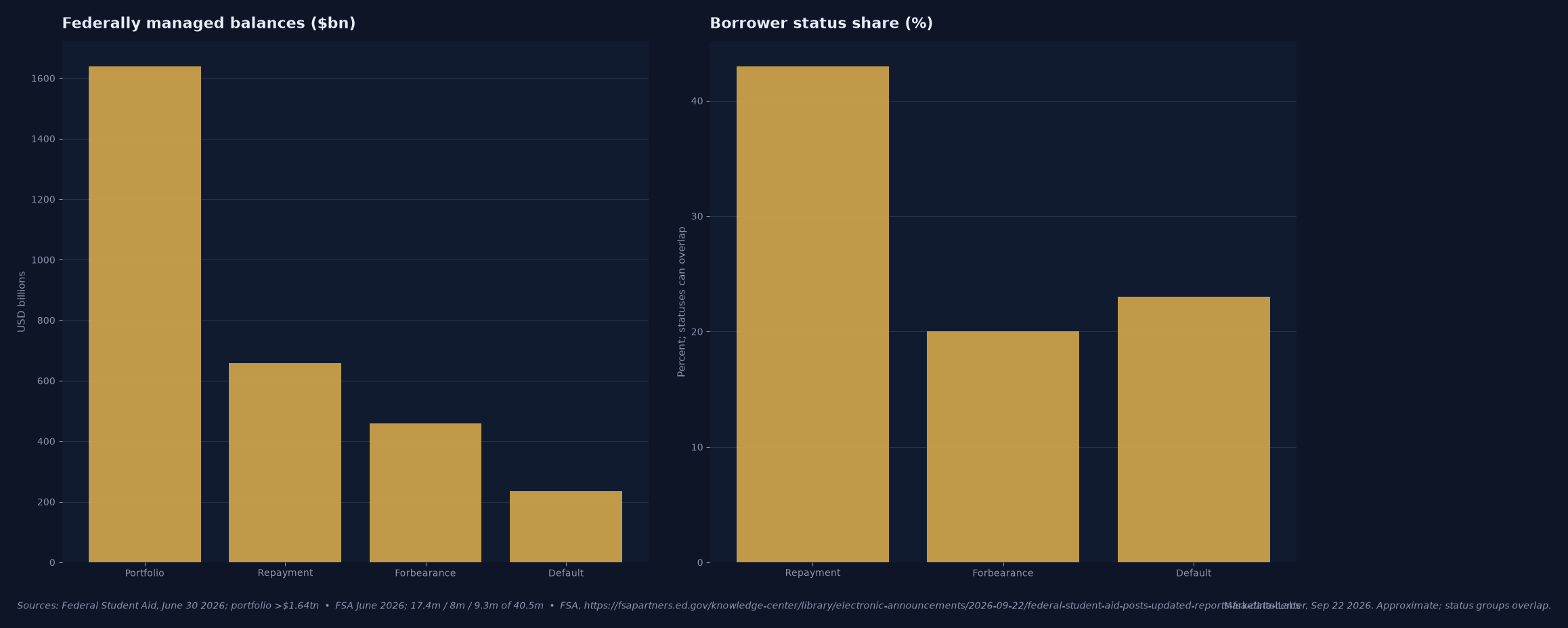
The word “share” needs care here. FSA counts a recipient in a status when at least one loan has that status, so a person can appear in more than one category. The three borrower percentages in the chart are approximate ratios to the 40.5 million federally managed recipients, not slices of a pie and not an exhaustive partition. The balances also use status-specific loan groupings and the published total is stated as “more than” $1.64 trillion. We do not add the bars to reconstruct a complete balance sheet.
One more warning is visible in the same release: nearly 20 percent of active-repayment recipients, about 3.5 million people, were more than 30 days delinquent, including roughly 1.5 million in late-stage delinquency. The active-repayment 31-day-plus delinquency rate measured by loan balance was 15.7 percent, compared with 12.7 percent in December 2019. Those denominators differ from the chart’s all-recipient status shares. A forbearance may temporarily keep a borrower out of a monthly bill and still leave a difficult return to repayment.
The Federal Reserve’s October 7 G.19 release shows a separate student-loan memo figure of $1,861.8 billion for the latest available student-loan observation in its table. It covers a different universe and reporting framework than the Education Department’s federally managed portfolio. It should not be treated as an updated federal-program balance, and its apparent difference from $1.64 trillion is not proof that a particular policy created or erased the gap. Federal balance estimates belong beside clearly named denominators.
Which document should you open first?
If all loans were first disbursed before July 1, begin with Federal Student Aid’s plan guide and your servicer’s repayment screen. Check whether the account shows IBR, PAYE, ICR, RAP or a fixed-payment plan; then note the next recertification and the July 2028 sunset for PAYE and ICR. If a loan was first disbursed on or after July 1, read the new-loan section of the guide for the available standard and RAP choices. For mixed loans, inventory eligibility one loan at a time. A single account dashboard can conceal different disbursement dates.
If the account still names SAVE, open the court-action page before calculating the next payment. Record the current forbearance status, accrued interest and number of qualifying months before an IDR application. An application confirmation is not the same as a processed new plan. Budget for the payment in the servicer’s written approval rather than assume that an old SAVE quote survives the March order.
If seeking PSLF, open the employer-rule text alongside the federal employer-certification tool and the payment tracker. Keep certification records by job and month. If in default, start with the Department’s collections-delay notice and the official default-resolution channel, not with an advertisement promising instant forgiveness. Check whether rehabilitation or consolidation is available and what it would do to interest, eligibility and credit reporting.
If paying on time but under pressure, compare the auto-pay discount on each eligible loan with the reality of your household checking balance. The Department’s rate notice describes who gets the increased reduction and when. A one-percent rate reduction on a $30,000 unchanged balance is roughly $300 a year in a simple illustration, not a guarantee of a $300 refund or a permanent discount. The stronger habit is to verify the next due date, balance and plan on the official account after any switch.
Frequently Asked Questions
Did the Trump administration end federal student loan forgiveness in 2026?
No blanket end appears in the primary rules. SAVE was stopped under a March 10 court order; IBR, ICR and PAYE remain available to eligible borrowers for now, with PAYE and ICR set to end no later than July 1, 2028. PSLF remains a program but the employer-qualification rule changed effective July 1, 2026. The status of a specific loan and employer matters.
Which federal student loan repayment plans are available in 2026?
For borrowers whose loans were all first disbursed before July 1, the official plan guide lists Standard, Graduated, Extended, IBR, ICR, PAYE and RAP, subject to each plan’s eligibility rules. Newer disbursements fall under a different menu. Check each loan’s first-disbursement date before selecting a plan.
Does the new PSLF rule erase payments already made?
The final rule creates a process to assess certain employers, not a universal cancellation of prior PSLF credit. Confirm the employer record and current counted payments in the federal account, and request a written determination if there is a discrepancy. Do not infer your own count from a description of an employer’s work.
Are student loan wage garnishments paused in 2026?
The Department announced in January a temporary delay in implementing administrative wage garnishment and Treasury offsets. Default is not forgiven and default reporting continues. A borrower in default should contact the official resolution channel for loan-specific next steps.
Does auto pay reduce federal student loan interest by 1%?
Eligible Direct Loans disbursed after July 1, 2012 can receive a total one-percentage-point rate reduction while enrolled in auto pay from July 1, 2026 through June 30, 2028, according to Federal Student Aid. Verify each loan and the debit with the servicer; the benefit does not reduce principal by one percent.
What comes next is not a single date for every borrower. The PAYE and ICR transition must be specified before their July 2028 sunset; the temporary auto-pay benefit also runs to June 30, 2028. In the meantime, fresh portfolio reports can show whether the eight million forbearance recipients move into repayment or default. For a household, the immediate measure is simpler: a verified loan status, an affordable documented payment and a reliable count of any qualifying months. This content is for informational purposes only and does not constitute financial advice. Past performance is not indicative of future results. Consult a qualified financial advisor before making investment decisions.
Get daily intelligence delivered
Create a free account for the Daily Brief every weekday and The Week Ahead every Sunday. No card required.