The 7% Mortgage Rate Meets Rising Home Supply This Fall


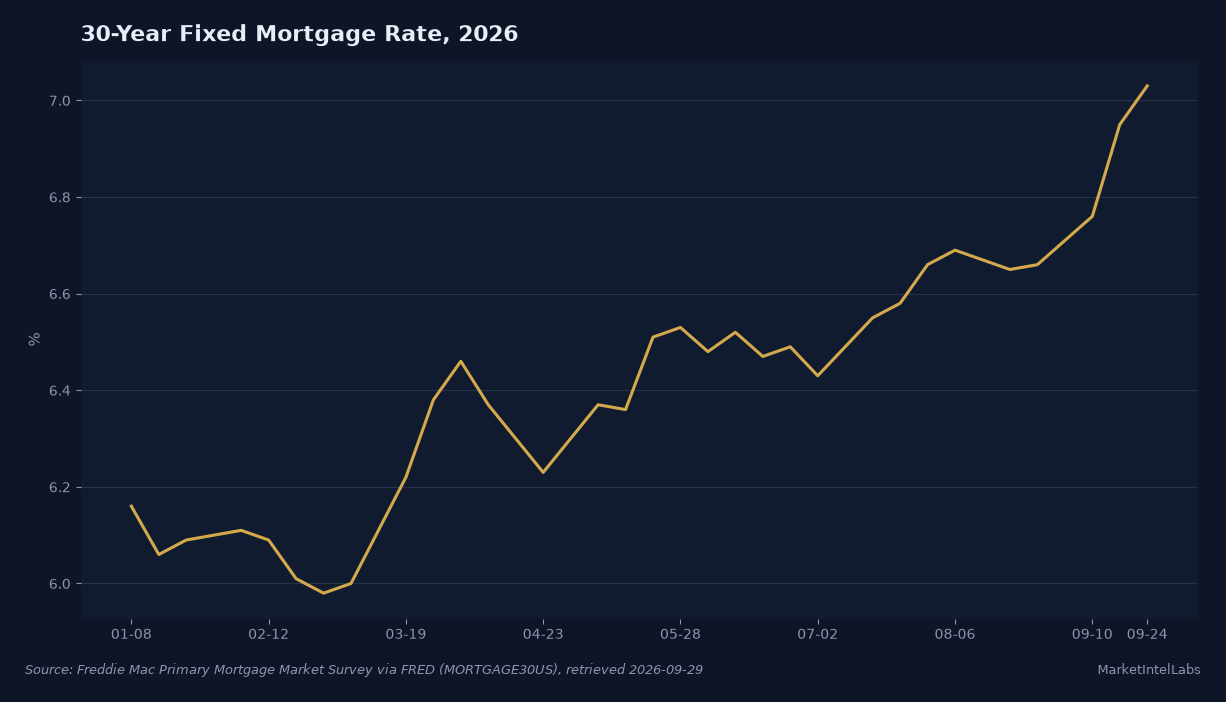
Mortgage rates finished last week at their highest level since the start of 2025. Freddie Mac's Primary Mortgage Market Survey put the 30-year fixed at 7.03% for the week ended September 24, up from 6.65% in late August and the first print above 7% since January 2025. The cheapest financing of the year, 5.98% in the week of February 26, lasted one season, and the payment on the same house is now $227 a month higher because of it.
That retrace would normally settle the question of where home prices go next. This month it does not, because the two releases that define the housing market are pulling in opposite directions. On August 25, S&P Dow Jones Indices reported that the Case-Shiller national index gained 1.5% in the year through June, its fastest annual pace since early 2026 and up from 1.2% in May. Two days earlier, Realtor.com's count of active listings had pushed through 1.1 million, a level last seen in the spring of 2025, and it kept climbing through August. Prices are accelerating and supply is building at the same time. One of those trends has to give.
Start with the price side, because it is the side people assume is frozen. The S&P Cotality Case-Shiller U.S. National Home Price Index reached 336.66 in June 2026, a nominal record, and its annual gain has now picked up for two consecutive months. The 20-city composite did better still, up 2.1% on the year in June against 1.6% in May, according to the same September 25 release from S&P Dow Jones Indices. Neither figure survives contact with inflation: CPI ran 3.5% over the same twelve months, so the national index fell in real terms for the thirteenth consecutive month. Since the real peak in May 2022, home values have lost about 3.7% of their purchasing power. Nominal records are what you get when inflation runs ahead of everything.
The regional spread inside the June report is where the supply story shows up early. Chicago led the 20-city composite with a 6.9% annual gain and New York followed at 4.8%, per the Case-Shiller metro data carried by FRED. Seattle fell 1.9%, Tampa 1.2%, Denver 1.2% and Phoenix 0.8%. The metros gaining fastest are the ones where supply never rebuilt after the pandemic; the metros losing are the ones where builders and listers have been adding inventory for two years. That is not a coincidence, and it is the mechanism to watch as national supply keeps expanding.
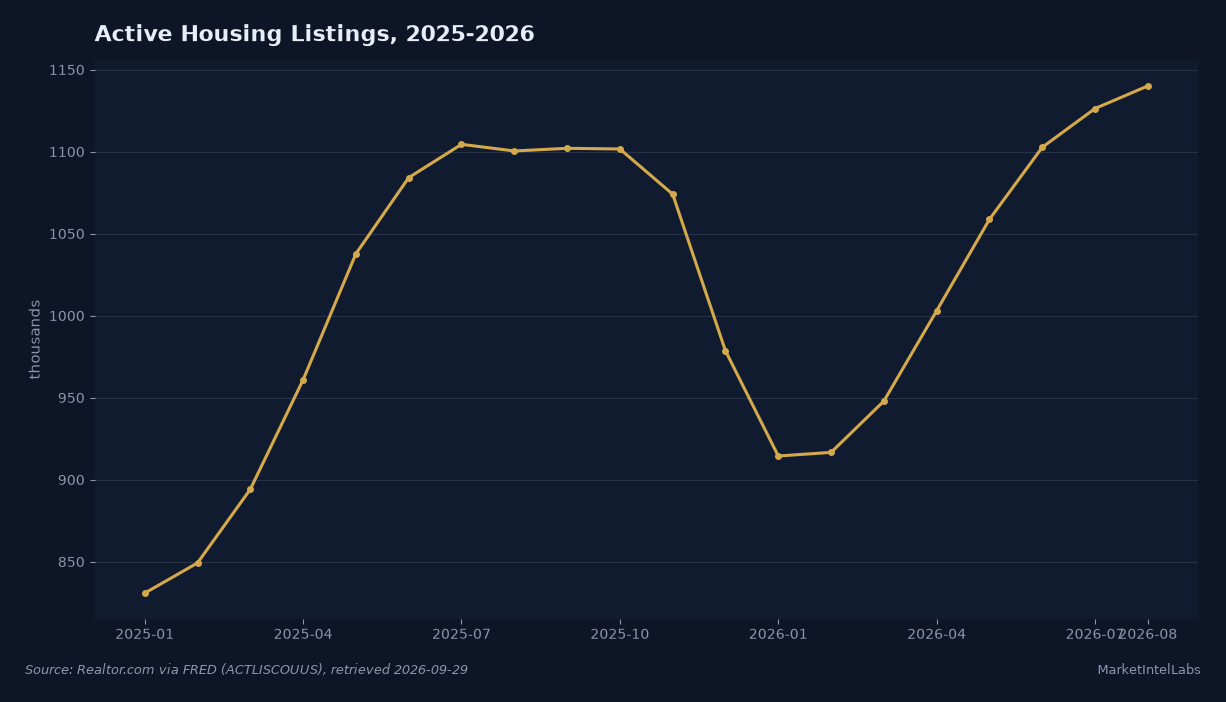
Now the supply side. Realtor.com's active listings count stood at 1,140,035 in August, up 3.6% from 1,100,371 a year earlier, according to FRED's series built from Realtor.com data. The count has now held above 1 million for five straight months, from April through August, after spending most of the winter near 915,000. Median list price per square foot slipped to $224 in August from $228 in June, a sign that the marginal seller is pricing to move rather than testing the ceiling. Months of supply on the new-home side measured 8.5 in August per Census Bureau data, far above the 6 months that signals balance, which is why builders have been discounting while existing sellers, protected by their locked-in mortgages, largely have not.
The question the fall market has to answer is what happens when 7% financing meets this much inventory. The payment math is not kind. At 7.03%, the principal and interest on a $410,700 median-priced home with 20% down runs $2,193 a month, against $2,034 a year ago when the rate was 6.30%, per Freddie Mac and FHFA median-sale-price data (MSPUS) carried by FRED. That is a $159 monthly increase for the same house. Buyers who waited through the spring for cheaper financing are watching the opposite happen, and each weekly increase since August has trimmed the pool of households who clear a standard payment-to-income test.
History says supply wins eventually, but the timing is the whole game. Owners holding mortgages well below 7% can hold out for years, and Freddie Mac's rate-lock-in research has documented how that effect throttles listings; the ones listing now are being pushed by job moves, divorces and estates. As the forced and discretionary sellers accumulate in that 1.14 million count, the share pricing to move grows, and the Case-Shiller metros that look like Seattle today multiply. The counterargument is that rate lock-in throttles listings before prices ever crack nationally. That worked in 2023 and 2024. It is being tested now: inventory has grown through a rate environment nearly as hostile, which means the people listing are not doing it by choice.
Two dates bracket the answer. The Case-Shiller July report lands this morning, Tuesday, September 29, at 9:00 a.m. Eastern, and consensus tracked by Calculated Risk looks for about a 1.7% national annual gain, which would be a third straight month of acceleration. The next Freddie Mac survey lands October 1. If July prices accelerate again while 7% rates hold, the gap between what sellers ask and what buyers can pay gets wide enough that the listed inventory itself becomes the news: look for the price-cut share of listings, not the headline index, to be the number that tells you which side is blinking first.
This content is for informational purposes only and does not constitute financial advice. Past performance is not indicative of future results. Consult a qualified financial advisor before making investment decisions.
Get daily intelligence delivered
Create a free account for the Daily Brief every weekday and The Week Ahead every Sunday. No card required.