Stocks Bounce After a Four-Day Slide, but a Binary Fed Looms

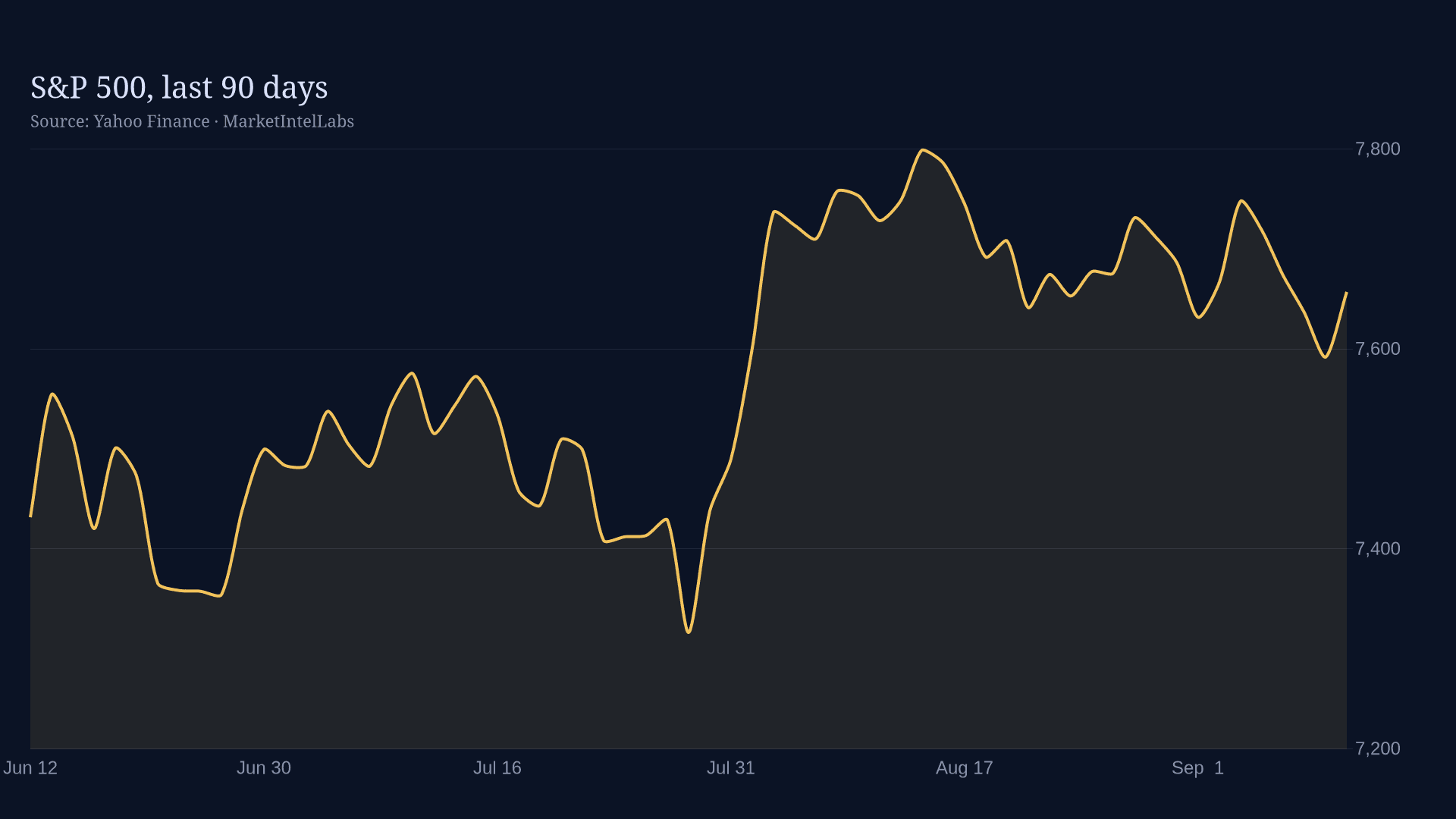
The S&P 500 added 0.86% to close Friday at 7,656.98, snapping a four-session slide on an in-line inflation print and a fresh AI capital-spending commitment from Oracle. The advance had real breadth, nine of eleven sectors higher and the equal-weight fund tracking essentially with the cap-weighted index, which is why this reads as a legitimate bounce rather than another megacap mirage.
The trigger for the turnaround was straightforward: an August CPI reading that matched consensus. Headline inflation ran 3.4% year over year, in line with forecasts, and that was enough to unwind a large part of Thursday's fear spike, with the VIX tumbling 11.2% to 15.84. The undercurrent deserves attention all the same. Core prices rose 0.3% after 0.2% in July, and University of Michigan one-year inflation expectations jumped to 4.6% from 4.0%. The friendly top-line number is real, but the hotter components beneath it are exactly the ones a hawkish committee would cite.
A bounce with real breadth
Oracle told investors to expect between $90 billion and $95 billion of capital spending in fiscal 2027, confirmation that the AI infrastructure buildout still has room to run. Dell and Hewlett Packard Enterprise, both named suppliers of AI racks, each climbed roughly 12%, and technology led the session with the XLK fund up 1.32%. That leadership is a double-edged sword. The AI hardware complex is the one area where top-line growth remains visible enough to justify premium multiples, which makes those multiples the first thing a hawkish surprise would hit.
The internals are what convince me this was not a fragile pop. The equal-weight S&P 500 fund rose 0.80%, essentially matching the cap-weighted index, so the tape was not carried by two or three mega names. Industrials gained around 1.1% and consumer discretionary roughly 0.9%, while defensive utilities and healthcare drifted lower. Cyclicals outperforming defensives alongside a falling VIX is a classic risk-on rotation pattern, and it suggests the bounce carried genuine conviction even if the setup around it is fragile. Our latest read on sector rotation tracks how durable that conviction looks.
The Fed is the whole ballgame
None of that settles the question that actually matters. The FOMC decision lands on Wednesday, September 16, after a two-day meeting, and market pricing is genuinely split, and our week-ahead preview of the FOMC decision lays out the event calendar. OIS markets implied roughly a 51% hold versus 49% hike in early September, and fed funds futures have at times priced better than 60% odds of a quarter-point increase since Chair Warsh's Jackson Hole remark that inflation has not meaningfully improved. The July meeting left rates at 3.50%-3.75% with three dissenting votes, and that dissent count keeps a hike on the table. What the September FOMC has priced in is the framework worth carrying into the vote.
Friday's bounce is best read as a relief rally into a binary event, not the start of a new trend. The market has swung violently twice in a week, four down days followed by one relief day, and the rally is priced for the friendliest outcome. The jump in inflation expectations is precisely the kind of persistent-anchoring signal a hawkish Fed would use to justify a move, which argues against treating any single-scenario read as a base case. If the committee holds and signals data dependence, the 2-year yield should stay range-bound and equities can defend this bounce. A hike would push the dollar and yields higher and set up a retest of the 757-760 zone.
One useful context for the week: the S&P spent most of the last stretch unwinding August's melt-up rather than absorbing a fresh shock. SPY slipped from a high near 777.88 in mid-August to a September 10 low of 757.83, and the one-month total return on the index is now slightly negative. That sequence matters, because it means the four-day slide was mostly a de-risking of an overbought tape, not the beginning of a shift in the earnings story. Friday's bounce fits that narrative: a correction that had gone far enough to attract buyers back in ahead of a catalyst, rather than a fundamental repricing.
For positioning into the event, the levels are the useful frame. SPY resistance sits at 766.38, Friday's high, with support at 757.83, the September 10 low. A break of that support would argue the four-day decline is resuming rather than finished. On Wednesday, watch breadth more than the headline move, because in a coin-flip setup the internals tell you whether the market trusts the Fed's message. A broad advance on a hold confirms the relief has legs; a narrow bounce, or an immediate fade, says the market was braced for the friendlier of the two outcomes.
This content is for informational purposes only and does not constitute financial advice. Past performance is not indicative of future results. Consult a qualified financial advisor before making investment decisions.
Get daily intelligence delivered
Create a free account for the Daily Brief every weekday and The Week Ahead every Sunday. No card required.