Builders Started 918,000 Single-Family Homes as Permits Pile Up Unbuilt

The National Association of Home Builders has been measuring builder confidence since 1985, and in September 2026 it hit 32, tying the second-lowest reading on record outside the pandemic spring of 2020. Yesterday the Census Bureau explained why that number looks the way it does. Builders started work on single-family homes at a 918,000 annualized pace in August, and permitted but not yet started single-family units now stand near 100,000, a backlog that has grown even as builders break less ground. The housing slowdown is not being driven by a shortage of homes to build. It is being driven by builders refusing to add supply into a market where the monthly payment has never been higher.
Start the supply math with the flow, not the stock. Housing starts overall came in at 1,275,000 annualized in August, down 7.7 percent from a year earlier, while building permits of 1,394,000 fell just 2.1 percent year over year, per the Census Bureau's New Residential Construction release published September 22, 2026. That gap between permits and starts is the tell. A permit is a piece of paper; a start is a decision to spend money. Builders are holding the paper and hesitating on the decision, and the single-family line is where the hesitation lives: 918,000 annualized, down 30.3 percent from last August's pace.
The divergence across housing types is sharp. Structures of five units or more, the apartment buildings, started at 331,000 annualized, roughly flat with last year, because rental demand has not cracked the way for-sale demand has. The single-family machine, meanwhile, has contracted in eight of the past twelve months. Compare the months of supply data and you can see both sides of the squeeze: the National Association of Realtors reported 9.6 months of supply for existing homes in July, the highest since 2016, and existing inventory has climbed for months even as builders throttle back.
Why would builders pull back into weak supply? Because their product competes directly with that inventory, and the price of their product has stopped working for buyers. the Freddie Mac 30-year fixed averaged 6.95 percent in the week of September 17, the highest weekly print of 2026 and up from 6.26 percent a year earlier. Put that rate against a median existing-home price of $410,700, per the National Association of Realtors' July report, and the payment on a 20 percent down 30-year loan is about $2,175 a month, roughly $150 more than the same house cost to finance a year ago. That is the affordability wall builders are pricing homes into.
Their response shows up in the confidence survey. The the NAHB/Wells Fargo Housing Market Index printed 32 in September, down from 33 in August and down from 41 a year ago, per NAHB's September 17 release. Any reading below 50 means more builders rate conditions poor than good. The composition matters more than the headline: NAHB reports that roughly two thirds of builders are using price incentives, and that price cuts alone averaged 5 percent this month. Lennar's fiscal third quarter, reported September 22, showed the same thing from the inside, with incentives running about 12 percent of sales price. When the largest builder in the country is discounting a tenth of the sticker, the new-home market's posted prices are negotiation anchors, not transaction prices.
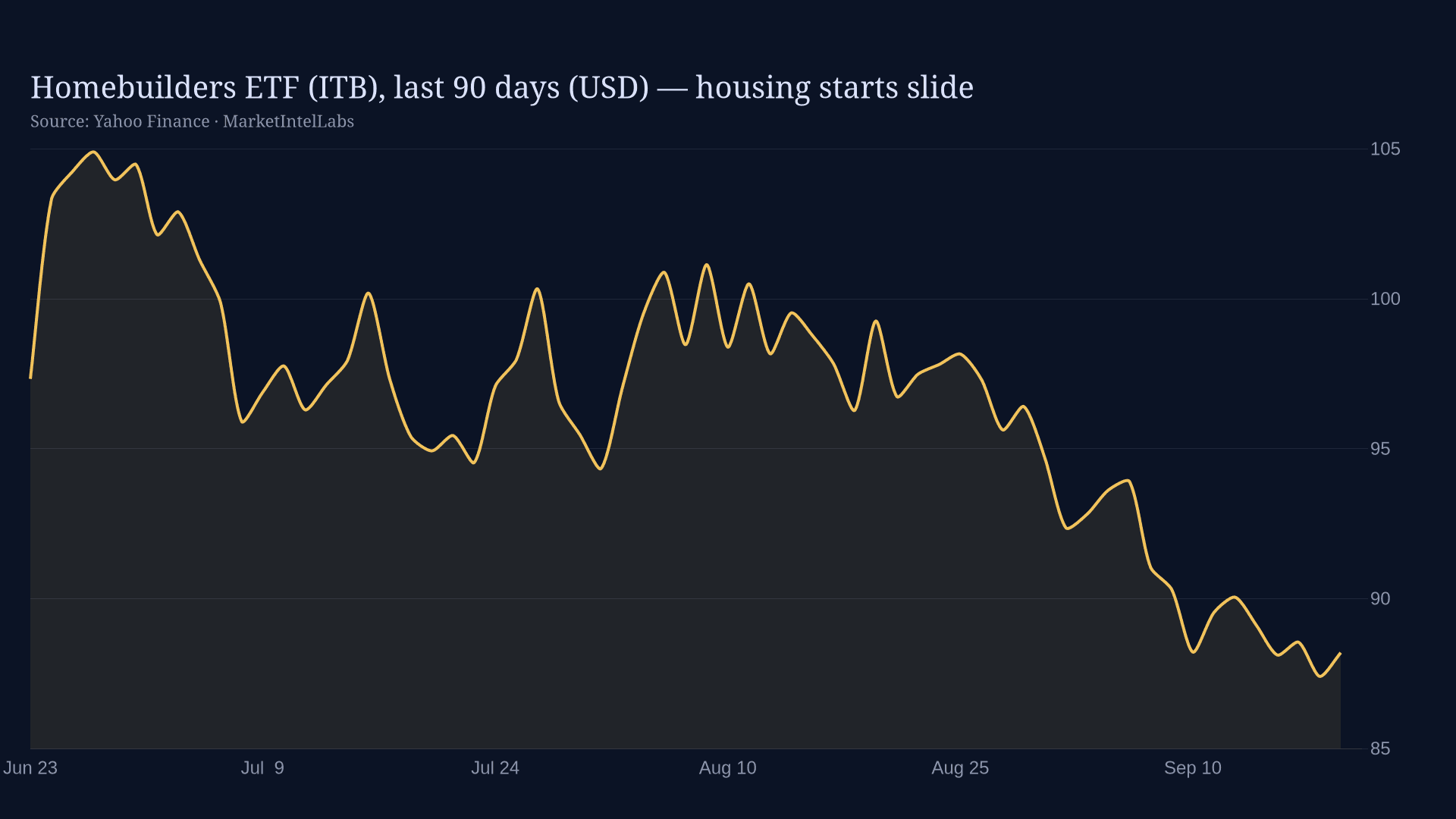
The read on margins follows directly. Builders who cut prices 5 to 12 percent while input costs hold steady are trading margin for velocity, and the equity market has already priced some of that: the iShares Home Construction ETF (ITB) is down roughly 14 percent over the past three months, per Yahoo Finance data as of September 22. D.R. Horton, Lennar and PulteGroup have all guided toward slower deliveries into fiscal 2027. The public builders can absorb a margin squeeze; the private builders who make up nearly half of single-family starts cannot, which is where the starts data gets its second leg down from.
So the paradox resolves cleanly. Inventory is the highest in a decade and rising, yet starts are falling faster than permits, because the marginal homebuilder does not believe the buyer is there at a price that clears a profit. That is not a supply shortage story and it is not a demand boom story. It is a standoff, and the standoff's terms are set by the mortgage rate. If the 30-year fixed holds near 7 percent, expect the single-family starts line to grind lower through the fourth quarter while the permit backlog grows, because a permit costs a builder little and a start costs everything.
The calendar gives us the next data points inside eight weeks. New-home sales for August land October 23 per the Census Bureau schedule, and they will test whether the discounting is actually clearing inventory or just moving it between builders' books. The Case-Shiller national index for August arrives September 30 and should confirm the flat-to-down price trend: the June reading of 336.7 was up just 2.4 percent year over year, well below consumer inflation. Existing-home sales for September come October 22 from the National Association of Realtors, and the months-of-supply number there is the one to watch. If it prints above 10, the standoff tilts toward sellers blinking, and the price-cut share of listings, already above 40 percent per HousingWire's tracker for the week ended September 18, will keep climbing.
For buyers, the practical meaning is that the market has shifted from a supply problem to a financing problem, and financing problems respond to the bond market, not to builders. For the broader economy, residential fixed investment is now a measured drag, and the starts decline is the leading indicator of that drag arriving in construction employment over the next two quarters. The data does not support the occasional headline that builders are "waiting out" the rates into a spring rebound. At 32 on the sentiment index, they are not waiting. They are finishing what they started and starting very little.
This content is for informational purposes only and does not constitute financial advice. Past performance is not indicative of future results. Consult a qualified financial advisor before making investment decisions.
Get daily intelligence delivered
Create a free account for the Daily Brief every weekday and The Week Ahead every Sunday. No card required.