Nano Banc Failure: California Seizes Irvine Bank in the Largest U.S. Bank Collapse of 2026

Nano Banc of Irvine, California, failed on Friday, September 25, and its collapse is the largest U.S. bank failure of 2026. The California Department of Financial Protection and Innovation (DFPI) seized the bank and appointed the Federal Deposit Insurance Corporation receiver, making it the sixth U.S. bank to fail this year and the biggest of the six. The FDIC preliminarily estimates the cost to the Deposit Insurance Fund at $114 million.
Why California moved
The seizure was the end of a capital battle that stretched for months. In March 2026 the bank reported a net loss of roughly $75.3 million, and the DFPI responded with an order directing Nano Banc to reach and hold tangible shareholders' equity of 9.5% or to liquidate, sell, or merge. The order carried a hard consequence: if the bank could not meet the standard, it would slip below the 3% statutory minimum that keeps an institution legally solvent.
Related reading: 197,000 Claims Meet a 51K Payroll Pace.
The bank did not satisfy the order. Equity fell below the 3% floor, and the DFPI concluded the institution was operating in an unsafe and unsound manner. The regulator's release framed the failure as the product of years-long struggles rather than a sudden shock, pointing to a 2022 Federal Reserve enforcement action over governance, compliance, and insider-transaction risk that was terminated in April 2025. The trajectory is the familiar one of a small bank whose capital cushion eroded while its regulators worked through corrective steps, up to and including the terminal one.
What depositors got
Depositors recovered everything. Sunwest Bank of Sandy, Utah, assumed substantially all of Nano Banc's deposits, including balances above the $250,000 insurance limit, and agreed to buy about $476 million of the failed bank's assets. The FDIC retained the rest and will sell it down over time, which is where the estimated $114 million loss to the insurance fund comes from. The single branch reopened as a Sunwest office on Monday, September 28.
Related reading: Record Nasdaq hides thin breadth and a 5.28% yield ceiling.
The outcome is worth contrasting with an earlier case this year. When Community Bank and Trust of West Georgia failed on May 1, the FDIC arranged a purchase and assumption in which Anchor Bank took only the insured deposits, leaving thousands of uninsured dollars outside the transfer. For Nano Banc, the agency chose a whole-bank deal that covered uninsured balances as well. Both structures are legal under the FDIC's resolution toolkit; the choice turns on which bidder offers the least cost to the fund and the best outcome for the local community.
Shareholders, by contrast, get nothing. Nano Financial Holdings, Incorporated, the parent company, is not part of the receivership, and the FDIC notes that equity holders have no claim on the receiver. That is the ordinary order of things in a resolved bank: depositors stand first, equity stands last.
Related reading: Fed's First Hike Since 2023 Puts the 10-Year at 5.11%.
What the run of six says
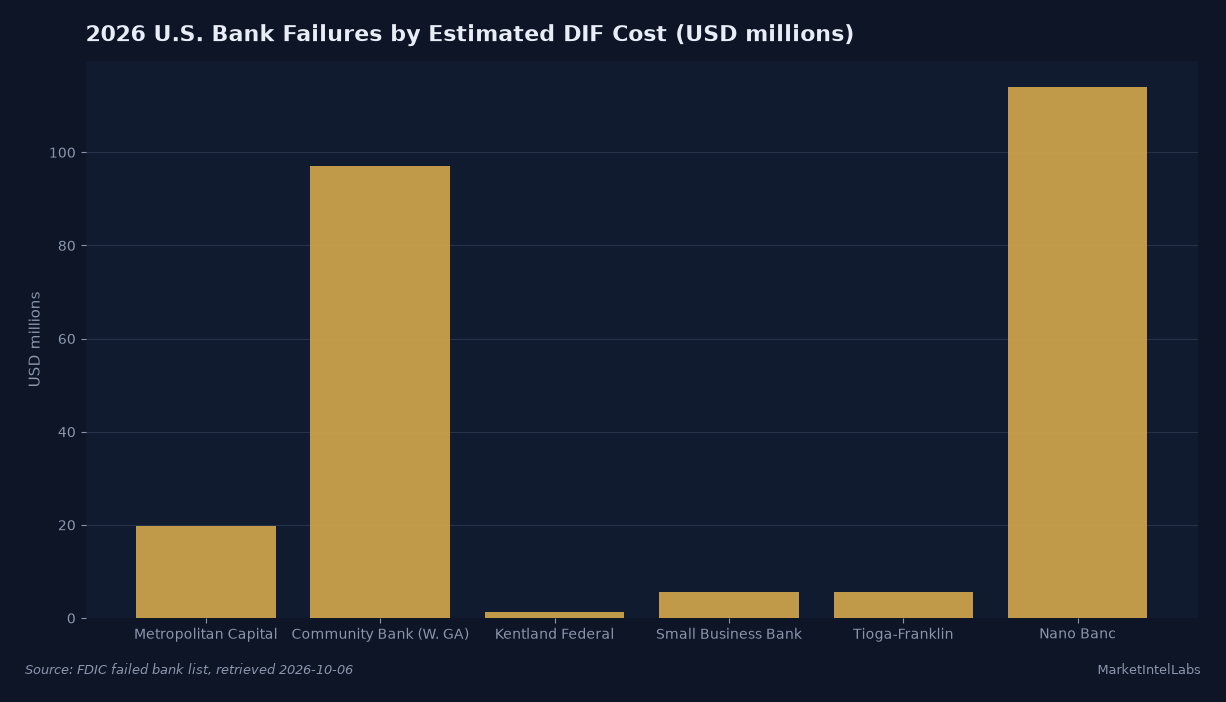
Nano Banc is emblematic of the 2026 pattern in scale, not in size. All six failures this year have been small institutions. Every one held less than $750 million in assets, and the failed-bank list shows aggregate estimated costs of about $243 million to the Deposit Insurance Fund, of which Nano Banc alone accounts for $114 million.
| Date | Bank | City, State | Assets | Acquirer | Est. DIF cost |
|---|---|---|---|---|---|
| Jan 30 | Metropolitan Capital Bank & Trust | Chicago, IL | $261.1M | First Independence Bank | $19.7M |
| May 1 | Community Bank and Trust - West Georgia | LaGrange, GA | $288M | Anchor Bank | $97M |
| Jul 10 | Kentland Federal Savings and Loan Association | Kentland, IN | $3.73M | Kentland Bank | $1.2M |
| Jul 17 | Small Business Bank | Lenexa, KS | $73M | The Farmers State Bank of Oakley | $5.7M |
| Aug 21 | Tioga-Franklin Savings Bank | Philadelphia, PA | $68M | Second Federal Savings and Loan | $5.5M |
| Sep 25 | Nano Banc | Irvine, CA | $736M | Sunwest Bank | $114M |
That mix looks different from 2023, when the failures of Silicon Valley Bank, Signature Bank, and First Republic tested the system's plumbing and the FDIC's fund at 10-figure costs. The 2026 cohort is a reminder that most closures in a normal year are community institutions whose problems are specific and local, rather than a signal of broad balance-sheet stress across the industry. The distinction matters because a handful of small failures, confined to weak capital positions and concentrated business models, does not by itself predict a systemic episode.
Related reading: BOJ Hikes to 1.25%: Dollar-Yen Carry Trade Narrowing Rate Gap.
The caveat is that the numbers are small enough that interpretation is limited. Six failures with roughly $1.4 billion in combined assets against a banking system measured in trillions is a modest count by historical standards, and the FDIC's own quarterly problem-bank list remains the better gauge of how broadly stress is spreading.
What to watch next.
Four data points will determine whether this is noise or something more. The FDIC's quarterly problem-bank list, next published with the agency's third-quarter results, shows how many institutions are privately classified as troubled and how their assets trend. The Deposit Insurance Fund's reserve ratio tracks whether the fund is being rebuilt after payouts like this one. The pace of Fed enforcement actions, and whether they are terminating on schedule the way Nano Banc's 2022 order did, signals whether regulators see citations as corrective or as preludes to closure.
The narrow lesson from Nano Banc is one of supervision: a capital order that is not met is a leading indicator, and this time regulators acted on it before the position worsened further. Depositors at the bank's single branch were made whole through the whole-bank agreement, but the episode is a reminder that uninsured coverage in a failure is a matter of resolution design, not a guarantee. For everyone else, the signal to watch is the breadth of the problem-bank list, not the count of small closures alone.
Sources. FDIC, "Sunwest Bank Assumes All Deposits and Certain Assets of Nano Banc, Irvine" (press release). FDIC failed bank list, Nano Banc page. California DFPI, "California Seizes Nano Banc" (press release). FDIC failed bank list, 2026 roster.
This content is for informational purposes only and does not constitute financial advice. Past performance is not indicative of future results. Consult a qualified financial advisor before making investment decisions.
Get daily intelligence delivered
Create a free account for the Daily Brief every weekday and The Week Ahead every Sunday. No card required.