Breadth Broadens Into a Loaded Catalyst Week for Stocks

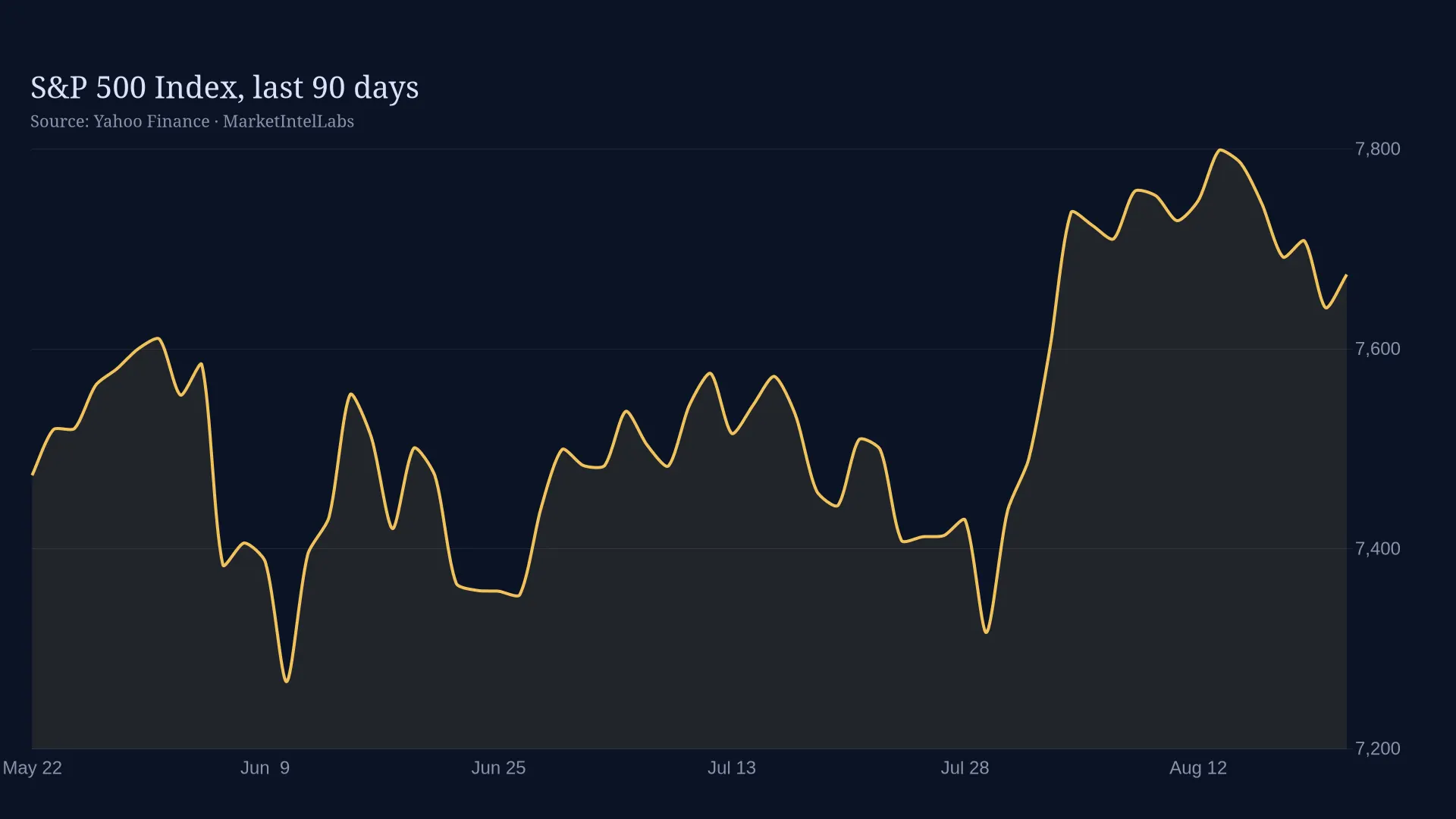
Breadth is broadening, not narrowing, and that is the real story heading into the most loaded catalyst week of the month. SPY closed at $765.72 (+0.41%) and QQQ at $713.44 (+0.35%), both near 52-week highs, but the more telling move came from DIA (+0.98%) and IWM (+0.77%), which outpaced the mega-cap benchmarks. When the Dow and small-caps keep pace with tech, it argues the rally has support beyond a handful of AI names.
Related reading: S&P 500 Sector Rotation and the AI Capex Supercycle, Copper Hits an All-Time High as Gold Tops $4,453 on Monday, Hormuz Ceasefire Lapses: Oil's Fourth Straight Rally.
Related reading: S&P 500 Sector Rotation and AI Capex, Copper Hits All-Time High as Gold Tops $4,453, Gold and Copper: Commodities Analysis.
Cheap volatility ahead of three simultaneous catalysts is the setup worth watching this week. The VIX closed at 15.13 on Thursday, down from an intraday high near 16.14 just three sessions earlier, putting implied volatility at the low end of its recent range. Wednesday brings the second GDP estimate and July durable goods, but the load-bearing release is core PCE, the Fed's preferred inflation gauge, arriving one week after hawkish FOMC minutes showed several officials open to further tightening if inflation does not converge toward target. Thursday brings NVIDIA's fiscal Q2 report after the close, still the single most index-moving earnings event of the quarter given the semiconductor sector's weight in QQQ and SPY. Friday closes the week with Fed Chair Kevin Warsh's Jackson Hole keynote, the highest-profile scheduled Fed communication outside an FOMC meeting.
A quick note on what "breadth" means here. True NYSE advance-decline data, new-highs versus new-lows counts, and the CBOE put/call ratio were not accessible through public feeds today, so this read leans on cap-tier ETF performance (SPY, QQQ, DIA, IWM) as a proxy. That proxy points the same direction as the index tape, but it is directional, not definitive, and it is worth closing that data gap before leaning too hard on the breadth thesis.
Sector rotation tells a more cautious story than the index level
Look past the index closes and the rotation pattern turns more defensive than the headline suggests. Healthcare (XLV) leads the past month at +9.53%, with Energy (XLE) close behind at +7.50% and Materials (XLB) at +5.35%. Technology (XLK), the sector that has carried this market for most of the year, is up just 1.69% over the same stretch, the sixth-best performer of the eleven sectors. Utilities (XLU) is the clear laggard, down 6.88%.
That Utilities weakness matters because utilities typically trade as a bond proxy, and the sector's slide is running alongside Treasury weakness. TLT, the long-duration Treasury ETF, sits at $82.05, closing in on its 52-week low of $81.17. Both moves point to the same mechanism: elevated long-end yields, with the 30-year hitting 5.34% intraday last week, are still pressuring duration-sensitive assets on both sides of the equity/fixed income line, even after a Treasury buyback response pulled yields back from their peak.
This is where the equity tape connects to the macro desk's liquidity work. The overnight reverse repo facility has effectively drained to $0.2 billion while the Treasury General Account has rebuilt by $124 billion over three weeks, a combination that pulls bank reserves lower with less cushion left to absorb further draws. Equities have not priced that fragility. Both SPY and QQQ trade comfortably above their 200-day averages. But the sector rotation, defensives and hard-asset plays leading while a rate-sensitive sector lags, suggests part of the market is hedging the liquidity story even as the headline indices grind to new highs. It is a setup with a real precedent: in mid-2019, similar reserve dynamics tightened even as indices made new highs, and the divergence did not resolve until a repo-market stress event forced Fed intervention. That is not a prediction of a repeat, but it is the pattern the data rhymes with, and it argues for watching repo rates and SOFR spreads alongside the equity tape rather than in place of it.
Gold and silver's moves today, GLD up 1.95% and SLV up 1.72%, fit a dollar-debasement read rather than a safe-haven bid, since equities rose in the same session instead of selling off in sympathy. If that framing holds, the market is simultaneously bidding risk assets and hard-asset hedges at once, a combination that works until one of this week's three catalysts breaks the narrative in either direction.
What the semiconductor complex says ahead of NVDA
The chip sector heading into Thursday's print is flat to mixed rather than positioned with conviction in either direction. NVDA is down 0.98% today at $214.72, AMD is up 0.81%, AVGO up 1.21%, TSM up 0.71%, and the broader SMH semiconductor ETF is down 0.40%. Zoom out to twelve months and the group still prices a live AI-capex thesis, with NVDA up 30.9%, AMD up 217.2%, and SMH up 98.9%. A market that has run that hard into an earnings print without a clear pre-positioning bias either direction is a market waiting for the number, not one that has already made up its mind.
The bull case rests on breadth broadening across cap tiers, a still-positive yield curve, and Materials and Energy strength suggesting this rally has more legs than a narrow AI-capex trade. A benign core PCE print, consensus sits near 0.2% month over month, paired with a strong NVDA beat would likely extend the move and could pull laggards like Tech and Utilities back toward the leaders. The bear case leans on a VIX sitting at multi-week lows heading into three concentrated catalysts, which is a textbook complacency setup, plus unresolved duration stress visible in Utilities and long Treasuries that equities have not yet priced. A hot PCE print, plausible given the hawkish FOMC minutes and a roughly 3.29% core PCE run rate, or a soft NVDA guide on capital spending could reprice both the rate path and the AI-capex story in the same week.
Watch three things between now and Friday: whether Wednesday's core PCE comes in at or below the 0.2% consensus, whether NVDA's guidance addresses capex durability rather than just the quarter's beat, and whether Warsh's Jackson Hole remarks lean toward the "many officials" tightening bias from the FOMC minutes or toward patience. Any one of the three landing on the hawkish or disappointing side of expectations would test a VIX that is currently pricing very little drama at all.
This content is for informational purposes only and does not constitute financial advice. Past performance is not indicative of future results. Consult a qualified financial advisor before making investment decisions.
Get daily intelligence delivered
Create a free account for the Daily Brief every weekday and The Week Ahead every Sunday. No card required.