Hyperscaler Capex Surge Signals Second-Half Acceleration


Five of the largest cloud providers collectively spent over $210 billion on capital expenditures in the second quarter of 2026, a 23 percent increase from the first quarter, and every one of them raised full-year guidance. The filings show where the money is going and what the acceleration means for the second half of the year.
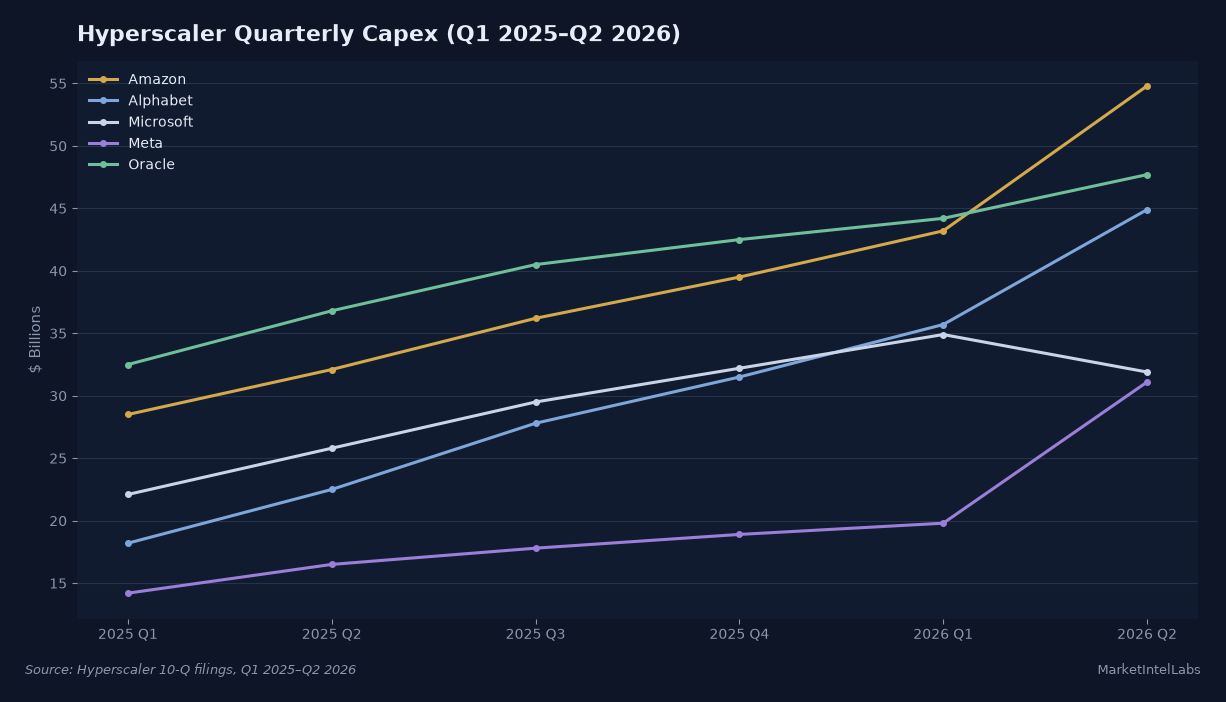
Amazon led the group with $54.8 billion in Q2 capex, up 27 percent from $43.2 billion in Q1 and 71 percent from $32.1 billion a year earlier. AWS accounted for $48.6 billion of that total, or 88 percent of Amazon corporate capex, a dramatic shift from the historical average of 44 percent. The company raised its full-year 2026 cash capex guidance to approximately $220 billion from $200 billion, citing higher memory costs. Even at that level, CEO Andy Jassy told analysts that capacity constraints will persist into 2027. The backlog sits at $496 billion with a weighted average remaining life of 6.4 years, suggesting the spending wave extends well beyond this cycle.
Alphabet reported $44.9 billion in Q2 capex, double the year-ago quarter and up from $35.7 billion in Q1. The company raised its full-year guidance to $195 to $205 billion from $180 to $190 billion. Finance chief Anat Ashkenazi said the vast majority of the spending went to technical infrastructure to support AI buildout. The gap between cloud growth and capex is widening. Google Cloud revenue grew 82 percent year-over-year to $24.8 billion in Q2, but capital intensity is accelerating faster as the company catches up to Microsoft and Amazon in data center capacity.
Microsoft reported $31.9 billion in Q3 fiscal capex, down from $34.9 billion in the prior quarter, but CFO Amy Hood attributed the decline to normal variability in equipment delivery and the timing of finance leases. The company maintained its guidance of $190 billion for calendar year 2026, including a $25 billion impact from higher component pricing. Roughly two-thirds of Microsoft capex goes to short-lived assets, primarily GPUs and CPUs, creating a depreciation drag that must be absorbed by AI revenue growth. Azure grew 39 percent at constant currency in Q3, with AI services contributing 22 percentage points of that growth.
Meta reported $31.1 billion in Q2 capex, up from $19.8 billion in Q1 and raised its full-year guidance range to $130 to $145 billion from $125 to $145 billion. The spending focuses on AI infrastructure for core business, including generative AI for its advertising and recommendation systems. Operating margins face pressure, but the company is betting that AI-driven monetization in Facebook and Instagram will offset the infrastructure costs.
Oracle reported $47.7 billion in net cash outlay for capital expenditures in Q4 fiscal 2026, up from $44.2 billion in Q3. The company's approach differs from peers. Remaining Performance Obligations ended the quarter at $638 billion, up 363 percent year-over-year, driven by large-scale AI contracts where customers either prepaid for GPUs or supplied the hardware themselves. That customer-supplied portion totals $75 billion, reducing the amount of capital Oracle must raise. Oracle expects to raise approximately $40 billion in debt and equity financing in fiscal 2027 to support continued buildout.
Quarter-over-quarter acceleration from approximately $178 billion in Q1 to over $210 billion in Q2 is the clearest signal yet that the hyperscalers are entering a sustained capex upcycle. Every company cited AI demand as the driver and every company indicated that supply constraints will persist through the second half of the year. The guidance totals now approach $900 billion across the five companies for 2026, up from previous consensus estimates in the $750 billion range.
This spending pattern suggests that hyperscalers are moving from opportunistic purchases to systematic capacity buildouts. The shift toward custom silicon at Amazon and Microsoft, the customer-funded model at Oracle, and the relentless spending at Alphabet all point to the same conclusion. Demand for AI compute is exceeding current supply, and the only way to close the gap is to build more data center capacity faster than the depreciation cycle on existing infrastructure.
Investors should watch three signals in the second half. First, whether Azure and AWS growth rates maintain current levels as capacity comes online. Second, whether AI revenue growth at each company accelerates enough to cover the increased depreciation burden. Third, whether any of the hyperscalers signal that they are approaching a plateau in capex or if the guidance creep continues into 2027. The filings so far suggest the latter. Each company described demand as broad-based and accelerating, not as a one-time upgrade cycle. The $900 billion annualized spending rate is becoming a structural reality of the AI era.
This content is for informational purposes only and does not constitute financial advice. Past performance is not indicative of future results. Consult a qualified financial advisor before making investment decisions.
Get daily intelligence delivered
Create a free account for the Daily Brief every weekday and The Week Ahead every Sunday. No card required.