macro

The AI Capex Super-Cycle Hits Its Power Wall

Published September 6, 202611 min read
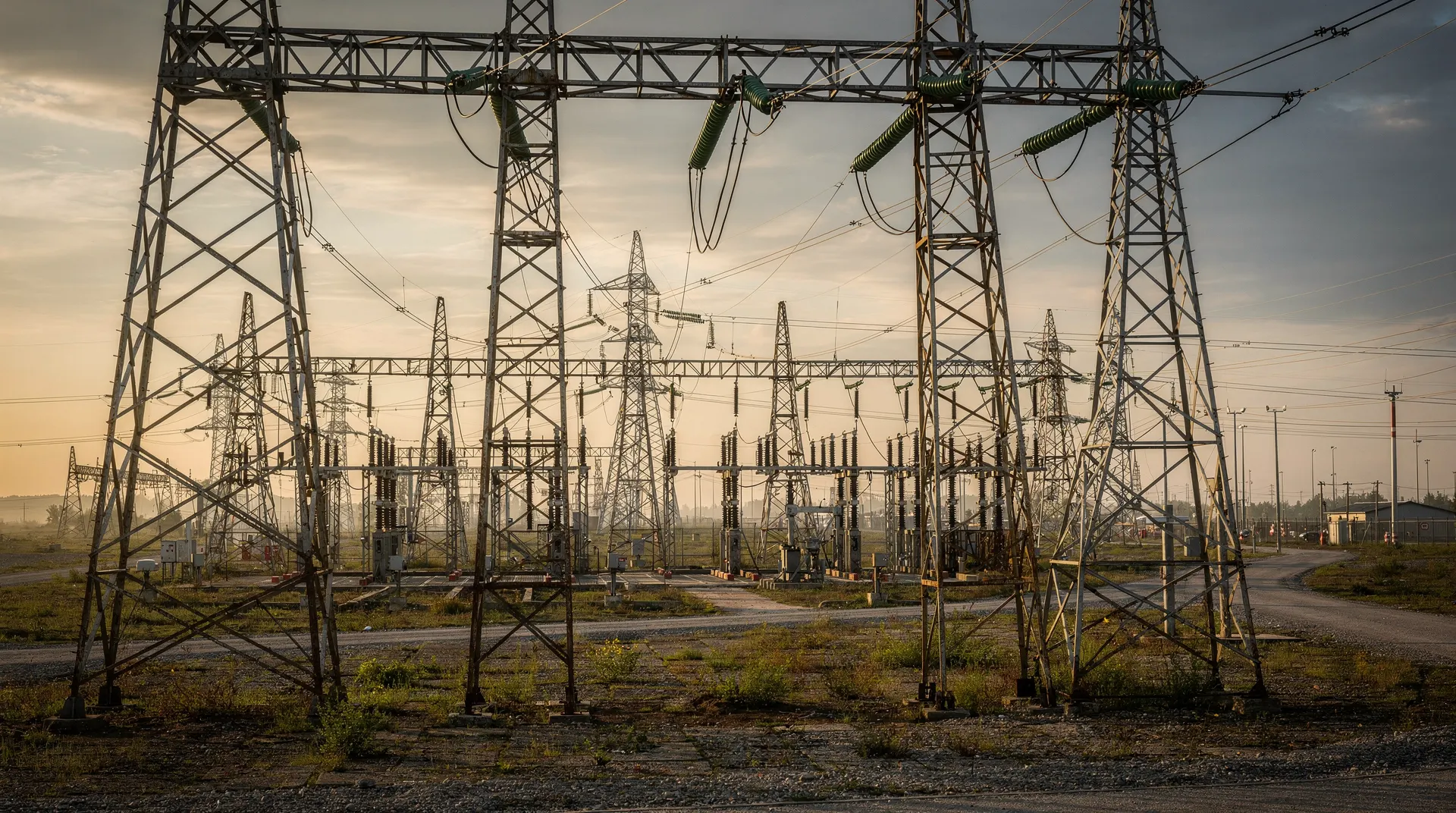
Electrical transmission towers across open industrial landscape
Power transmission infrastructure confronts expansion limits — Illustration: MarketIntelLabs

The numbers are staggering. Microsoft, Amazon, Google, and Meta are on track to spend over $200 billion on data centers this year alone, a run-rate that would have seemed unfathomable three years ago.

But this week, a different story emerged from the capex headlines. The AI buildout is running into a wall, and that wall is made of copper, concrete, and grid capacity.

The interconnection queue at the Federal Energy Regulatory Commission now exceeds 2,000 gigawatts of proposed generation projects, with average wait times stretching beyond three years.

Hyperscaler earnings calls this week featured a new refrain, not about GPU shortages but about power availability, permitting timelines, and the physical limits of where you can put a 100-megawatt compute cluster.

The financing architecture is shifting too. Investment-grade bonds backed by data center assets and GPU collateral facilities have surged to over $15 billion in issuance this quarter, as capital markets find new ways to fund infrastructure that the traditional power sector never contemplated.

What was a silicon supply problem is now a power grid problem, and that changes everything about how the AI super-cycle proceeds.

The Grid as the New GPU

The physics are uncompromising. A single large-scale AI training cluster requires anywhere from 50 to 100 megawatts of continuous power, equivalent to the electricity consumption of a mid-sized American city, per industry estimates and hyperscaler disclosures.

Ten such clusters and you need a gigawatt-scale substation, new transmission lines, and permitting approvals that run through multiple jurisdictions.

The FERC interconnection data tells the story. As of August 2026, the queue contains over 2,000 gigawatts of proposed generation and storage projects, but only about 200 gigawatts have actually reached commercial operation over the past five years.

The bottleneck is not generation capacity, it is the transmission and distribution infrastructure needed to move power from where it is produced to where these data centers need it.

Average interconnection wait times have stretched from 18 months in 2020 to over 36 months today, and that is before you account for the additional time required for environmental reviews, local zoning approvals, and construction of the physical infrastructure.

The hyperscalers are seeing this firsthand. In earnings calls this week, Microsoft management noted that while GPU availability has improved, power availability in desired locations has become the pacing factor for new data center deployments.

Amazon made similar comments, highlighting that data center capacity expansion is now gated by utility lead times rather than equipment supply.

Google's CFO went further, explicitly stating that the company is developing "micro-grid solutions" and exploring on-site generation options, including solar and battery storage, to reduce dependence on strained utility infrastructure.

This is a significant shift from two years ago, when the conversation was entirely about securing enough chips from NVIDIA, AMD, and Intel. The chips are flowing now. The electricity is not.

The water constraint is equally pressing. A 100-megawatt data center can consume upwards of 5 million gallons of water annually for cooling, per Lawrence Berkeley National Laboratory estimates, with the actual figure depending on the climate and cooling technology used.

In regions facing drought conditions or water rights restrictions, this has become a permitting issue independent of power availability. Some hyperscalers are exploring direct-to-chip cooling and alternative cooling fluids to reduce water consumption, but these technologies add cost and complexity to already expensive facilities.

The environmental review process adds another layer of delay. Large-scale data center projects typically trigger National Environmental Policy Act reviews, which can take months to years depending on the scope and location.

Projects in areas with endangered species habitats, wetlands, or other sensitive environmental features face additional scrutiny and mitigation requirements, all of which extend timelines and increase costs.

The regulatory fragmentation across states creates additional complexity. Each state has its own public utility commission, environmental agency, and permitting authority, with varying rules and timelines for power infrastructure.

A data center that straddles state lines may require approval from multiple regulatory bodies, each with its own process and timeline. This fragmentation makes it difficult for hyperscalers to plan and execute large-scale infrastructure projects efficiently.

Some states are moving to streamline the process. Texas, for instance, has implemented reforms to accelerate transmission project approvals and reduce interconnection queue times.

Other states remain mired in lengthy review processes, creating a patchwork of regulatory environments that advantages some regions over others.

The federal government could play a role in harmonizing these processes, but progress has been slow. The Department of Energy has identified grid modernization as a priority, but concrete actions to address the interconnection backlog have yet to materialize at scale.

The Financing Pivot

Capital markets are adapting. The traditional model of data center financing, through data center REITs like Equinix and Digital Realty, is being supplemented by new structures that reflect the unique economics of AI infrastructure.

Investment-grade bonds backed by data center cash flows have proliferated, with issuers including hyperscaler-affiliated SPVs and specialized infrastructure funds.

More innovative is the emergence of GPU-backed financing facilities, where lenders take a security interest in the hardware itself. These facilities allow companies to monetize their GPU inventories without selling them, providing liquidity while retaining operational control.

According to data from Debtwire and LCD, AI-linked debt issuance exceeded $15 billion in Q3 2026, with average yields tightening to just 150 basis points over Treasuries for top-tier issuers.

The market is treating AI infrastructure as a new asset class, somewhere between traditional real estate and equipment leasing, with a risk profile that investors find attractive given the underlying revenue visibility.

The equity side is seeing its own evolution. Data center REITs have outperformed the broader REIT index by over 20% year-to-date, with premium valuations reflecting their role as the purest play on AI infrastructure.

But even here, the power constraint is beginning to affect the narrative. Analysts have started downgrading some operators that lack access to power-constrained markets or that are overly concentrated in regions where utility capacity is maxed out.

Northern Virginia, still the largest data center market in the world, has effectively no available power capacity for new large-scale projects until at least 2027, according to Dominion Energy's published transmission plans.

That is pushing development into secondary markets like Phoenix, Atlanta, and the Midwest, where power is available but where the hyperscalers have less existing infrastructure and face higher latency to major population centers.

The geography of AI is being rewritten by the geography of the grid.

Private capital is also flowing into the space. Infrastructure funds, real estate investment trusts, and direct investment vehicles are raising dedicated capital pools targeting AI-related data center and power infrastructure.

Blackstone, Brookfield, and other major alternative asset managers have announced or are considering multi-billion dollar funds specifically focused on digital infrastructure, with power availability as a core investment thesis.

These funds are taking positions not just in the data centers themselves, but in the upstream power infrastructure, including transmission lines, substations, and renewable energy projects that can serve AI loads.

The strategy reflects a recognition that controlling the power supply is as important as controlling the compute capacity in the long run.

Project finance structures are evolving too. Rather than traditional balance sheet financing, we are seeing more long-term power purchase agreements between data center operators and renewable energy developers.

These PPAs provide certainty to both parties. The data center secures a supply of renewable energy at a known price, while the energy developer gets a credit-worthy off-taker that can finance project construction.

The trend toward renewable energy for data centers is driven not just by sustainability concerns but by economic and reliability considerations.

Solar and wind projects can be sited closer to data centers than traditional thermal generation, reducing transmission costs and improving reliability.

Battery storage adds flexibility, allowing data centers to manage peak demand and reduce exposure to grid volatility or outages.

What Comes Next

The implications depend on your time horizon. In the near term, expect hyperscaler capex to continue growing, but with a changing mix.

More spending will flow into power infrastructure, on-site generation, and grid upgrades.

Companies that can secure power access will have a competitive advantage, and that advantage may be reflected in their AI service economics.

The secondary data center markets will see accelerated development, potentially creating regional disparities in AI infrastructure availability.

Utilities will face new investment demands, and the regulatory framework governing interconnection and transmission will come under pressure to accelerate.

The AI super-cycle is not ending, but it is changing. The constraint that determines the pace of deployment is no longer silicon, it is electrons.

That is a different kind of problem, with different solutions and different beneficiaries.

For investors, the question is how to position for this shift. Pure-play AI infrastructure exposure is no longer just about data center REITs and semiconductor equipment companies.

It increasingly involves utilities, transmission developers, renewable energy providers, and the regulatory frameworks that govern them.

The companies that can secure power rights, build the infrastructure needed to deliver electrons to compute clusters will be the ones that determine the pace of the AI rollout.

This is not a short-term issue. Transmission lines take years to build, and regulatory reform moves slowly.

The power constraint will shape AI infrastructure development for the remainder of the decade, and likely beyond.

The pace of AI innovation will continue, but the deployment bottleneck means that the economic benefits may accrue more slowly than the optimists project.

This creates a different kind of investment opportunity. The buildout will take longer, but the infrastructure being built will have durable value and generate returns over extended periods.

Investors should look for companies with existing power capacity, access to transmission, or the ability to influence regulatory outcomes in their favor.

The winners in this phase of the AI cycle will be those who solve the power problem, not those who design the chips or write the algorithms.

Deals & IPO Desk

AI infrastructure financing dominated the debt capital markets this week, with several notable offerings.

A hyperscaler-affiliated SPV priced $2.5 billion of 10-year notes at 145 basis points over Treasuries, the tightest spread ever for an AI infrastructure issuer.

The notes are backed by cash flows from a portfolio of data centers in the Midwest and are rated A-minus by Moody's and S&P.

Separately, a specialized infrastructure fund announced a $1.8 billion secured facility collateralized by a pool of NVIDIA H100 and forthcoming Blackwell GPUs.

The facility, arranged by a consortium of banks, allows the borrower to access liquidity without selling the hardware, reflecting the market's appetite for GPU-secured lending.

On the equity side, a data center REIT focused on power-constrained markets filed for a $500 million IPO, seeking to capitalize on the scarcity premium attached to facilities with existing power capacity.

No traditional tech IPOs priced this week, as the market continues to favor infrastructure over pure-play software or consumer internet companies.

The deal pipeline remains focused on AI-enabling infrastructure, with several additional data center and power transmission deals expected to come to market in the coming weeks.

M&A activity picked up slightly, with a utility operator acquiring a regional transmission developer for $1.2 billion to expand its footprint in data center-heavy markets.

AI & Technology

Beyond the infrastructure bottleneck, AI product development continued at a rapid pace.

OpenAI announced GPT-5-alpha, a model optimized for enterprise applications with enhanced multimodal capabilities and reduced hallucination rates.

The announcement sent shares of OpenAI's backer Microsoft up 2.3% on the day, as investors anticipate the model driving increased Azure consumption.

Google released Gemini Ultra 2.0, featuring improved reasoning capabilities and integration with Google Workspace.

The release positions Google more directly against Microsoft's Copilot offering, and analysts expect increased competition for enterprise AI contracts.

Meta introduced an open-source version of its Llama model, expanding access for researchers and developers while maintaining a commercial tier for enterprise customers.

The move underscores Meta's strategy of commoditizing AI models to drive adoption of its social and advertising platforms.

NVIDIA reported strong quarterly results, with data center revenue up 45% year-over-year and gross margins expanding to 72% in the most recent quarter.

However, the company's guidance for the coming quarter was more muted, reflecting expected moderation in GPU demand as some customers digest prior purchases.

The market reaction was mixed, with NVIDIA shares initially declining before recovering as investors focused on the company's long-term positioning in AI infrastructure.

Several AI-focused startups announced significant funding rounds, with computer vision and natural language processing companies leading the pack.

The deals suggest that while infrastructure spending is hitting constraints, application-layer development continues to attract capital.

Jobs & Sectors

The labor market showed continued resilience this week, with unemployment holding steady at 4.1%.

Job openings in the power utility sector reached a five-year high, reflecting increased hiring for transmission construction, grid modernization, and renewable energy integration.

According to data from the Bureau of Labor Statistics, employment in electric power generation, transmission, and distribution grew 3.2% year-over-year, outpacing the overall economy.

Construction employment in data center-heavy metros, including Northern Virginia, Phoenix, and Atlanta, showed strong gains, with permit data indicating accelerated construction starts for new facilities.

However, hiring in the broader tech sector remained subdued, with several large tech companies announcing modest headcount reductions in non-AI functions.

The divergence reflects a broader trend, with capital and talent flowing toward AI infrastructure and away from other areas of technology.

The data suggests that the AI boom is creating jobs, but not necessarily in the places or occupations that benefited from previous tech cycles.

Skilled tradespeople, including electricians, linemen, and HVAC technicians, are in high demand as data center construction accelerates.

Wage growth in these occupations has outpaced the national average, reflecting labor shortages and the specialized nature of the work.

Meanwhile, software engineering hiring remains focused on AI specialization, with traditional web and mobile development roles seeing slower growth.

The sector rotation extends beyond technology. Manufacturing employment in electrical equipment and machinery is picking up, driven by demand for transformers, switchgear, and other grid infrastructure.

This reallocation of labor and capital will have long-term implications for regional economies and educational institutions that must adapt their training programs to match changing demand.

The Week Ahead

Monday brings the tactical week-ahead setup, with focus on the September CPI print and what it means for the Fed's September policy meeting.

Oil markets will be watching developments in the Gulf amid ongoing geopolitical tensions.

Corporate earnings season kicks off later in the week, with financials and consumer discretionary names in focus.

Investors will be watching for commentary on inflation, consumer spending, and the impact of higher rates on borrowing costs.

On the macro front, retail sales data and industrial production figures will provide additional insight into the strength of economic activity.

The Treasury will auction 10-year and 30-year bonds, with market participants watching for any signs of foreign demand weakening.

Internationally, central banks in Europe and Japan are expected to hold rates steady, maintaining the current divergence with the Federal Reserve.

Geopolitical developments in the Middle East and Eastern Europe remain a wildcard that could disrupt energy markets and risk sentiment.


This content is for informational purposes only and does not constitute financial advice. Past performance is not indicative of future results. Consult a qualified financial advisor before making investment decisions.

Get daily intelligence delivered

Create a free account for the Daily Brief every weekday and The Week Ahead every Sunday. No card required.