HPE Books a $1.2 Billion AI Order From Vultr Without an Nvidia Rack, as the Buildout's Value Moves to the Network

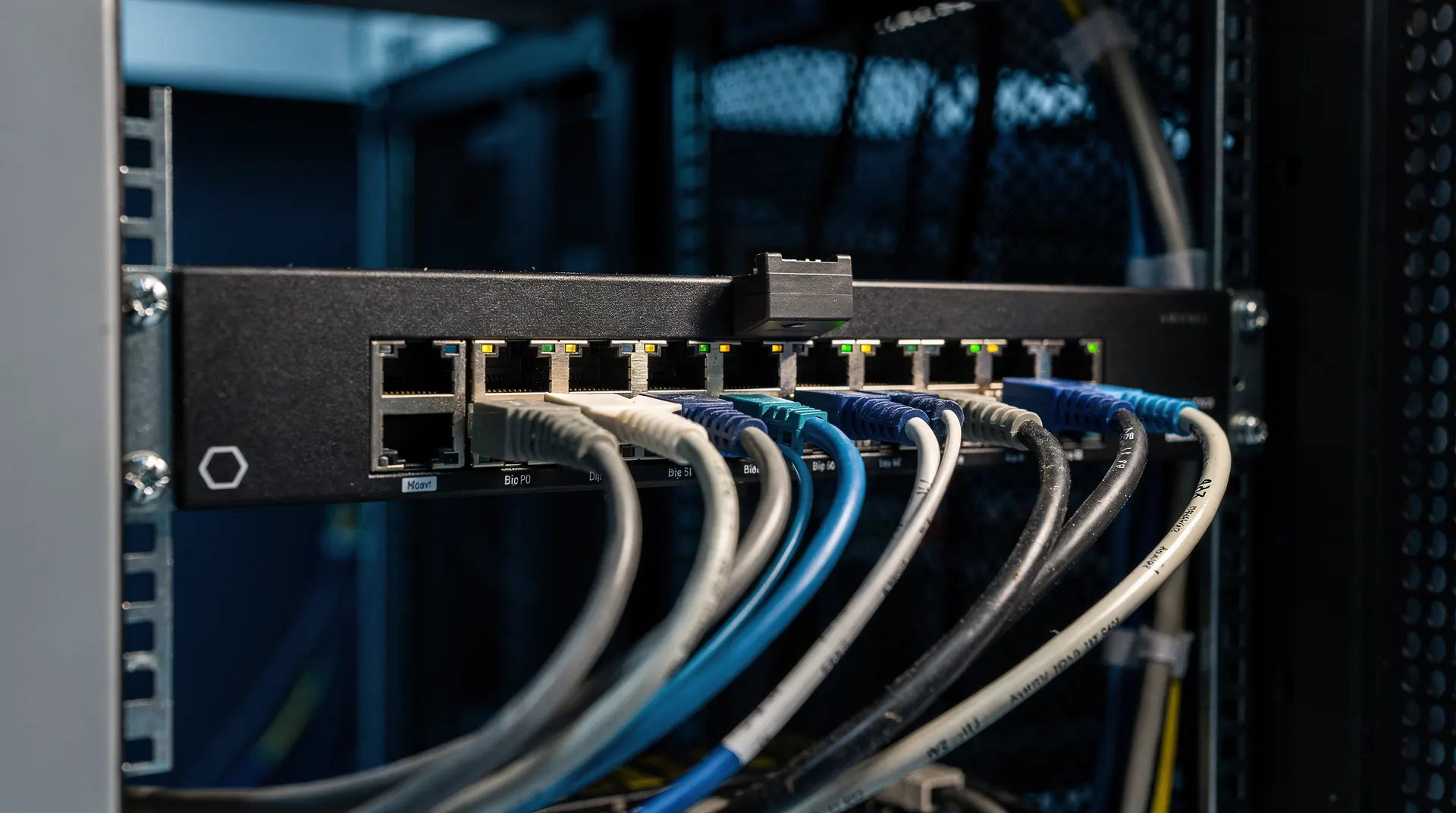
Hewlett Packard Enterprise secured a $1.2 billion order from cloud provider Vultr on September 30, 2026, and it is the first commercial order for the AMD Helios AI Rack by HPE system, per the press release filed as Exhibit 99.1 to HPE's 8-K with the Securities and Exchange Commission. The system carries purpose-built HPE networking hardware and software, and each rack integrates 72 AMD Instinct MI455X GPUs, according to HPE's announcement. HPE shares were up about 4.5 percent in Wednesday trading following the disclosure, per Yahoo Finance. The most interesting part of the filing is not the order itself. It is what HPE said about the network around the GPUs.
The filing raises HPE's Juniper Networks cost savings target to $800 million in annual run-rate savings by the end of fiscal 2028, from a previous target of at least $600 million. It lifts the fiscal 2027 Networking segment revenue growth outlook to between high teens and low-20s percent, with segment operating margin in the mid-to-high 20s percent range. And it projects Data Center Networking revenue growing at a low-to-high 50s percent CAGR through fiscal 2029. Those are not the numbers of a server company riding the GPU cycle. They are the numbers of a company positioning the switch fabric as the scarce resource in the AI data center.
The logic is straightforward. Every hyperscaler and neocloud building AI capacity is hitting the same constraint: GPUs that idle while waiting on the network. Nvidia answers that internally with NVLink, Spectrum-X and InfiniBand, and it monetizes the fabric with the rack. AMD Helios has no equivalent monopoly on interconnect, which leaves room for an HPE or a Cisco to sell the switching layer around it. HPE's bet, articulated by networking chief Rami Rahim in the filing, is that AI makes the network strategic enough that buyers will pay for it separately. A $1.2 billion first order from the largest privately held cloud provider is the first external test of that thesis, and Vultr chose to buy the AMD rack plus HPE networking rather than the Nvidia rack that owns the fabric by default.
Supply is the second signal in the filing. HPE disclosed it had previously doubled its quarter-over-quarter networking supply purchase commitments in the third quarter of fiscal 2026 to support demand entering fiscal 2027. Component commitments are where intent becomes verifiable, and doubling them into a soft quarter says management sees order flow arriving faster than it can ship. The Juniper savings raise from $600 million to $800 million does the same work on the cost side: the acquisition is paying for itself faster than planned, which frees capacity to chase the data center market.
The same afternoon produced a second datapoint on where AI infrastructure value is moving. CoreWeave announced at its Fully Connected conference in San Francisco that Nvidia's Vera Rubin NVL72 system is now generally available on its platform, with software firm Cognition as the first customer, per the company's announcement covered by Data Center Dynamics. Cognition, which began using the systems in early September, has seen up to a 4.8x increase in total token throughput on its SWE-2 inference workloads, according to CoreWeave. The more unusual disclosure is that CoreWeave will offer Nvidia's Vera CPU as a standalone bare-metal product: 128 CPUs and 11,264 cores per rack, aimed at agentic workloads. A GPU-first neocloud selling a CPU by itself is a small product decision with a large read-through: inference economics are drifting toward general-purpose compute as agents, not single queries, dominate demand.
The third item cuts in the opposite direction, and it is the one Nvidia investors should read most carefully. DeepSeek open-sourced Ascend versions of its TileLang, DeepGEMM and DeepEP software tools on September 30, targeting Huawei's Ascend 950 chips, per Reuters and Pandaily. Huawei simultaneously detailed its SuperPoD interconnect architecture, and reports of the release describe the stack as reaching parity with the Nvidia toolchain for core training and inference kernels. The claim of one-to-one parity comes from the parties involved and should be treated as exactly that, a vendor and user claim rather than an independent benchmark. But the strategic fact does not depend on the benchmark: the reason DeepSeek, a lab that trained frontier-class models on export-controlled Nvidia hardware, is writing and giving away the software layer for Chinese chips is that CUDA is the last defensible part of Nvidia's China story, and that story is already constrained by export controls.
Put the three together and the afternoon's lesson is that the AI buildout's profit pool is being contested at the edges. Vultr, a customer that most of Wall Street had filed under "regional cloud", is writing nine-figure orders for a rack system Nvidia does not sell. CoreWeave is unbundling the CPU from the GPU rack because agent workloads need both. DeepSeek is trying to make CUDA optional in the one market Nvidia cannot sell into. None of this threatens Nvidia's near-term order book, which remains sold out through the Vera Rubin generation. All of it says the second-order suppliers, the switching vendors, the neoclouds and the software layer, are pricing themselves into the trade.
The dates to watch next are HPE's fiscal fourth quarter report in early December, where the Vultr order will show up in backlog and the networking segment's growth rate gets its first test against the low-20s outlook, and Huawei's Ascend 950 launch window in the fourth quarter, which will show whether the software stack ships with silicon. If the networking CAGR proves out, the AI trade's next crowding will not be in GPUs at all.
Related reading on MarketIntelLabs: Five AI Deals in One Day, and Not One Was About GPUs; Nvidia Expects Chip Sales to Double: The Filings Back It; OpenAI Asks for $30 Billion at $1.4 Trillion, and the Math Behind It Does Not Close.
This content is for informational purposes only and does not constitute financial advice. Past performance is not indicative of future results. Consult a qualified financial advisor before making investment decisions.
Sources: HPE press release, Exhibit 99.1 to Form 8-K, SEC EDGAR, September 30, 2026; Yahoo Finance, HPE Shares Rise 4.5% After Networking Outlook Upgrade and $1.2 Billion Vultr AI Deal, September 30, 2026; Data Center Dynamics, CoreWeave makes Nvidia Vera Rubin NVL72 available, September 30, 2026; Reuters and Pandaily coverage of DeepSeek's Ascend software open-sourcing, September 30, 2026.
Get daily intelligence delivered
Create a free account for the Daily Brief every weekday and The Week Ahead every Sunday. No card required.