macro

The Fed's Quiet Liquidity U-Turn
By Marcus WebbPublished August 27, 20265 min read
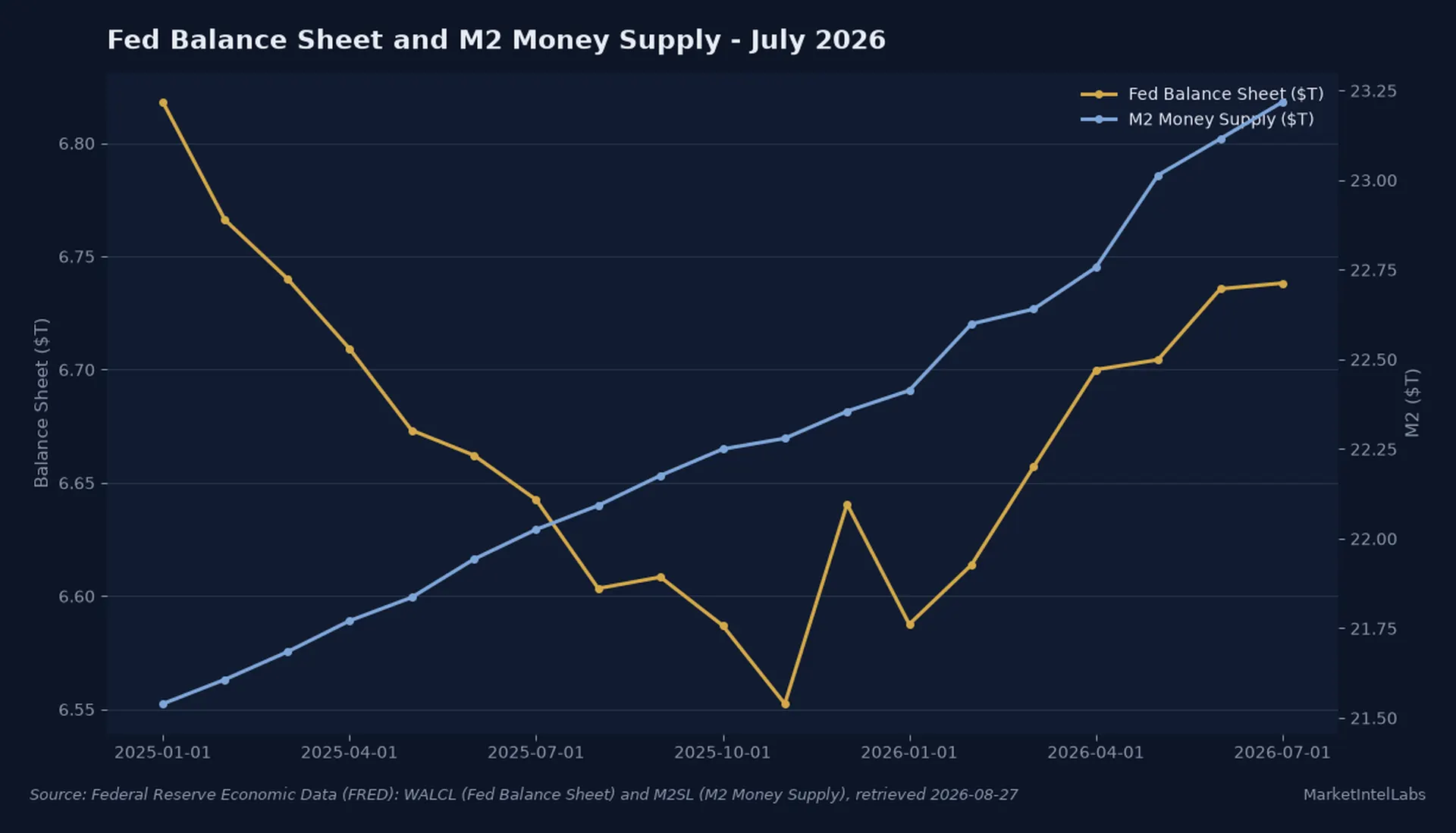
Fed Balance Sheet has flattened near $6.75T since mid-July while M2 money supply re-accelerated to 5.41% YoY growth in July 2026. Source: Federal Reserve Economic Data (FRED): WALCL and M2SL series

The Fed's Quiet Liquidity U-Turn

Quantitative tightening was supposed to be systematically draining liquidity from the financial system. The Fed's balance sheet tells a different story. Total assets have been essentially flat near $6.75 trillion since mid-July, essentially unchanged from late July at $6.738 trillion.

QT has quietly paused rather than accelerating. This is happening while core PCE inflation runs at 3.34% and three hawkish FOMC members dissented on the July hold, arguing for a 25 basis point hike. That contradiction is what Jackson Hole 2026 is really about.

Related reading: Jackson Hole 2026 Opens: What Markets Are Watching Today

The hawkish bloc sees inflation at 3.34% and wants tighter policy. The Fed's balance sheet says policy is already constrained, not by inflation data but by something else. You cannot simultaneously drain reserves aggressively and expect the funding market to function smoothly.

The plumbing comes first. The data supports the pause theory more than the continued tightening story. M2 money supply grew 5.41% year-over-year in July and rose 0.44% month-over-month to $23.218 trillion.

That is a re-acceleration from the multi-year post-QT contraction pattern. Liquidity is returning to the system even as the Fed's official stance is that core PCE at 3.34% remains above target. Money market signals reinforce the picture.

Related reading: Jackson Hole 2026: Reserve Scarcity Meets a Fed Split

Fed Balance Sheet (WALCL) has flattened near $6.75T since mid-July while M2 money supply re-accelerated to 5.41% YoY growth in July 2026. Source: Federal Reserve Economic Data (FRED): WALCL and M2SL series
Figure 1: Fed Balance Sheet (WALCL) has flattened near $6.75T since mid-July while M2 money supply re-accelerated to 5.41% YoY growth in July, signaling a quiet QT pause.

SOFR is printing slightly above the effective fed funds rate, a modest but persistent spread. Banks are competing more aggressively for available funding. Jackson Hole opens today with this tension unresolved.

Fed Chair Kevin Warsh will face questions about the July 29 hold that saw three dissents from Hammack, Kashkari, and Logan. Those three wanted to hike. The majority held. The balance sheet has been flat since.

Related reading: July PCE: Core Inflation Holds at 3.3% as Income Jumps 0.4%

The most straightforward reading is that the majority sees limits to how much further tightening the system can absorb before something breaks. The hawkish dissenters see inflation risk that justifies pushing those limits. The historical precedent from 2019 is instructive.

When repo rates spiked in September of that year, the Fed responded with emergency operations and ultimately restarted balance-sheet expansion. Policy communication softened because central banks prioritize market functioning over headline inflation optics.

The plumbing worked until it did not, and when it stopped working, the Fed pivoted. The difference today is that the Fed is not waiting for a crisis to respond. The balance sheet has been flat for weeks. M2 is re-accelerating.

SOFR is trading above the fed funds rate. These are not crisis conditions, but they are stress signals. The Fed appears to be managing the plumbing in real-time rather than waiting for a September 2019-style spike.

The counter-case deserves serious weight. Core PCE has held at 3.34% across four consecutive prints, with no meaningful disinflation progress since March. The three hawkish dissenters could be reading the data correctly: the economy may be able to absorb more tightening without breaking, and the balance-sheet pause may be temporary operational maintenance rather than a strategic shift. If Warsh validates this view and signals willingness to resume QT once funding markets normalize, the current liquidity support disappears quickly.

That suggests the Jackson Hole remarks will emphasize data dependence and reserve adequacy rather than validate the hawkish dissenters. If Warsh uses the platform to signal that the July dissents were minority views to be noted but not accommodated, the QT pause becomes the new baseline.

The Fed maintains a hawkish stance on inflation while acknowledging that further tightening risks funding-market stress. Gold benefits from capped real yields, and the compressing 10s2s curve (+47bp and falling) has room to steepen if the market prices in eventual easing.

A hawkish speech that ignores the balance-sheet reality breaks the equilibrium. If Warsh validates the dissenters and signals a willingness to resume QT despite the liquidity signals, real yields rise and gold extends its recent pullback.

The risk is not immediate hiking, but the market pricing a higher probability of future liquidity withdrawal into a system that is already showing stress signals. The September 15-16 FOMC meeting is the actual policy-setting event.

Jackson Hole previews rather than pre-commits. But the signals from the Fed's balance sheet are real. QT has paused. M2 is re-accelerating. Funding markets are showing early stress.

These are not random data points. They are the same warning lights that appeared in 2019, only this time the Fed is responding before the lights turn red. Watch for two things in the Jackson Hole remarks.

First, any acknowledgment of balance-sheet dynamics or liquidity conditions. Second, whether Warsh frames the July dissents as a meaningful constraint on policy or as views to be noted but not accommodated.

The Fed has quietly stopped draining liquidity. Jackson Hole is where we find out whether that was a tactical pause or the new direction.

---

*This content is for informational purposes only and does not constitute financial advice. Past performance is not indicative of future results. Consult a qualified financial advisor before making investment decisions.*

For more analysis on macro trends, visit our Macro hub.

Get daily intelligence delivered

Create a free account for the Daily Brief every weekday and The Week Ahead every Sunday. No card required.