Tenure Data Lands Today, and a Frozen Labor Market Should Push the Median Up

The Bureau of Labor Statistics publishes its Employee Tenure report at 10:00 AM ET on September 24, 2026, and it is the right release for this exact labor market. The biennial survey, a supplement to the January Current Population Survey, gives the median number of years wage and salary workers have been with their current employer.
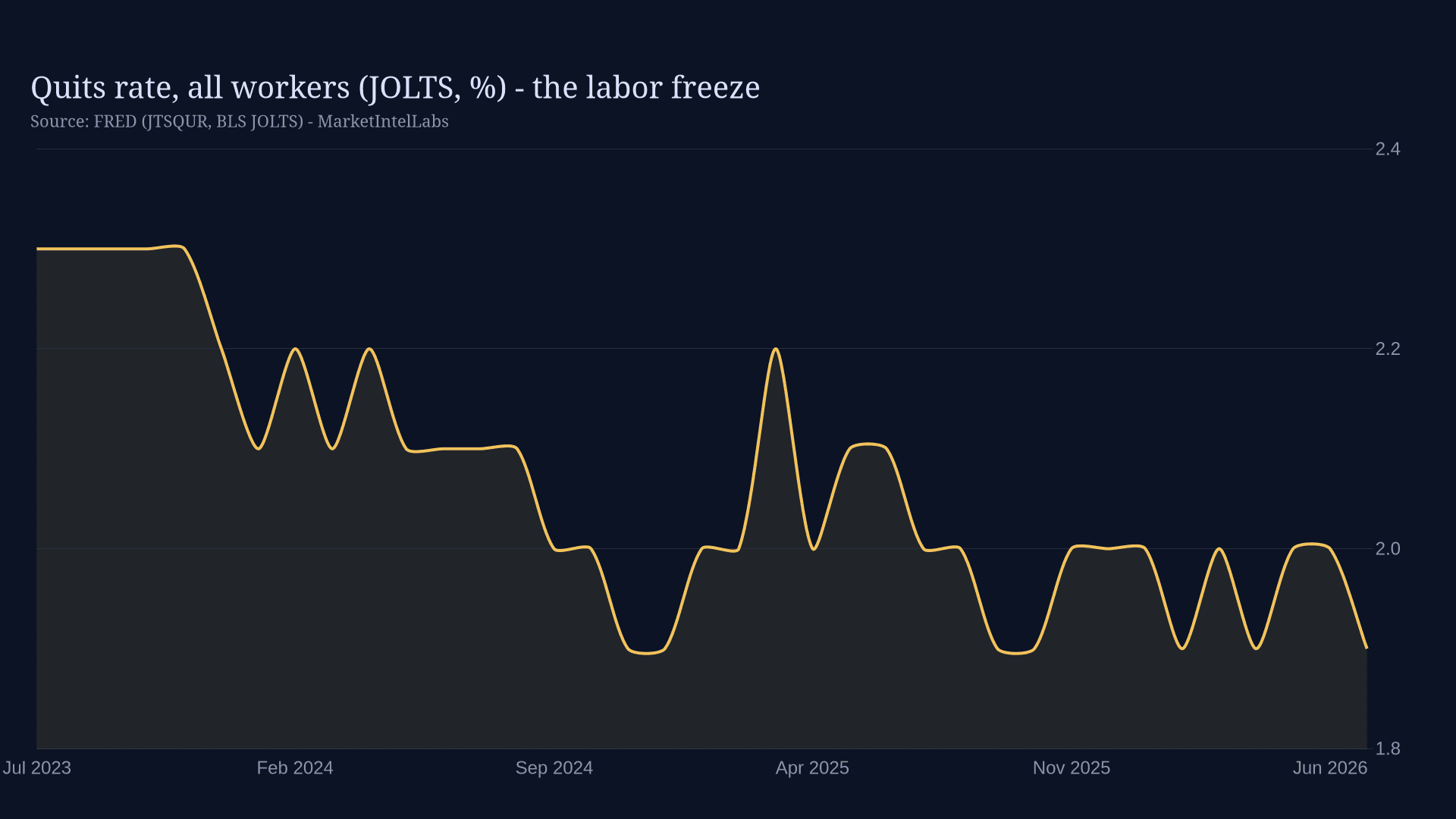
The last reading, from January 2024, was 3.9 years, the lowest since 2002. Conditions for a reversal are as good as they get, since quits are running at 1.9 percent of employment, the July 2026 JOLTS print shows hiring at a 3.2 percent rate, and firms are simply not firing. When nobody leaves and nobody is let go, time on the job stretches. That is the mechanism behind every tenure cycle on record.
The forecast is mine, not the government's. BLS publishes the level, not a direction.
But the arithmetic of the series is simple, and every input points the same way. Median tenure falls when separations outpace hires, because short new spells dilute the pool. It rises when workers sit still.
In the twelve months through July 2026, the quits rate has oscillated between 1.9 and 2.0 percent, per BLS JOLTS data, and the layoffs and discharges rate has sat near 1.1 percent. A worker's chance of either leaving or being pushed out has rarely been this low. Turnover on both edges of the job is quiet at the same time, which is precisely the configuration that pushes a median upward.
The claims data says the same thing from the other side. Initial claims for the week ending September 12, 2026 came in at 196,000, and continuing claims fell to 1,730,000 in the week ending September 5, per Department of Labor figures carried by the Federal Reserve Bank of St. Louis.
Four-week averages in this range have historically coincided with tight labor markets, yet hiring has not picked up. Firms are not cutting headcount, and they are not adding it either.
That is the frozen market our coverage of the September payrolls survey week described on September 23: rare layoffs, stalled hiring, and a claims print that looks like the 1960s. Tenure is the household-survey measure of the same freeze. If the freeze is real, today's median rises.
The last tenure report, released September 26, 2024, carried details worth holding onto as today's numbers land. Median tenure for men was 4.2 years against 3.6 years for women, and the share of workers aged 25 and over with ten or more years at their employer was 32.0 percent for men and 28.2 percent for women, a gap that has roughly tripled since 2014, per BLS Table 2. By age, the spread runs from 1.4 years for workers aged 20 to 24 to 9.6 years for those aged 55 to 64. By industry, leisure and hospitality sat at 2.1 years while mining, quarrying and oil and gas extraction led the private sector at 5.7 years.
The cut with the most room to move is hospitality. The quits cooldown since 2022 has been sharpest in exactly the sectors with the shortest tenure. Food preparation and serving already rose from 1.6 to 2.0 years between the 2022 and 2024 surveys, the largest proportional gain in the occupation table. Today's update should extend that.
One thing the report will not resolve is the popular story that young workers job-hop more than their elders. The January 2024 data said the opposite. Median tenure rose between 2022 and 2024 for 18 to 19 year olds, from 0.7 to 0.9 years, and for 20 to 24 year olds, from 1.2 to 1.4 years, while nearly every older cohort saw tenure fall. Short tenure at 25 looks like a function of being 25, not of being young in this decade.
If today's report repeats that pattern, the job-hopping narrative loses its last bit of survey support. For the labor market's direction, tenure is a lagging mirror, but a useful one. A rising median would confirm what claims and the JOLTS separations data already show: a market held in place, with low quits on the way out and low layoffs on the way down. A flat or falling median would be the surprise, and it would mean one of two things.
Either a hiring reacceleration is injecting fresh short spells, or layoffs are finally catching up with the restructuring announcements that led the Challenger job-cut report in August, when employers announced 52,881 cuts. Given that continuing claims made a new cycle low at 1,730,000 in the week ending September 5, the layoffs path looks less likely. Watch the hires rate when August JOLTS arrives on September 29, and the payrolls revision cycle with the September employment situation on October 2. If hiring stays at 3.2 percent and separations stay near 3.2 percent, today's print should mark the turn, and the 2028 report should show a median clearly above 4 years for the first time since 2020.
This content is for informational purposes only and does not constitute financial advice. Past performance is not indicative of future results. Consult a qualified financial advisor before making investment decisions.
Get daily intelligence delivered
Create a free account for the Daily Brief every weekday and The Week Ahead every Sunday. No card required.