Diesel Sets a New Record at $6.53 While Crude Slides. Your Groceries Don't Care About Crude.

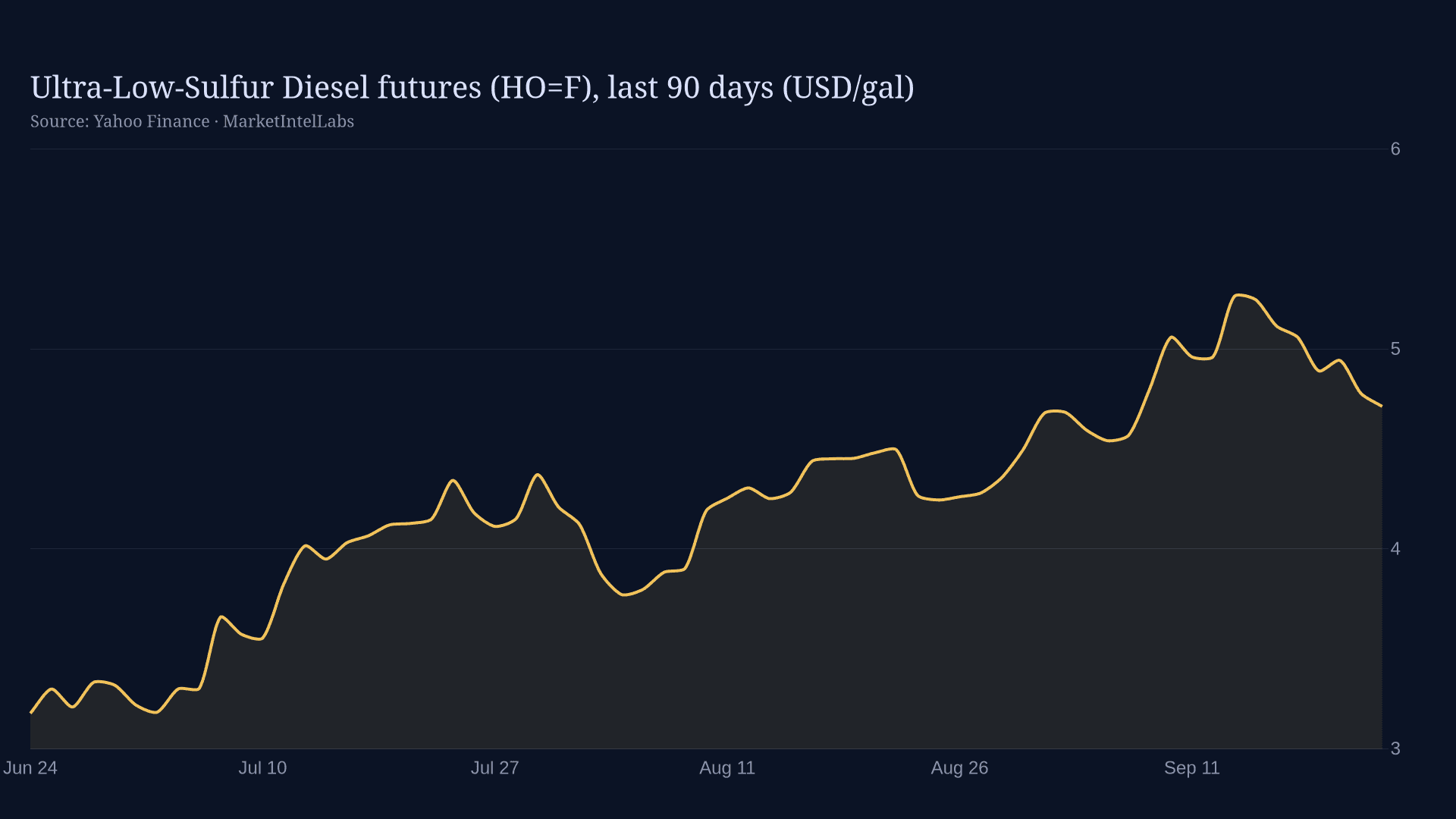
The diesel number that matters landed on Monday and it broke the record the desk flagged four days earlier. The Energy Information Administration's weekly survey put the U.S. retail price of on-highway diesel at 6.529 dollars a gallon for the week of September 21, up from 6.285 the week before and 5.599 in the week of August 24. A year ago, in the week of September 22, 2025, the same survey read 3.749. That is a 74 percent increase in twelve months, and it is now the highest weekly average in the history of the series (a nominal record).
Here is the strange part, and it is the part worth understanding: crude oil is falling. West Texas Intermediate traded around 91 dollars a barrel on September 24, per FT market data, down from roughly 106 dollars in the middle of last week, a figure AAA cited in its September 23 weekly roundup. The pump did not follow crude down. Regular gasoline averaged 4.778 dollars a gallon in the EIA weekly survey for September 21, up from 4.640 the prior week, against 3.437 a year ago, a 39 percent annual increase. AAA's daily national average sat at 4.47 dollars on September 23, sixteen cents above the week before, per the AAA weekly state roundup.
When refined product prices rise while crude falls, the gap between them, the crack spread, is widening. That is what a refining squeeze looks like. Russia's gasoline and diesel export ban, extended through January 2027 per The Moscow Times, has removed supply from a market that was already tight, and Ukrainian strikes on Russian refining capacity continue. Ukraine's General Staff confirmed strikes on two more Russian oil refineries on September 22, per UNN. Russia is a top diesel exporter to Europe and other markets, so every barrel of Russian refining capacity that goes offline tightens the global diesel balance that U.S. prices clear against. Meanwhile Saudi Arabia restarted its East-West Pipeline, which could eventually add crude, not products, as the Sprague market note for September 23 observed. The market is long crude and short diesel, and retail prices are set by the diesel.
For a household, diesel is not a line item the way gasoline is. You notice gasoline because you buy it weekly. Diesel you buy invisibly, in the price of everything that arrives on a truck. Diesel is the fuel of nearly every freight move in the country, so its price is a tax on logistics that shows up weeks later in shelf prices. A truck running about a thousand gallons a month is paying roughly 2,780 dollars more per month than a year ago at this spread. Some of that gets absorbed in carrier margins, and some gets invoiced forward as fuel surcharges, which is the mechanism that turns a refinery story into a grocery bill.
The timing matters for the inflation calendar. September CPI is due October 14 at 8:30 a.m. Eastern, per the BLS release schedule. August CPI, released September 11, ran 3.4 percent year over year, and it was assembled before most of this month's fuel surge hit the basket. The EIA weekly gasoline average rose about 38 cents a gallon across the four weeks from August 24 to September 21. Energy commodities feed CPI with a short lag, so September's print will carry the first full month of it, and diesel works through the slower food and core-goods channels after that. The BLS average-price series already showed regular gasoline at 4.20 dollars a gallon in August, up from 4.09 in July, and those were the cheap weeks.
Two things decide what you pay at the pump through October. The first is whether refined product supply catches up: U.S. refinery utilization is seasonal and autumn maintenance, plus any storm disruption, lands right now, so the physical market stays tight even with crude soft. The second is the war premium, which nobody can schedule. AAA's own commentary on September 23 was blunt that with conflict unresolved there is little reason for crude to settle, and product markets are tighter than crude. If Russian export capacity keeps getting hit, the diesel record is less likely a peak than a plateau.
The practical translation for a household budget: assume fuel surcharges keep feeding into delivered-goods prices for another two cycles, expect the September CPI print on October 14 to show energy commodities doing the heavy lifting, and treat any gasoline relief at the pump as temporary until diesel stops setting records. Gasoline follows diesel in these episodes, not the other way around. Crude at 91 dollars says the raw material is available. Diesel at 6.53 says the bottleneck is everything that happens after it leaves the wellhead, and that bottleneck, unlike crude, does not respond to OPEC headlines.
Watch the EIA weekly survey next Monday. If the diesel average prints above 6.53 again, the record run continues, and the grocery shelf inherits it in November and December, right as holiday shipping demand puts a second bid under freight capacity. That is the calendar, dated and priced.
This content is for informational purposes only and does not constitute financial advice. Past performance is not indicative of future results. Consult a qualified financial advisor before making investment decisions.
Get daily intelligence delivered
Create a free account for the Daily Brief every weekday and The Week Ahead every Sunday. No card required.