Danube strike cuts Ukraine grain exports a third, wheat at $725

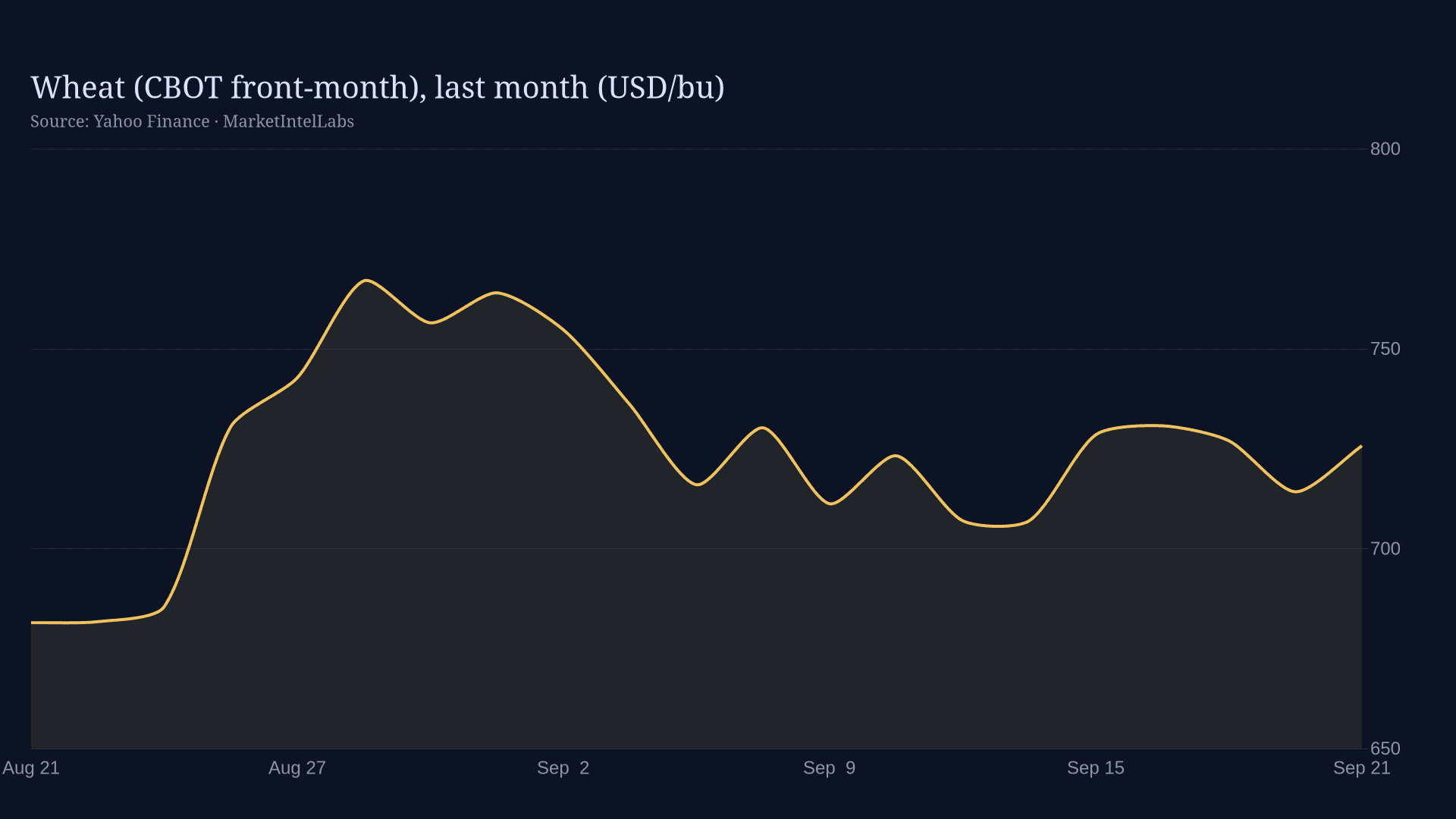
A Reuters-confirmed strike on the bridge vital to Ukraine's Danube grain route last week is the newest knot in a Black Sea export chain already running a third below normal. Front-month wheat stood at $725.75 in early trading, up 1.6% from Friday's settled close of $714.25, and corn at $533.75, up 1.2% from $527.50, as traders priced a tighter headline supply through the corridor the country leans on to move its autumn crop, per Yahoo Finance.
The numbers tell the disruption story plainly. Ukraine's August grain exports came in near 774 kt, about a third below the recent run-rate, and last week's strike on a bridge critical to the Danube route tightens the picture further. The Danube corridor is Ukraine's main alternative to its deep-water Black Sea ports, which Russia's renewed blockade keeps off-limits, and RANE flags that blockade as the structural force holding export flows below their pre-war norms. Tanker Rates Top $1.2 Million a Day as War Risk Compounds tracks that shipping-cost side of the corridor squeeze. Every tonne that cannot leave Ukraine has to be sourced elsewhere, and the gap shows up in the futures tape first.
Wheat is the headline, because it is the direct bread and flour input. Corn is the quieter one: it feeds poultry, pork, dairy, and the processed-food aisle, so a sustained corn premium reaches the shelf through animal products and packaged staples rather than a single loaf. Our cost-of-living desk watches exactly this transmission, how a freight and grain squeeze works into household food dollars with a lag rather than overnight. Producer Prices Are Running 2 Points Ahead of Your Receipts captures the producer side of that same lag at the index level.
The bear case deserves equal weight. Weather has generally cooperated, and a borderline softening in global demand can cap wheat and corn even with Black Sea disruption, as our analysts noted. The crude risk premium is also unwinding, with Brent easing about 2% to the low-$98s, and cheaper fuel trims the shipping and input costs that grain moves are built on. On the freight side, Dry Bulk Splits in Two: A $28,550 Daily Gap Between Capesize and Panamax shows how cargo demand for grain and iron ore now prices differently. That deflationary offset argues against a full-blown food-price spiral while the grain squeeze itself stays real.
If the Danube corridor stays impaired into the autumn export season, expect the Black Sea premium to hold and European and Middle East importers to lean harder on US, EU, and Australian supply. The next USDA balance-sheet read is the tell on whether this is a bump or a structural repricing. Either way, the disruption starting to bite in the grain pits is one to keep watching from the grocery checkout too.
This content is for informational purposes only and does not constitute financial advice. Past performance is not indicative of future results. Consult a qualified financial advisor before making investment decisions.
Get daily intelligence delivered
Create a free account for the Daily Brief every weekday and The Week Ahead every Sunday. No card required.