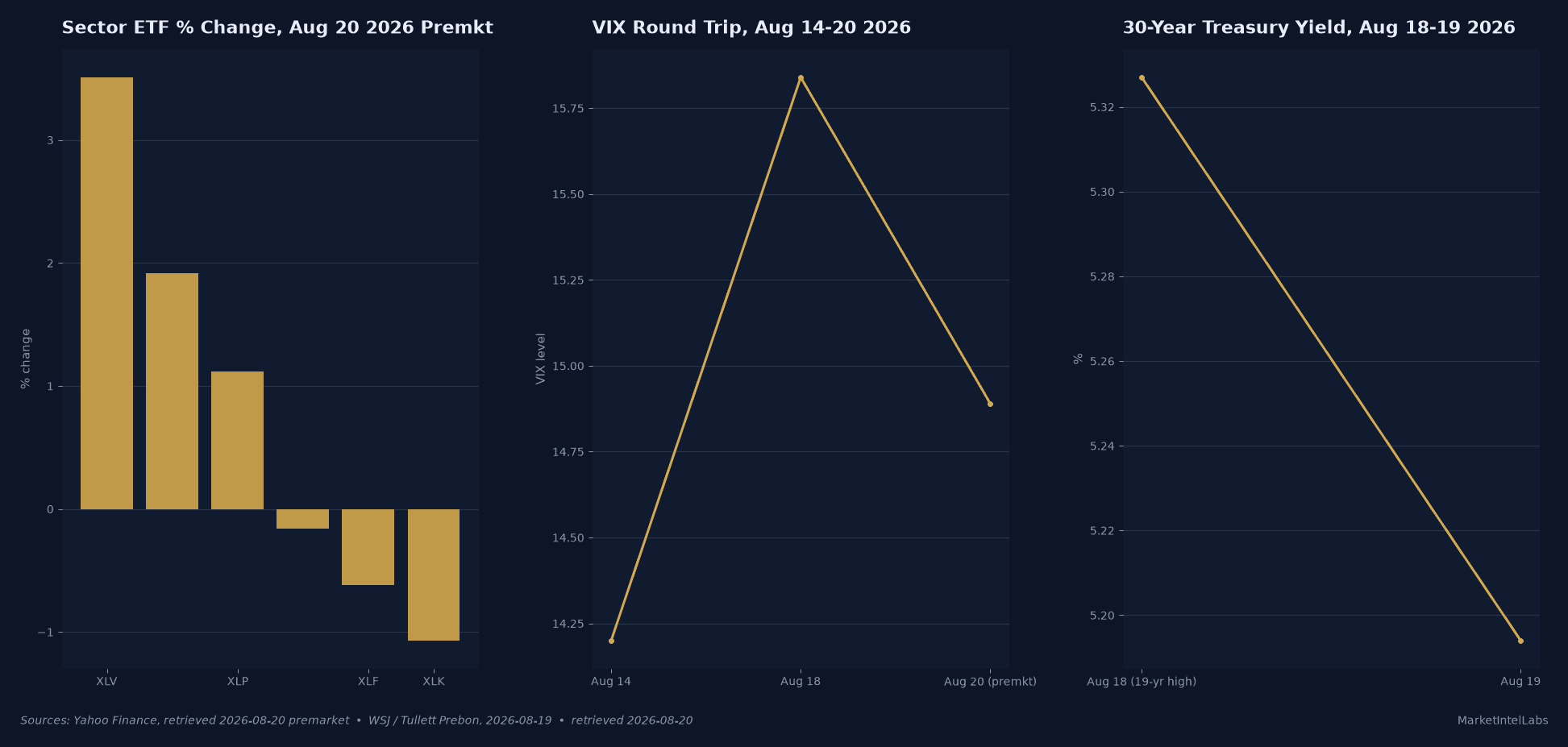
Yield Relief Lifts Healthcare to a Record, Tech Lags Behind
S&P 500 rose 0.24% to 7,709.91 as a Treasury buyback eased the 30yr yield, but healthcare led while tech and semis lagged. Breadth, not the index, is the signal.
Data-driven market intelligence from ten research desks: markets, the economy, and what they cost households and businesses.

S&P 500 rose 0.24% to 7,709.91 as a Treasury buyback eased the 30yr yield, but healthcare led while tech and semis lagged. Breadth, not the index, is the signal.

With 88% of S&P 500 companies reporting, Q2 2026 blended earnings growth stands at 50.4% year-over-year, the highest since Q2 2021. But the headline hides concentration risk, and the sector tape is already rotating ahead of this week's retail catalyst gauntlet.

Anthropic's Q2 2026 revenue hit $11.5 billion, a 14x year-over-year gain. But the sector tape on August 17 tells a more complex story: Energy and Industrials are leading while XLK pulls back. Here is what the rotation, the breadth data, and the Fed risk say about equity positioning.

The S&P 500 hit a record 7,816.70 intraday on August 13 as tech (XLK +1.01%) and communication services (XLC +2.07%) led, backed by ~50% y/y Q2 earnings growth. But VIX at 14.63 and a call-heavy 0.59 put/call ratio leave the market with a thin hedging cushion, and today's Applied Materials report is the next test of the AI-capex thesis behind the rotation.

Tech (XLK +1.49%) and small caps (IWM +0.57%) lead an AI-earnings-driven rally as equities await today's July PPI print, whose consensus estimates conflict across data providers ahead of Applied Materials' earnings.

S&P 500 fell for a second session as capital rotated into energy and utilities ahead of July CPI, with Kalshi pricing a cooler print than consensus.

Q2 earnings season is splitting the market into two camps: high-multiple growth names facing valuation scrutiny even after beating estimates, and cash-rich, guidance-raising mid-caps getting rewarded with fresh highs. Energy's 4.66% day is the clearest sign that rotation is happening beneath a flat index tape.

SPY closed at $773.26 and QQQ at $723.03 as 9 of 11 S&P sector ETFs advanced, with Technology, Consumer Discretionary and Materials leading. The rally is being driven by a weak July jobs report boosting Fed rate-cut odds, but a VIX-put/call divergence signals institutions are still hedging.

Three macro forces converge on August 7 in a configuration that creates asymmetric downside risk for US equities, with SPY near record highs but breadth incomplete and the Fed's widest dissent margin of 2026.

SPY sits at $768.56 near all-time highs, but only five mega-cap names drove the August 5 record close. Market breadth, chip volatility, and a binary NFP event are creating an inflection point for US equities.

The S&P 500 closed at a record high on August 5 for the first time in two months. But only 17% of its members outperformed the index last month. That gap between headline and reality is where the trade risk lives.

Great Eastern Shipping posted the most profitable quarter in its history as Hormuz disruption sent tanker rates to all-time highs. The freight cycle math is extraordinary. The sustainability question is harder.