equitiesboltSpecial Coverage

Target Q2 FY2026: Comp Sales Beat, Guidance Raised

Published August 19, 20266 min read
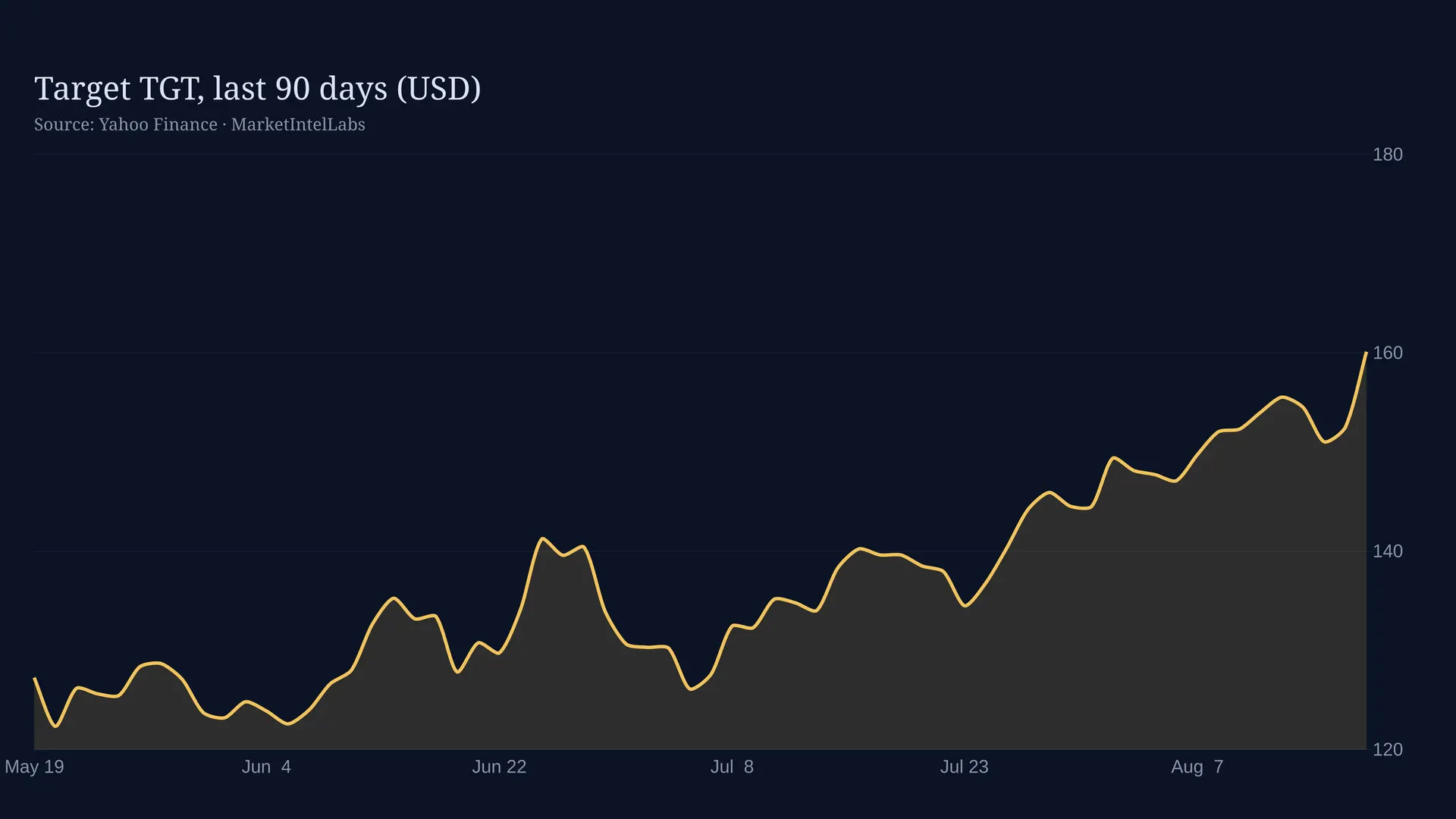
Line chart of Target TGT stock on a dark background showing positive earnings reaction
Target's Q2 FY2026 earnings beat drove stock gains — Illustration: MarketIntelLabs

Target's second quarter looked like a blowout on the surface, EPS of $4.11 against a Street estimate near $2.21 to $2.28, and comparable sales up 3.8% against a consensus closer to 2.4%. Strip out a one-time tariff refund and the picture is still a genuine beat, just a smaller one, and that gap between the headline number and the underlying trend is the actual story premarket traders spent Wednesday morning digesting.

Start with what actually happened. Target reported net sales of $26.54 billion for the quarter ended August 1, above the $26.0 billion to $26.1 billion range analysts had modeled from FinancialModelingPrep and Globe and Mail estimates as of mid-August. Comparable sales grew 3.8%, built from a 2.7% increase in store sales and an 8.7% jump in digital sales, with same-day delivery up more than 25%. That is a clear acceleration from Q1's already-strong 6.7% net sales growth, and CEO Michael Fiddelke called it confirmation that the retailer's pricing and merchandising reset is "resonating with our guests."

The EPS line is where the story gets more complicated. GAAP and Adjusted diluted EPS came in at $4.11, more than double the $2.05 posted a year ago and well above the $2.21 to $2.28 consensus range recorded ahead of the print. But $994 million of that beat's engine sat in a pretax benefit from International Emergency Economic Powers Act tariff refunds, which added $752 million to net earnings and $1.65 to EPS. Back that out and GAAP and Adjusted EPS still grew 20% year over year, a real improvement, but a fraction of the headline's 100% jump. Readers doing quick math off the raw EPS number alone would badly overstate how much Target's core operating performance actually improved.

Guidance tells the same two-track story. Target raised full-year net sales growth guidance to "around 5%," a full percentage point above the prior range, and lifted its EPS guidance to $9.90 to $10.90 including the tariff windfall. Strip the refund out and the new range is $8.25 to $9.25, a $0.75 increase at the midpoint versus the old $7.50 to $8.50 band. Operating income margin guidance for the full year sits around 6%, with roughly 90 basis points of that coming from Q2's tariff refund alone. Management is telling investors the underlying business is improving, but they are also being unusually transparent that a chunk of this year's earnings power is a nonrecurring accounting event tied to trade policy, not a structural margin expansion.

How the market actually reacted

Premarket trading on Wednesday told a more skeptical story than the headline numbers alone would suggest. TGT opened the premarket session near $153, dropped as low as roughly $146 by 6:00 a.m. ET as investors digested the tariff-refund composition of the beat, then clawed back through the 7 a.m. and 8 a.m. hours to trade around $152, essentially flat against Tuesday's $151.01 close. CNBC reported shares were down about 1% in premarket dealing even as the headline beat both revenue and EPS estimates, a signal that professional money looked past the adjusted EPS line almost immediately and priced the sales trend and clean guidance instead.

TGT premarket price action on August 19, 2026, showing a drop from roughly $153 to $146 in the first hour after the earnings release before recovering to near $152. Source: Yahoo Finance (1-minute premarket data)

That round trip matters more than the raw EPS surprise for how equity desks are positioning discretionary retail into the back half of the year. A stock that opens strong on a beat, sells off once the composition of that beat becomes clear, then stabilizes near the prior close is a market telling you it already understood the tariff-refund math and was waiting to see the comparable sales and guidance detail before deciding the print was genuinely good news. On that read, Target's quarter earned a "fine, not spectacular" verdict rather than the "blowout" the raw EPS number implies.

The category split under the headline

All six of Target's core merchandising categories grew for the first time in this recovery, with Fun 101 (toys, seasonal, entertainment) up double digits and Food & Beverage and Beauty each posting high single-digit growth. Apparel and Home lagged the rest of the portfolio, and Fiddelke told reporters the company changed 75% of its decorative accessories assortment in Home specifically to chase the comparable-sales lift it's now seeing follow that reset, while acknowledging "we need a lot more of that type of improvement" across both categories. Non-merchandise revenue, which includes Roundel ad sales and Target Circle 360 membership fees, grew more than 20%, a mix shift toward higher-margin revenue lines that partly explains why gross margin expanded roughly 100 basis points even after excluding the tariff benefit.

Set against peers, Target's 3.8% comparable sales growth is the strongest print of the week among the big-box discretionary names. Home Depot posted 1.7% comparable sales growth Tuesday, its best since fiscal Q3 2022, but CFO Richard McPhail described the housing market as still "frozen," with big-ticket DIY projects deferred even as pro contractor spending held up. Lowe's reported comparable sales up just 0.2% Wednesday, with Pro and services strength offsetting continued weakness in do-it-yourself categories. That spread, Target's discretionary and general-merchandise categories outrunning home-improvement comps by 3 to 4 percentage points, is the clearer read on where the consumer is actually spending than any single company's tariff-adjusted EPS line. (See our preview of Home Depot, Target, and Walmart earnings for context.)

Comparable sales growth for Q2 FY2026: Target up 3.8%, Home Depot up 1.7%, Lowe's up 0.2%. Source: company press releases

What this changes and what to watch

The bull case out of this print is straightforward: comparable sales acceleration for a second straight quarter after five quarters of declines is the kind of trend equity investors reward with multiple expansion, and Target trades at a meaningful discount to Walmart on a forward earnings basis. The bear case is just as available in the same release: a five-percentage-point full-year EPS guidance raise that depends on nonrecurring tariff refunds for roughly $1.65 of underlying earnings power is not the same quality of guidance beat as one driven purely by margin execution, and Apparel and Home remaining soft means the turnaround is not yet running on all cylinders.

Walmart reports its own second-quarter results Thursday, and that print will be the cleaner read on whether Target's comparable sales strength reflects real market-share gains from the value repositioning Fiddelke has been describing since Q1, or whether it simply tracks a broader discretionary-spending pickup that lifts every large retailer at once. Either way, the 10-year Treasury yield sitting near 4.72% and a VIX near 15.4 this week suggest the macro backdrop remains calm enough that earnings composition, not rates or volatility, is what's actually moving these stocks intraday.

This content is for informational purposes only and does not constitute financial advice. Past performance is not indicative of future results. Consult a qualified financial advisor before making investment decisions.

Related Reading

Get daily intelligence delivered

Create a free account for the Daily Brief every weekday and The Week Ahead every Sunday. No card required.