Diesel Falls to $6.20, Yet Freight Fuel Bills Remain High


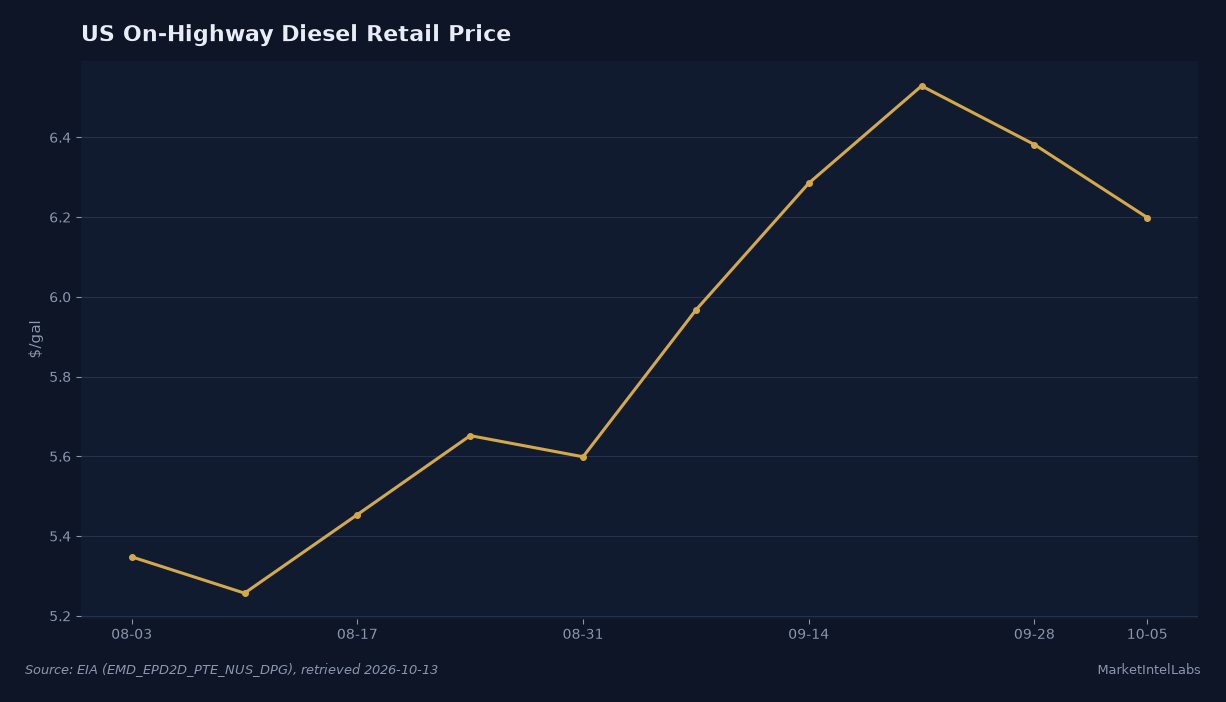
U.S. on-highway diesel slipped to $6.199 per gallon for the week of October 5, down 18.3 cents from the prior week, the Energy Information Administration reported in its weekly retail series. The retreat offers carriers some near-term relief, but the national price remains 60 cents above its August 31 level, and fuel still sits high enough to matter in spot bids and border freight budgets.
After a sharp climb through September, the weekly series rose from $5.599 on August 31 to $6.529 on September 21, then eased to $6.382 on September 28 and $6.199 on October 5. The full September rise added 93 cents per gallon before the two-week pullback recovered 33 cents. That is a meaningful change at the pump, though not enough to erase the prior cost increase.
Related reading: Diesel Tax Relief Offers Carriers $61 per 250-Gallon Fill.
For a truck operating at 6 miles per gallon, an 18.3-cent move changes the fuel component by about 3.05 cents per mile before taxes, discounts, and fuel-surcharge formulas. On a 1,000-mile loaded leg, that is roughly $30.50 per truck. The arithmetic is simple; the timing is not. Carriers often buy fuel across several days and regions, while contracts may adjust a surcharge weekly or monthly. A shipper should not expect every invoice to fall in step with a national weekly average.
Why a lower national average is not a rate reset
For a fleet, EIA's national retail series is a reference point, not a quote. A carrier's actual fuel bill depends on route geography, retail network discounts, fuel efficiency, deadhead miles, and how much of a haul is covered by a surcharge. Those differences can make the benefit larger or smaller than the national change implies.
For the broader framework, see our crude oil coverage.
Related reading: Container Freight Rates: Drewry WCI Falls 2% to $4,351.
Fuel relief and freight capacity are separate measures. Diesel is one operating cost. It does not tell us how many trucks are available, whether a lane is tight, or whether a driver can cross the border. The desk's October 12 supply-chain coverage already examined a rail fuel surcharge and wholesale inventory data. This update is narrower: the latest EIA price and the way its retreat may pass through to truckload expenses.
Across the border, a lower fuel input can soften the cost of repositioning equipment, but it does not resolve driver eligibility, customs processing, or uneven equipment flows. C.H. Robinson's October 1 North America freight update described September cross-border markets as broadly stable while identifying driver availability and temporary crossing restrictions as constraints. That company assessment is not a government statistic, but it is a useful reminder that route capacity and diesel costs are separate variables.
Related reading: Gas Falls to $4.35, but Household Inflation Stays Hot.
What the move says, and what it does not
Two weekly declines point to easing after a rapid September increase, not yet a durable downtrend. Two weekly declines are a small sample. If diesel falls further, carriers with frequent surcharge resets may pass some relief through quickly. Where rates are negotiated on fixed terms or fuel adjustments lag, the benefit may take longer to appear.
A renewed rise in crude or refined-product costs could reverse the October decline before contract formulas catch up. Even if diesel remains near $6.20, labor, maintenance, insurance, and backhaul availability still shape the all-in freight quote. No single fuel print establishes whether freight rates will rise or fall.
Related reading: Freight's 42-Month Slump Ends, and Diesel Is Sending the Bill.
For supply-chain planning, the distinction matters. Shippers can compare surcharge schedules against the EIA series and ask whether the contract uses a weekly, monthly, or threshold-based reset. The carrier's own surcharge table and route-specific quote remain the right documents for measuring an actual shipment, rather than applying the national average as if every truck paid it.
Next week's EIA release should show whether the national diesel average continued down after October 5. A second lower reading would strengthen the case that September's acceleration has cooled. A rebound would leave carriers with a smaller margin of relief and could keep fuel adjustment discussions active through the quarter. Either way, the important signal is not just the pump price but the lag between the price series and the surcharge on a real freight invoice.
Sources
U.S. Energy Information Administration, Weekly Retail On-Highway Diesel Prices. Series EMD_EPD2D_PTE_NUS_DPG, weekly observations through October 5, 2026.
C.H. Robinson, October 2026 Freight Market Update: Cross Border. Published October 1, 2026.
This content is for informational purposes only and does not constitute financial advice. Past performance is not indicative of future results. Consult a qualified financial advisor before making investment decisions.
Get daily intelligence delivered
Create a free account for the Daily Brief every weekday and The Week Ahead every Sunday. No card required.