Defensive Rotation Into a Hawkish Fed: Why Tech Led the Declines and the VIX Spiked

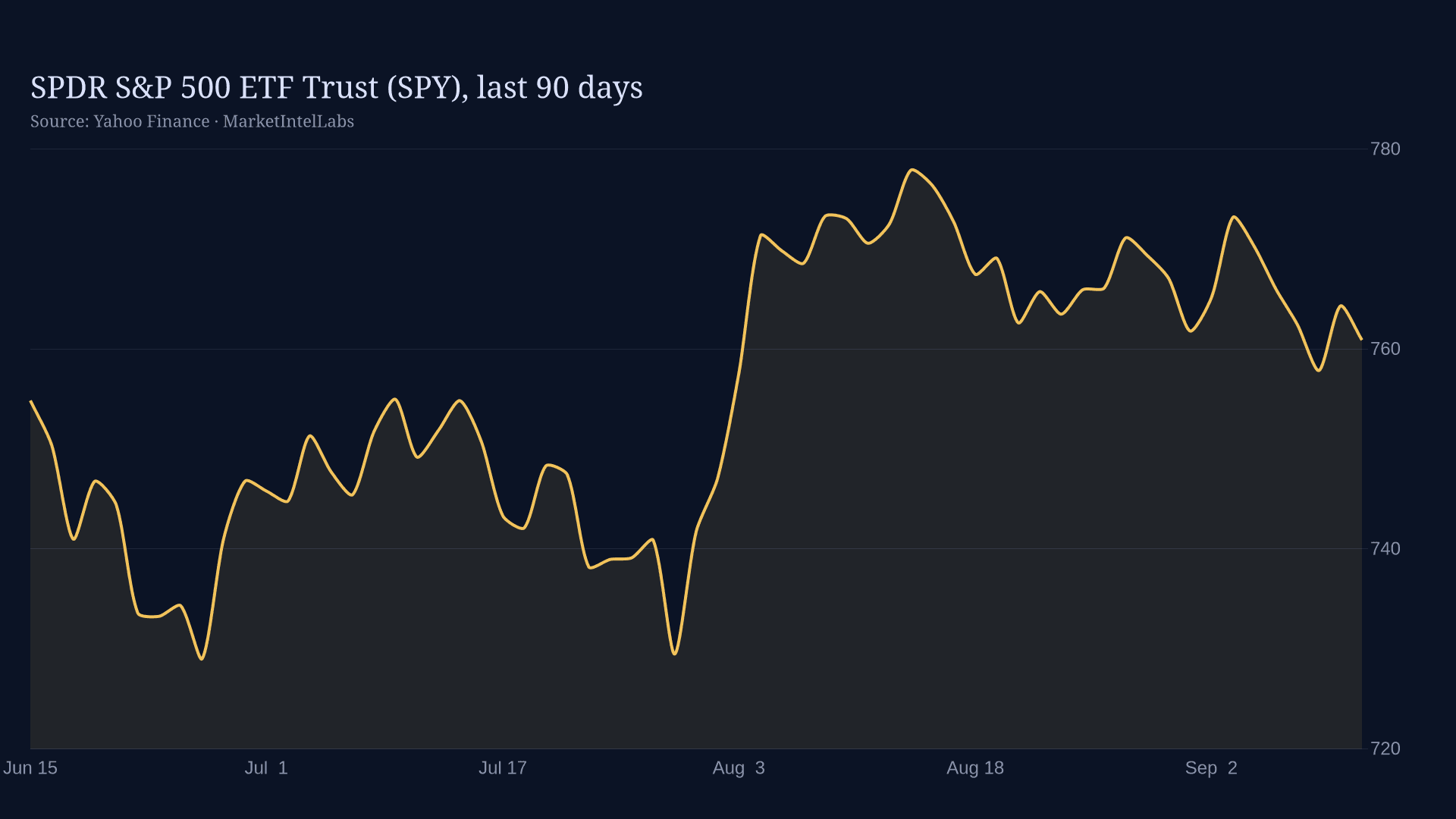
Monday's tape did not look like a market dumping risk. It looked like a market quietly repositioning for a rate decision it already expects. SPY, the exchange-traded fund that tracks the broad large-cap index, closed at $760.88, down 0.45%, as money rotated out of the long-duration growth names that carried the recent rally and into lower-beta healthcare, staples, and communication services. The rotation, the jump in the VIX to 17.10, and the widening gap below SPY's 52-week high all trace to the same catalyst: the FOMC decision due tomorrow, September 16, which Kalshi implied odds now put at an 88% probability of a 25 basis point hike.
The day's shape mattered more than its size. SPY fell less than half a percent, yet technology, the sector with the heaviest index weight, dropped 1.81% with XLK at 184.28. Communication services led the other way, rising 2.19% to 115.07, followed by healthcare at 167.75 and staples at 84.42. That is a clean defensive rotation, not a distribution-driven selloff. The index barely moved because the weight of tech losses was offset by gains in the sectors investors bought as shields.
A Rotation, Not a Rout
Sector rotation has been the defining equity theme of September, and look under the surface and Monday’s message is consistent. Small caps and the Dow held up far better than the Nasdaq on Monday, with IWM down 0.34% and DIA down 0.25% against a 0.80% drop in QQQ at 709.18. That pattern points to concentrated selling in mega-cap growth rather than index-wide pain.
Utilities, often bid in a pure risk-off tape, actually fell 1.34% at 41.82, and industrials dropped 1.42% at 169.93. The buyers were not stampeding everywhere defensive; they were picking moderate-duration, lower-multiple sectors, which is the signature of positioning for a specific policy surprise rather than a general flight.
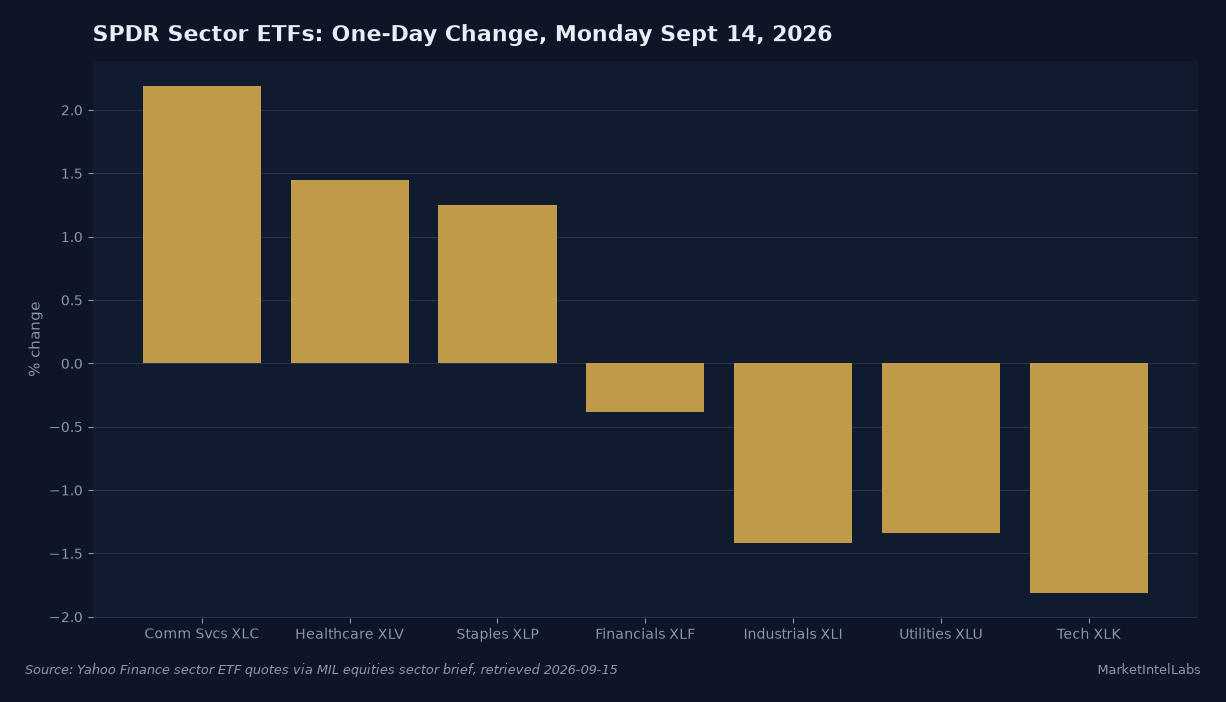
The rotation itself is a statement about duration, not about the economy. Each sector that led on Monday, communication services, healthcare, staples, holds the lower-beta, steadier cash-flow profiles that fare better when discount rates climb. Each sector that lagged, tech above all, prices the furthest-out earnings. Industrials sitting in the laggard column reinforces the point, since cyclicals behave like extended assets when investors see cost of capital rising. The leadership list on a day like this is the market's answer to the question the Fed will answer formally on Wednesday.
The breadth data sharpens the read still further. When SPY slips 0.45% while the Russell 2000 proxy and the Dow barely move, and the Nasdaq falls three times as much, the damage is happening in a narrow set of high-multiple names rather than across the whole tape. Advance-decline arithmetic that looks mildly negative on the surface is really a story about weight, with a handful of mega-cap growth stocks doing most of the index's heavy lifting on the downside. That is the opposite of a broad liquidation, and it is why the defensive bid did not turn into a panic bid.
Technology carried the downside because it is the sector with the most embedded interest-rate exposure. Growth companies discount their furthest-out cash flows at today's rates, so a higher-for-longer path compresses those valuations fastest. When markets repriced toward a hike, XLK was the first place to take it.
The second straight down session for the sector, after it lost ground into the 190 area, says this is not momentum exhaustion. It is deliberate de-risking into a scheduled catalyst.
VIX jumped 8.4% a week ago as investors rotated to defense, and it is the best read on intent again today. It jumped 7.95% to 17.10 on a day SPY fell less than half a percent. That divergence, where volatility outpaces the underlying move, is characteristic of investors buying protection before a binary event.
The other tell is where the VIX is not: at 17.10 it sits well below the running 52-week high of 35.30. Hedging is picking up, but it is nowhere near panic, which leaves room for the move to extend in either direction depending on what the Fed says.
Pricing the Rate Path Ahead of the Decision
The pricing has shifted sharply toward a hike. Kalshi's KXFEDDECISION market, retrieved September 15, puts an 88% probability on a 25 basis point increase tomorrow, 14% on a hold, and under 1% on a move larger than that. The Federal Reserve currently targets a 3.50-3.75% range, and the July 29 minutes showed three members dissenting in favor of an immediate 25bp hike, according to the Federal Reserve. Consensus has clearly moved toward the hawkish outcome, and the defensive tilt on Monday is the market's way of getting to the front of that repricing.
This pivot traces a path the September FOMC already appears to have priced in, and the dissents are the underappreciated part of the setup. Three sitting members wanted an immediate hike at the last meeting, a visible signal that pressure to move has been building inside the committee even while the official stance stayed put. When a committee publishes pressure like that, the follow-through usually arrives within a meeting or two, and market pricing has effectively front-run that expectation. The 88% implied odds are not a one-day spike; they are the cumulative weight of a policy path that has been telegraphing this for weeks.
That repricing matters because it has already done part of the Fed's work. SPY has given back 1.53% over its last 20 sessions and sits 2.4% below its 52-week high of $779.37. A defensive rotation ahead of a scheduled Fed decision is a familiar pattern, and where it goes next usually tracks the outcome.
In past cycles where markets pre-priced a hike and the Fed delivered, the selloff frequently proved shallow once the uncertainty cleared. Where the Fed surprised against pricing, hiking more than expected or signaling a longer hold, growth names took the brunt first because their valuations embed the furthest-out cash flows.
What changed in the last few days is the probability mass. A market that was pricing a coin flip a week ago now treats a hike as a near-certainty, and the one-day sector dispersion on Monday was the mechanical response to that shift. Defensive sectors tend to lead the sessions immediately before a hike because the positioning trade, not the fundamental trade, is what moves the tape in the forty-eight hours before a print. The follow-through after the decision is where the fundamental trade takes over, which is why reading Monday's rotation as a verdict on the economy would be a mistake.
Two Paths Through Tomorrow
The hawkish path is the one markets are positioned for, and that matters for both sides of the trade. If the Fed delivers the expected 25bp hike, the near-term support is the zone SPY has held around roughly 757 to 764, the September highs area where buyers stepped in. A hike delivered with hawkish language, signaling more to come, would likely put that zone under pressure and let the VIX extend from 17.10 toward the higher end of its recent range. Gold faces a short-window headwind in that scenario, since higher nominal rates raise the opportunity cost of non-yielding bullion, which is consistent with GLD falling 1.49% to 392.84 on Monday alongside SLV's 2.20% drop.
Financials would be the most direct beneficiary of a hike, since banks earn net interest income on a firmer curve. XLF fell only 0.38% on a day tech dropped nearly two percent, and relative strength like that is the kind of signal that shows up before a policy shift, not after it. Crypto traded down in sympathy on Monday, with BTC at 77,700.74 and ETH at 2,499.64, both off less than a percent, tracking the risk-off tape rather than carving an independent path. Their direction near term is a function of the Fed outcome, not crypto-specific catalysts.
The contrarian case is just as concrete. Consensus is defensively positioned, and that itself is a risk. If the FOMC holds rates, the 14% bucket, or softens its forward guidance despite the pricing, the most crowded position since the August 31 pullback is stretched tech, and a sharp relief rally into these de-risked levels would lift growth and gold together. The market has already taken away the downside a confirmed hike implies, which is why a delivered hike may trigger a relatively muted reaction while a hold or a dovish lean could set off a snapback that catches defended portfolios flat-footed.
The asymmetry is worth framing in concrete terms. At 88% implied odds, a hike is priced for the most part, so the marginal payoff sits with the surprises: a hold, a smaller projected path in the dot plot, or a press conference that walks back hawkish tone. Defensive positioning only pays while rates keep rising, and the position sizes in those trades cannot expand much further without looking crowded. That is precisely why, for a market that has already sold off into the decision, the path of least resistance after the print may well be higher rather than lower even if the hike arrives as expected.
The reaction map for the first hour after the 2pm release is simple to read if you know where to look. A hawkish delivery sends banks and energy book the small gains while tech keeps stretching lower, and the VIX holds its elevation. A hold or a dovish tilt shows up immediately as leadership flipping back to growth, with XLK leading the index higher and the defensive bid unwinding. The opening sector tape on Wednesday morning does that work faster and more honestly than any summary of the statement, because it reflects actual positioning money, not interpretation.
For a premium reader the useful frame is where the risk-reward sits after Monday, not just which sectors moved. The market has front-loaded the hawkish case, which is why the cheap hedges heading into a confirmed hike were the defensive sectors that already ran, not new exposure at these levels. The expensive side of the trade is the one that everyone is already in. That is the definition of crowded positioning, and it is why the marginal dollar tomorrow is more likely to chase the surprise than the base case.
The cross-asset tape reinforces the same logic. Gold, silver, and the crypto complex all fell with equities on Monday, GLD down 1.49%, SLV down 2.20%, BTC and ETH both off less than a percent, because a hawkish repricing is a liquidity event as much as a rates event. When de-risking happens in lockstep across stocks, metals, and crypto at once, it is generally hedging, not fundamentals, driving the move. Assets that fall together into a binary event often lead the relief trade together when the catalyst lands on the softer side of expectations.
The medium-term read is separable from the single print. A confirmed hike, even a well-telegraphed one, resets the discount rate that the whole market is priced against, and the sector complex tends to keep trading the new regime for weeks after the event, not hours. Defensives tend to hold their leadership only while the path keeps sloping up; the moment the dot plot flattens or the forward guidance softens, value and growth tend to reclaim leadership quickly, and the higher-beta trade that was de-risked into the meeting gets rebuilt with the same speed. The durability of Monday's rotation is therefore the thing to watch in the sessions after the decision, because a rotation that survives contact with the actual policy outcome is a regime trade, while one that reverses on Wednesday was pure positioning noise.
Neither reading is a forecast, and the honest summary is that pricing has moved so far toward a hike that the asymmetry now leans toward the hold. What tips the balance is the language around the decision, the dot plot, and the tone of the press conference. Watch whether SPY holds the roughly 757 to 764 support zone into and after the 2pm decision, whether the VIX retreats rather than extends once the uncertainty clears, and whether defensive leadership persists or rotates back toward growth on any sign of dovishness. The sector tape next session will tell you which scenario the market believes before the summary does.
This content is for informational purposes only and does not constitute financial advice. Past performance is not indicative of future results. Consult a qualified financial advisor before making investment decisions.
Get daily intelligence delivered
Create a free account for the Daily Brief every weekday and The Week Ahead every Sunday. No card required.