The AI slowdown debate took $800 billion of capex to task. TSMC's record August says the money is still moving

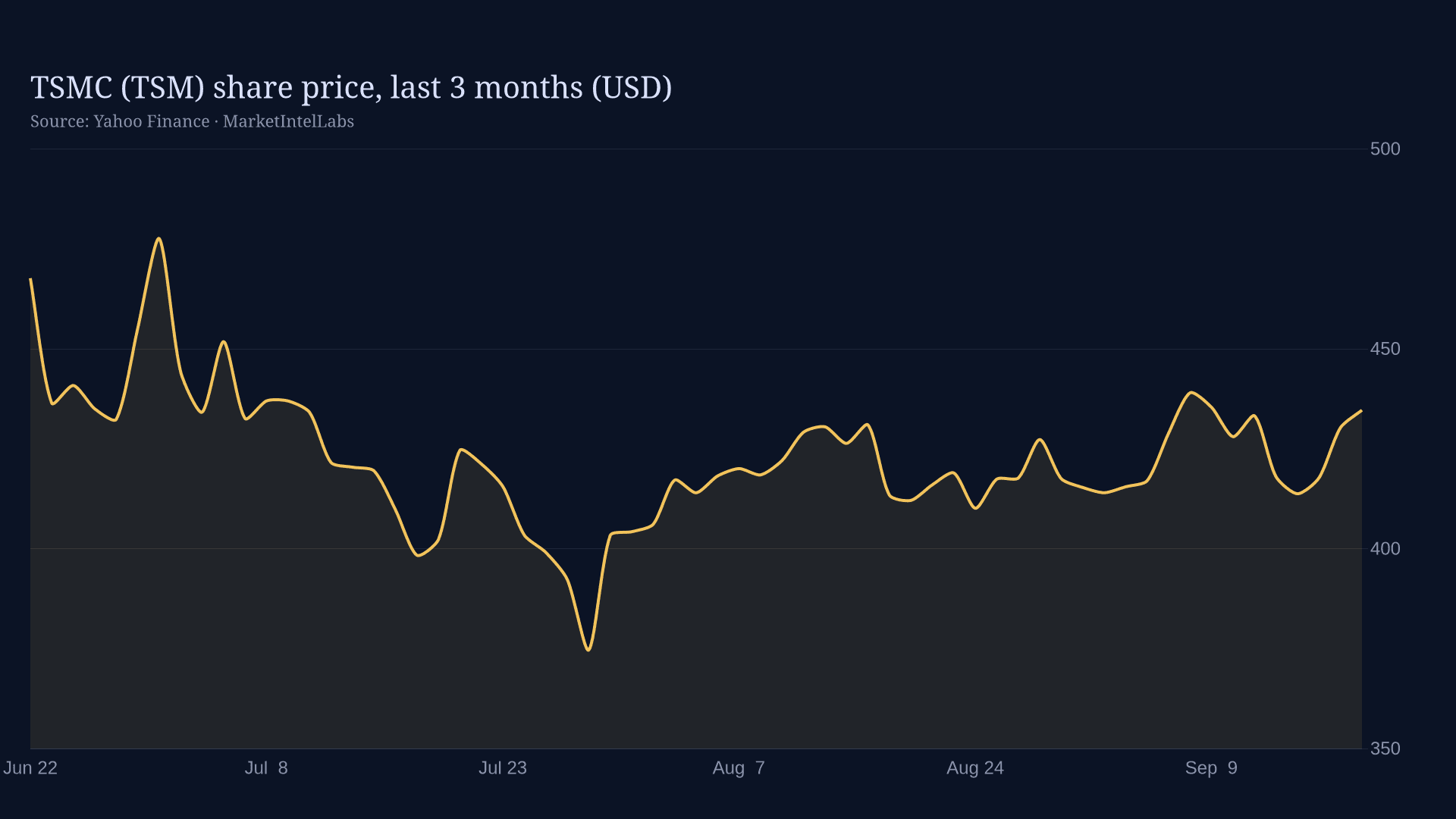
The loudest AI story of the past two weeks was an argument about slowing down. Dario Amodei's essay "We Must Pace the Frontier" landed on September 12, and by Monday, September 14, the Philadelphia semiconductor index had lost 5.86% in a single session. Nvidia fell 3.4%, AMD 4.4%, Broadcom 4.8%, Micron 5.3%. But ten days earlier and four days into the panic, the loudest datapoint arrived from a company that did not issue an opinion: TSMC reported August consolidated revenue of NT$514.81 billion, roughly $16.35 billion, a record month (see TSMC August Revenue Hits NT$514.81 Billion, Up 53.3% Year Over Year), up 53.3% from August 2025 and 10.1% from July. The two facts are not in conflict. They are the same fact seen from two ends.
The market's read of the pacing debate was straightforward: slower model iteration means weaker chip demand. That logic punished the picks-and-shovels layer hardest, exactly as Arena Private Wealth's Erik Kratz put it, because that layer is most exposed to a slowdown in the rate of capability improvement. Software names rallied the same day, inverting the year's hardware-over-software trade in one session. Morningstar strategist Michael Field called the reversal a genuine change for markets.
The problem with reading the selloff as a capex event is that the capex guidance says otherwise. The five hyperscalers are guiding roughly $800 billion of 2026 capital expenditure at the midpoints: Amazon $220 billion, Alphabet $195 to 205 billion, Microsoft around $175 billion for calendar 2026, Meta $130 to 145 billion, and Oracle $90 to 95 billion gross for its fiscal 2027 after a $40 billion raise on September 10. Bank of America's aggregate estimate, $795 billion this year rising to nearly $1.08 trillion in 2027, is in the same neighborhood. Citi's research desk is more aggressive still, projecting $730.9 billion of data center capex from the big five clouds in 2026 and more than $1.16 trillion by 2028. No budget has been cut since the essays went up.
TSMC's monthly print is the cleanest test of whether that money is actually flowing, because the foundry sits underneath every one of those budgets. August's 53.3% year-over-year surge was not a one-month spike. January through August revenue reached NT$3,386.87 billion, up 39.3% from the same period of 2025, and the monthly figure has now risen for four consecutive months. Customer prepayments in the June quarter, per the filings cited by Lance Roberts, doubled to $3.6 billion from $1.8 billion at year-end, which is cash arriving for chips not yet delivered. That is the opposite of demand destruction.
What the debate actually did was reprice the financing risk of the buildout, not its size. Oracle's FY2027 gross capex guide of $90 to 95 billion came with a $40 billion raise, and the market marked the stock down 5.4% that day; it is down roughly 28% for the year even as its backlog story stays intact. The worry migrating through the sector is that an $800 billion annual bill, on its way to a trillion, has to be carried by someone through a rate environment where the 10-year Treasury crossed 5% on September 14. The AI buildout is being financed through higher-for-longer rates, a dynamic examined in The Fed's 4.1% Dot Puts AI's Cheap-Money Math to the Test; capex is not slowing so much as being refinanced.
Two other data points from the week cut against the slowdown narrative entirely. At the AI Infra Summit in Santa Clara, September 15 to 17, 250 companies including Nvidia, OpenAI, Google and Micron gathered while Korean analysts argued the bottleneck is shifting from GPUs to memory (see Memory Is Now the Most Expensive Part of an AI Server), which explains Micron's 556.84% 52-week run even after the Monday slide. And Meta, the company that publicly refused to slow down, gained 4.2% over three sessions while the chips it buys were falling, closing at $670.24 on September 15. The equity market is not pricing an end to the buildout. It is pricing a question about who captures it.
The bear case deserves its say. If Amodei, Altman and the safety consensus carry institutional weight, regulation or voluntary pacing could stretch model generations and, with them, the depreciation schedules on $800 billion of annual hardware. Chinese open-weight models now trail US frontier systems by only four to six months at a fraction of the cost, per CSIS, which compresses the pricing power that justifies the spend. And a 5% 10-year yield is a real discount rate for projects whose cash flows sit years out.
But the week's hard numbers line up on the other side. A record foundry month with 39.3% year-to-date growth, capex guidance that has only moved up, and prepayments doubling are order-book facts. Sentiment took the hit; the orders did not. That distinction held through the DeepSeek scare in early 2025, and nothing in the past two weeks suggests this round is different.
What to watch next: TSMC's September monthly revenue in early October, which will show whether August's record was a quarterly push or a run rate. Micron and the memory complex, where the bottleneck-shift thesis lives or dies. And the first hyperscaler to trim rather than raise a capex number. That last one has not happened yet. Until it does, the slowdown debate is an argument about pace, and the money is still moving.
This content is for informational purposes only and does not constitute financial advice. Past performance is not indicative of future results. Consult a qualified financial advisor before making investment decisions.
Get daily intelligence delivered
Create a free account for the Daily Brief every weekday and The Week Ahead every Sunday. No card required.