Gold Tops $4,690 as Fund Buying Extends to Fourth Week

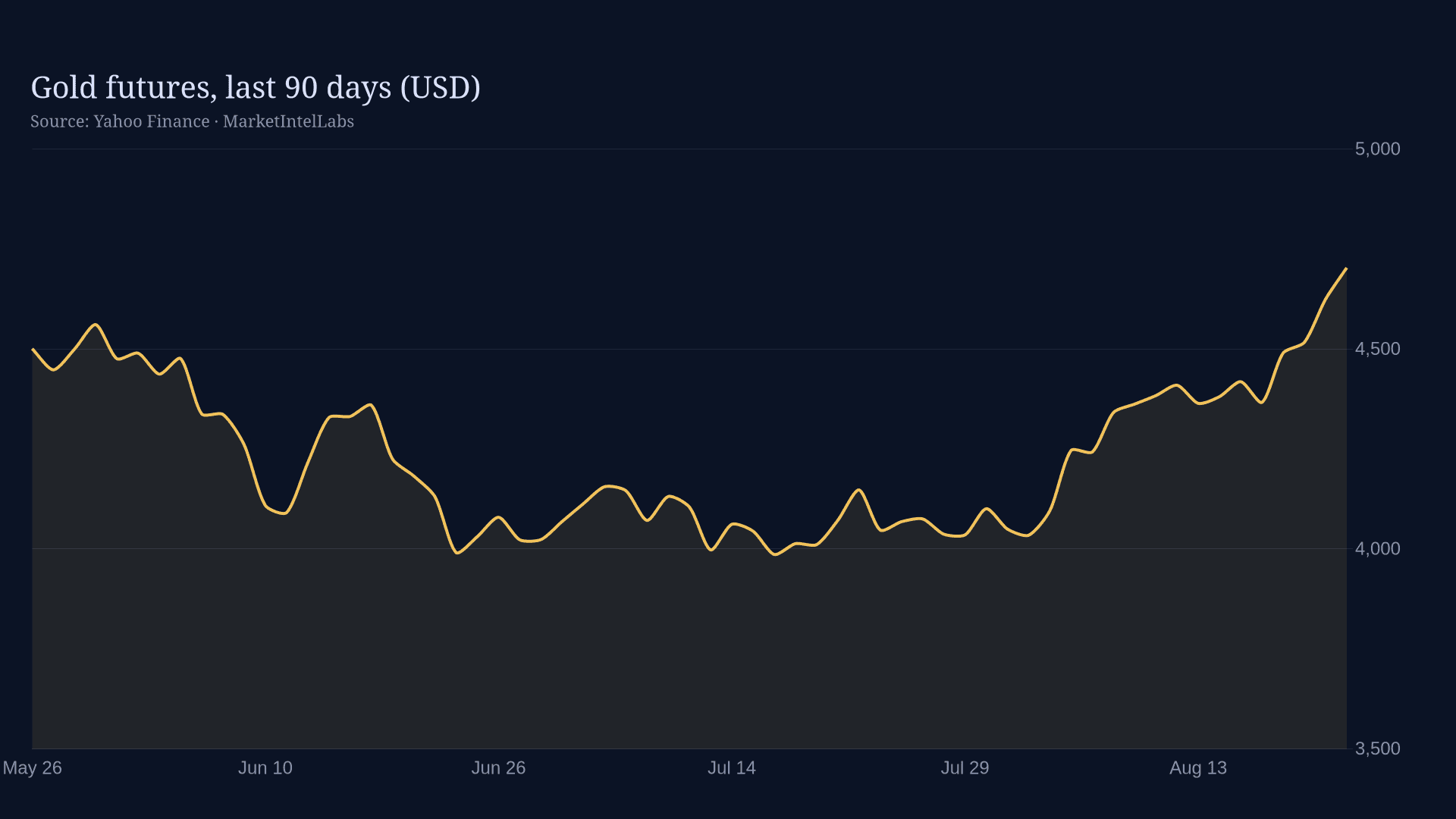
Gold futures cleared $4,690 in early Monday trading, up nearly 2% from Friday's $4,605.40 close and marking a fourth straight week of accumulation from the same buyers who have been building the position since late July. That's not a headline-driven pop. It's momentum from a market that closed last week strong and thin, now running into a calendar that puts Fed Chair Warsh's first Jackson Hole keynote and the September 4 payrolls report directly in its path.
Copper Hits an All-Time High as Gold Tops $4,453 on Monday.
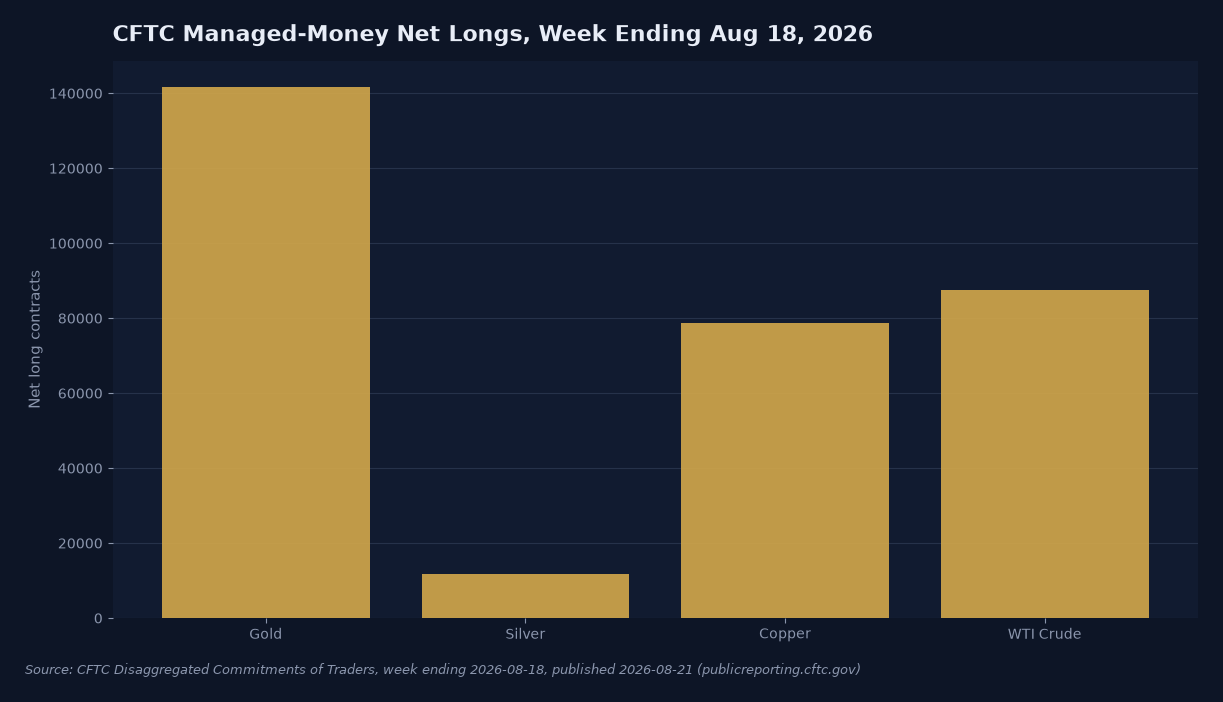
The positioning data backs up the idea that this is a broadening trade, not a narrow one. Managed money added to gold longs for the fourth week running through August 18, taking net length to 141,648 contracts (154,595 long against 12,947 short), according to the CFTC's disaggregated Commitments of Traders report. More notable is what happened in silver, where net longs rebounded 4.8% to 11,695 contracts after a two-week wobble in which positioning eased even as price rallied.
Speculators are now confirming the move with fresh length instead of the market running ahead of the futures book, and that's the healthier setup for a rally that wants to continue. Copper is the one metal in the complex where positioning cooled: net longs eased to 78,648 contracts from 79,027 the prior week, a modest 0.5% pullback but the first one in three weeks.
I'd watch copper closely, because it's the barometer for whether this is a genuine reflation trade or a narrower rates and dollar story confined to precious metals. If copper positioning keeps softening while gold and silver keep climbing, that argues for the latter, and it changes how durable the rally is once the rate-cut narrative gets tested.
The physical demand side of this trade doesn't care about Friday's dollar move or Monday's futures session. The World Gold Council's Q2 2026 print showed central banks bought 289 tonnes, the strongest second quarter on record and 62 tonnes ahead of the same period a year ago. The PBOC alone added roughly 33 tonnes, continuing a pattern of reserve diversification that has held through multiple gold price regimes.
See also our gold coverage: https://marketintellabs.com/topics/gold.
This is price-insensitive buying. It's a floor under the physical market, not a catalyst for the next $50 move, and it's worth separating from the paper positioning story when you're sizing up how much of this rally is momentum versus structural support.
Oil isn't confirming any of it, and that divergence is the most useful signal in the complex right now. WTI slipped 0.8% to $85.68 and Brent fell 0.31% to $93.20 to start the week, even with the Hormuz corridor situation still unresolved after the U.S.-Iran ceasefire memorandum lapsed on August 17 without an extension. What makes this interesting is that managed-money longs in WTI actually rose 9.5% week over week to 87,479 contracts while price lagged.
That's either funds positioning ahead of a catalyst they expect, or a market that got too cheap relative to the geopolitical risk still sitting on the table. Either way, if this were a genuine flight-to-safety trade, oil would be catching a bid alongside gold. It isn't, which tells me the metals move is a rates and dollar story specifically, tied to the Treasury's decision to double long-bond buybacks and pull yields lower, not a broad risk-off rotation across commodities.
None of this changes the calendar risk sitting directly ahead. Warsh's first Jackson Hole keynote runs August 27 to 29, and the prior FOMC minutes showed a 9-3 vote with three hawkish dissents, the most divided the committee has been since 2016. Gold's entire move off its post-FOMC low has been built on falling long yields and a softer dollar, engineered in part by the Treasury's buyback operation rather than a Fed policy pivot.
If Warsh leans hawkish, or if the September 4 payrolls print comes in hot after a run of soft prints, the rate-cut repricing underneath this rally can unwind fast, and a market that's added length for four straight weeks has real room to give it back. The level I'm watching on any pullback is $4,400 spot, which works out to roughly $400 on GLD.
That's the line that would separate a routine consolidation from something that actually challenges the four-week accumulation trend. Until then, the setup stays constructive: crowded but confirmed by physical demand, with the next real test arriving in five trading days.
This content is for informational purposes only and does not constitute financial advice. Past performance is not indicative of future results. Consult a qualified financial advisor before making investment decisions.
Get daily intelligence delivered
Create a free account for the Daily Brief every weekday and The Week Ahead every Sunday. No card required.