Walmart Q2 FY2027: EPS Beats at $0.81, Stock Falls 8% on Tariff-Refund Caveat


Walmart beat Wall Street's estimates on both lines this morning, and the stock sold off anyway. Adjusted earnings per share of $0.81 topped the $0.74 to $0.76 range analysts had penciled in, and revenue of $187.9 billion cleared the high end of the $186.2 billion to $188.9 billion consensus band. Shares that had traded as high as $116.00 in the premarket session fell to roughly $105.90 within the first hour after the 8 a.m. ET earnings call began, a drop of nearly 8% from Wednesday's $115.20 close.
The disconnect between the print and the price is the story here. A beat-and-raise quarter that sends a stock down 8% is not a data problem, it is an expectations problem, and Walmart's own numbers point to where the market's doubts are coming from., as seen in Target's Q2 comparable sales beat
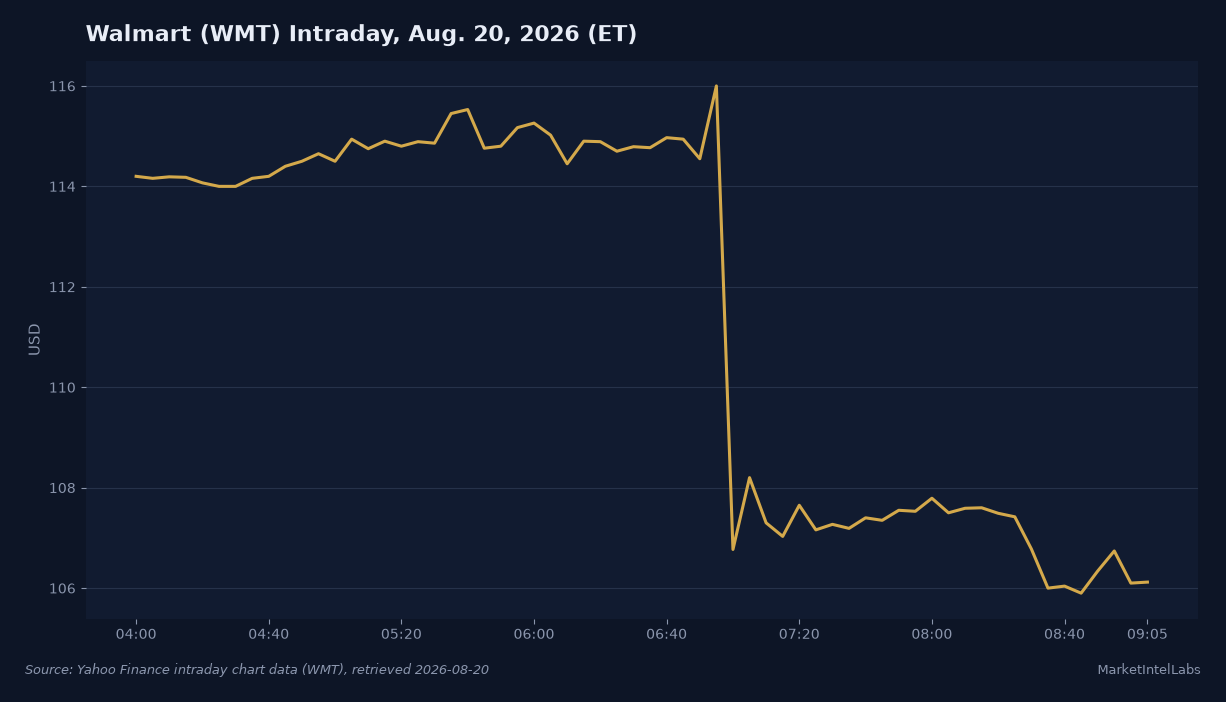
The Headline Numbers, and the Catch
Total revenue rose 5.9% year over year to $187.9 billion, or 5.1% in constant currency, extending a streak of acceleration from the $177.75 billion posted in Q1 FY2027 and the $177.4 billion from the year-ago Q2. GAAP earnings per share came in at $0.80, with the adjusted figure at $0.81 after backing out a $0.12 per share loss on equity investments and an $0.11 per share tax benefit. Operating income grew 28.8% on a reported basis and 17.4% on an adjusted, constant-currency basis, according to the company's press release.
That operating income growth is where the caveat lives. Walmart said it received nearly $2.9 billion in IEEPA tariff refunds during the quarter, a benefit management estimated added roughly 750 basis points to the 17.4% adjusted growth figure. Strip that out, and CFO John David Rainey said underlying operating income growth landed at the top end of the company's 7% to 10% guidance range, still a solid quarter, just not the blowout the reported number implies on its own., similar to Lowe's Q2 earnings beat
Rainey's guidance for how to read the print was explicit. "I encourage you to consider Q2 and Q3 performance together to assess the underlying growth of the business," he said in the release, because Walmart is deliberately pushing the tariff-refund windfall back out to customers as price investments in the back half of the year rather than banking it as margin. That is a company choosing volume and market share over a one-time profit pop.
Where the Growth Engine Is Slowing
Walmart U.S., the largest segment, posted net sales of $125.2 billion, up 3.5%, with comparable sales rising 2.6% against a 4.6% comp a year earlier. Roughly 125 basis points of that deceleration traces to new maximum fair pricing regulation on pharmacy products that took effect January 1, a policy-driven headwind rather than a demand problem. Even adjusting for that, though, the deceleration from last year's comp pace is real, and it lands at a moment when investors have been asking whether Walmart's multi-year share-gain story is starting to mature., amid a broader equities rally
eCommerce remains the clearest bright spot inside that segment. Walmart U.S. digital sales grew 24%, contributing roughly 510 basis points to the comp, up from about 420 basis points a year ago, with store-fulfilled delivery up 40% and marketplace net sales up more than 50% in the quarter.
Global advertising revenue grew 38%, with Walmart Connect in the U.S. up 43% excluding the VIZIO acquisition. Those are the numbers management is leaning on to argue the business mix is shifting toward higher-margin, higher-growth revenue streams even as the core comp-sales number cools.
Sam's Club U.S. told a similar story: comparable sales excluding fuel rose 4.4%, down from 5.9% a year ago, though transaction growth accelerated to 7.0% from 3.9%, meaning more members are shopping even as average ticket size fell 2.5%. Walmart International grew net sales 7.9% in constant currency, with Sam's Club China posting record member counts and Flipkart Ads up 20% in India.
Guidance Went Up. The Stock Went Down Anyway.
Walmart raised its full-year outlook on every major line. Constant-currency net sales growth guidance moved to 4.0%-5.0% from 3.5%-4.5%, adjusted operating income growth guidance rose to 7.0%-8.5% from 6.0%-8.0%, and adjusted EPS guidance climbed to $2.80-$2.87 from $2.75-$2.85. For a company that had already guided conservatively coming into the print, a second consecutive upward revision would typically be treated as unambiguously bullish.
The market's reaction suggests something else is weighing on the stock: valuation and positioning heading into the print. WMT shares had rallied hard over the past year, and options market data ahead of the release, cited by Barchart on August 18, pointed to traders bracing for a post-earnings decline regardless of the numbers. When a stock has priced in perfection, a genuinely good quarter wrapped in a one-time tariff-refund asterisk and a softer core comp gives sellers a reason to take profits rather than a reason to buy more.
The Q3 guidance itself carries a flagged headwind of more than 100 basis points from a timing shift in Flipkart's Big Billion Days promotional event between the third and fourth quarters, an unusual level of granular caution for a company simultaneously raising its full-year numbers.
The broader retail tape offers a contrast worth noting. Target, which reported Wednesday, saw its shares rise nearly 2% after beating estimates and raising guidance of its own, following a smaller prior-quarter base and lower expectations. Home Depot and Lowe's, which also reported this week, traded roughly flat to modestly higher on their prints. Walmart's sell-off looks specific to Walmart, not a read-through on discretionary or home-improvement retail broadly, and the SPDR S&P Retail ETF (XRT) was little changed on the day even as WMT fell sharply.
What to Watch Next
The next real test of Walmart's tariff-refund framing comes in the Q3 print, when the company itself has asked investors to compare results as a two-quarter blend rather than in isolation. Watch whether Walmart U.S. comp sales stabilize closer to the 2026 trend once the pharmacy-pricing headwind rolls off, and whether the eCommerce and advertising growth rates hold up as the base gets tougher.
FOMC minutes due this afternoon and Friday's broader market close will shape whether today's move gets read as company-specific noise or gets caught up in a wider risk-off session. For a stock that just delivered a beat-and-raise quarter and fell 8% anyway, the next print carries more weight than usual in settling which read was right.
This content is for informational purposes only and does not constitute financial advice. Past performance is not indicative of future results. Consult a qualified financial advisor before making investment decisions.
Get daily intelligence delivered
Create a free account for the Daily Brief every weekday and The Week Ahead every Sunday. No card required.