Steady Expansion, Not Overheating: Why the Fed Is Holding Pat

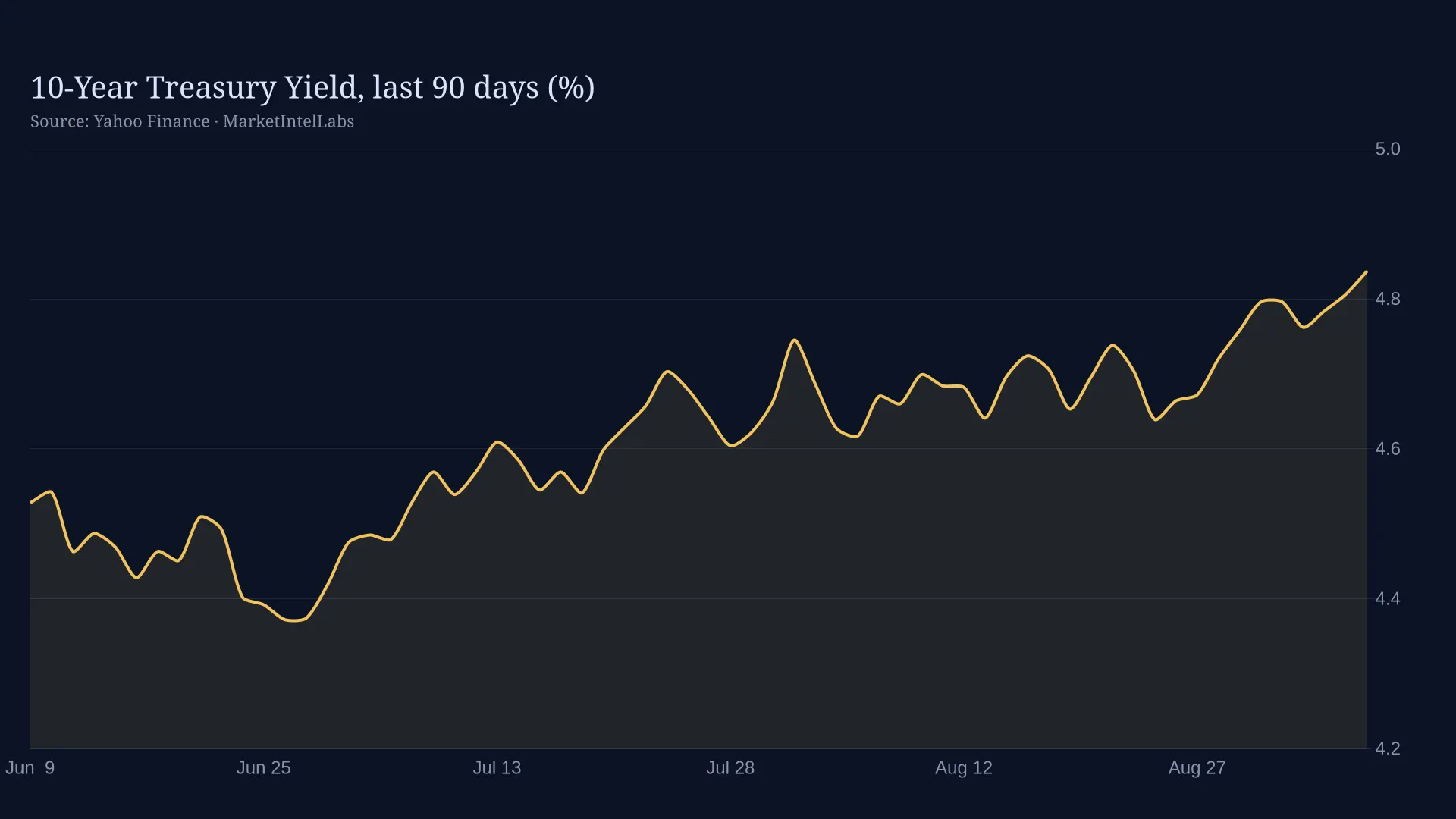
The July macro data confirms what the Federal Reserve already suspected. The U.S. economy continues expanding without overheating, leaving policymakers with little reason to adjust course before year-end. M2 money supply grew 0.45% in July, while core CPI rose just 0.22% month-over-month. Unemployment holds at 4.1%, and the 10-year Treasury yield sits at 4.8%. The Phillips-curve trade-off remains benign, giving the Fed room to maintain its pause at 3.63%.
The money supply data tells a clear story. M2 expanded by 0.45% in July, adding $102.8 billion to the monetary aggregate according to FRED data. That growth is modest but meaningful. It provides a liquidity floor for risk assets without stoking inflationary pressures. The Federal Reserve's balance sheet policy remains accommodative enough to support market functioning, while the data shows no need for immediate tightening.
Inflation remains contained. The headline CPI rose 0.07% in July, with core CPI up 0.22%. Both readings sit well within the Fed's comfort zone. Core PCE, the Fed's preferred inflation gauge, increased 0.16% in July. These numbers give the Fed breathing room. The central bank can afford to wait and see, rather than pre-emptively adjusting policy based on inflation fears that have yet to materialize.
The labor market shows resilience without tightness. The unemployment rate held at 4.1% in August, according to the Bureau of Labor Statistics. Job growth remains steady, but not so strong that it forces the Fed's hand on rates. The Phillips-curve trade-off remains benign. This is exactly the scenario the Fed wants: enough job creation to sustain economic growth, but not so much that it drives wages and prices higher.
Treasury markets reflect this equilibrium. The 10-year yield closed at 4.8% on September 8, while the 2-year yield sits at 4.39%. The 41-basis-point positive spread matters. Historically, a positively sloped yield curve has preceded equity gains over the following quarter. An inverted curve would signal recession fears. The current curve suggests markets expect neither recession nor runaway inflation, they expect a soft landing.
Cross-asset positioning confirms the data. SPY and QQQ traded marginally lower on September 10, down 0.46% and 0.29% respectively. The macro data does not justify a material sell-off, but it also offers no catalyst for a breakout. Investors are positioned neutrally, waiting for the next data point to provide direction.
Precious metals tell a different story. GLD gained 0.91% and SLV jumped 2.27%. Gold benefits from incremental M2 expansion and stable real yields. Silver outperformed due to strong industrial demand plus monetary support. This divergence suggests capital is rotating into real assets that benefit from liquidity without relying on growth acceleration.
Fixed income saw slight declines. TLT fell 0.57% and IEF dropped 0.29% as yields edged higher. The curve steepening reflects market expectations that the Fed will neither hike nor cut in the near term. Investors are demanding term premium for duration risk, but not pricing in a rate-cut cycle.
Crypto traded flat. BTC rose 0.11% and ETH gained 0.40%. Digital assets remain decoupled from macro flows for now. Regulatory clarity drives these markets more than liquidity conditions. Until that overhang resolves, crypto will likely continue trading on its own fundamentals rather than macro data.
The primary risk to this thesis is a surprise spike in the September CPI print. The Cleveland Fed nowcast gives a 55% probability that year-over-year inflation remains above 3.0%. A month-over-month print above 0.3% would test the Fed's patience and could force a reconsideration of the pause. Conversely, a sharper slowdown in employment could shift expectations toward earlier rate cuts, boosting bonds and growth equities.
Geopolitical risks are elevated but contained. Trade tensions with China have not escalated materially, and energy prices remain stable. The macro backdrop currently accounts for these risks without pricing in a shock event.
What to watch next week. The August CPI print arrives September 12. That is the most consequential data point between now and the September 16 FOMC meeting. Weekly jobless claims on September 17 will show whether labor market resilience continues. Retail sales data on September 18 will confirm whether consumer spending is sustaining the expansion.
The CME FedWatch tool assigns an 85% probability that the Fed holds rates unchanged at the September 16 meeting. The data supports that view. The Fed's data-dependent framework remains dependent on whichever data supports the current narrative, and the current data supports staying the course.
The near-term outlook is neutral. The macro backdrop remains supportive of risk assets, but with limited upside given current valuations. Investors looking for direction should watch the curve. Further steepening would confirm the soft-landing narrative. Flattening would signal earlier rate cuts. The data will tell us which path we are on within weeks.
This content is for informational purposes only and does not constitute financial advice. Past performance is not indicative of future results. Consult a qualified financial advisor before making investment decisions.
For deeper context, see our Fed policy coverage.
Related Reading
Get daily intelligence delivered
Create a free account for the Daily Brief every weekday and The Week Ahead every Sunday. No card required.