equities

Market Internals Show Negative Breadth, VIX Rises Modestly

Published September 9, 20262 min read
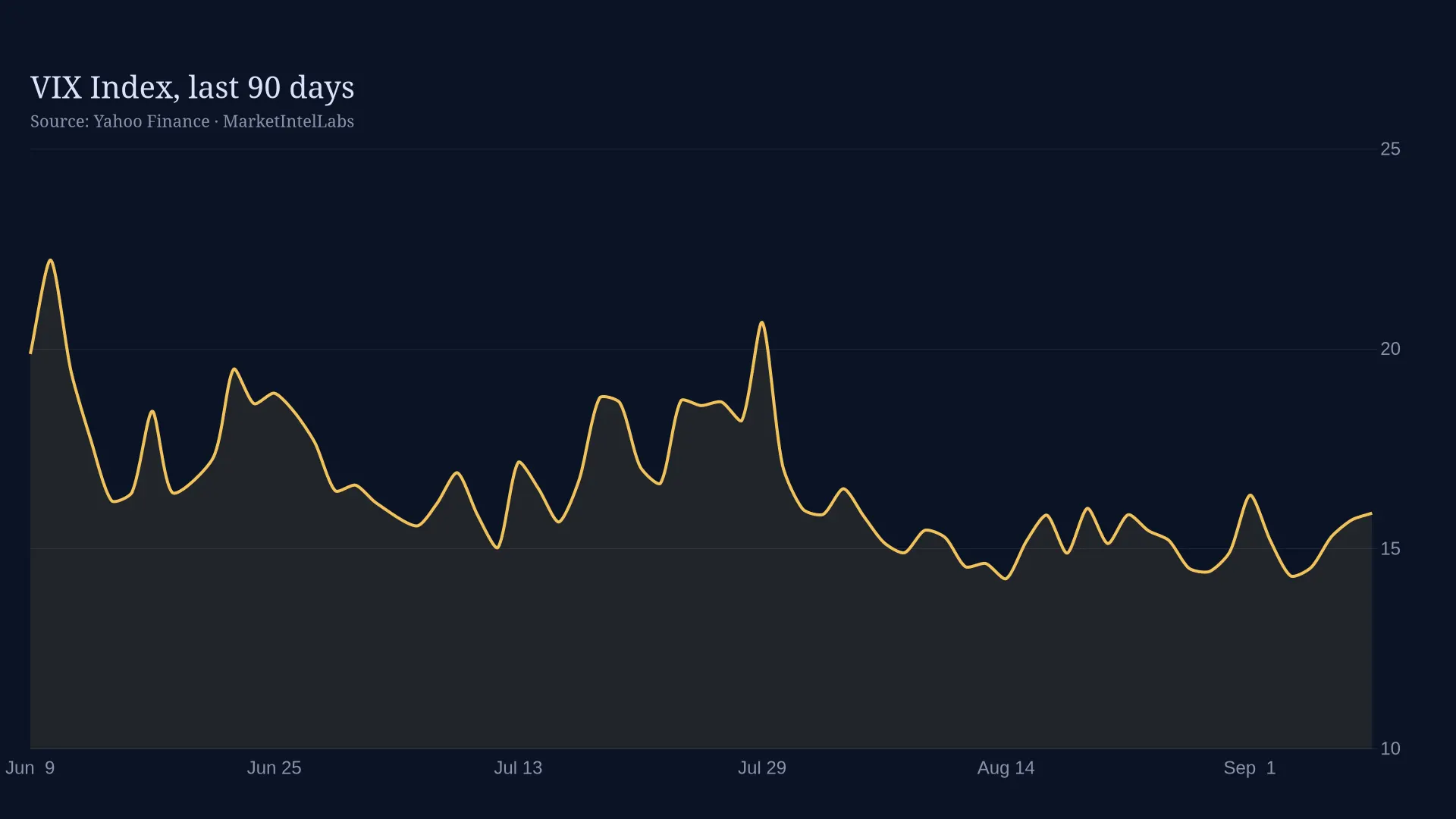
Line chart of VIX Index, last 90 days on a dark background
VIX Index shows market volatility over time — Illustration: MarketIntelLabs

The S&P 500 ETF (SPY) fell 0.55% on Wednesday, September 9.

Data sources: CBOE for VIX, U.S. Treasury data for the 10-year yield, and exchange data for all ETF closing prices.

Market breadth turned negative with eight of eleven sectors closing lower. The VIX rose 2.75% to 15.72, indicating modest anxiety among traders.

Related reading: NVIDIA's Groq Racks Deploy as AI Inference Race Accelerates, Gap Store Closures and Old Navy Strategy Headwinds, Tech Leads as Sector Rotation Accelerates.

This index decline masks a more nuanced shift in sector leadership.

Technology (XLK) and energy (XLE) were the only sectors to post gains. They added 0.32% and 1.11% respectively.

This divergence highlights ongoing rotation from defensive sectors toward growth and commodity-exposed areas.

Health care (XLV) suffered the worst decline at 2.52%. Financials (XLF) followed with a 1.38% drop.

Utilities (XLU) posted an unusual 0.86% gain despite rising rates. That likely represents an oversold bounce rather than a trend reversal.

The 10-year Treasury yield climbed to 4.81%, up 0.46% on the day.

Higher yields typically pressure rate-sensitive sectors like utilities and real estate. Yet technology managed to outperform.

This resilience suggests that other factors, such as strong earnings expectations, are supporting tech stocks.

Energy's strength likely reflects firmer oil prices. Ongoing geopolitical tensions are underpinning those prices.

The sector's gain of 1.11% shows investors seeking exposure to commodities.

The Nasdaq-100 ETF (QQQ) held up better than the broad market. It declined just 0.08%.

The Dow Jones Industrial Average ETF (DIA) underperformed with a 1.13% drop. Small caps (IWM) retreated 0.45%.

This pattern shows growth-oriented assets maintaining relative strength.

Market breadth data confirms the negative sentiment. Only three sectors advanced and eight declined.

The market is not experiencing broad-based selling. Capital is rotating between sectors based on changing interest rate expectations.

Thursday's weekly jobless claims report will be the next key data point. The consensus estimate stands at 215,000 claims.

A softer number could reignite risk appetite and extend the rotation into cyclicals. A hotter read would likely reinforce the current shift away from rate-sensitive areas.

The VIX level of 15.72 remains below panic thresholds. It is above the complacency zone seen earlier in the year. This suggests markets are in a cautious wait-and-see mode ahead of the data.

This content is for informational purposes only and does not constitute financial advice. Past performance is not indicative of future results. Consult a qualified financial advisor before making investment decisions.

Get daily intelligence delivered

Create a free account for the Daily Brief every weekday and The Week Ahead every Sunday. No card required.