Copper Weakness Signals Global Demand Fears

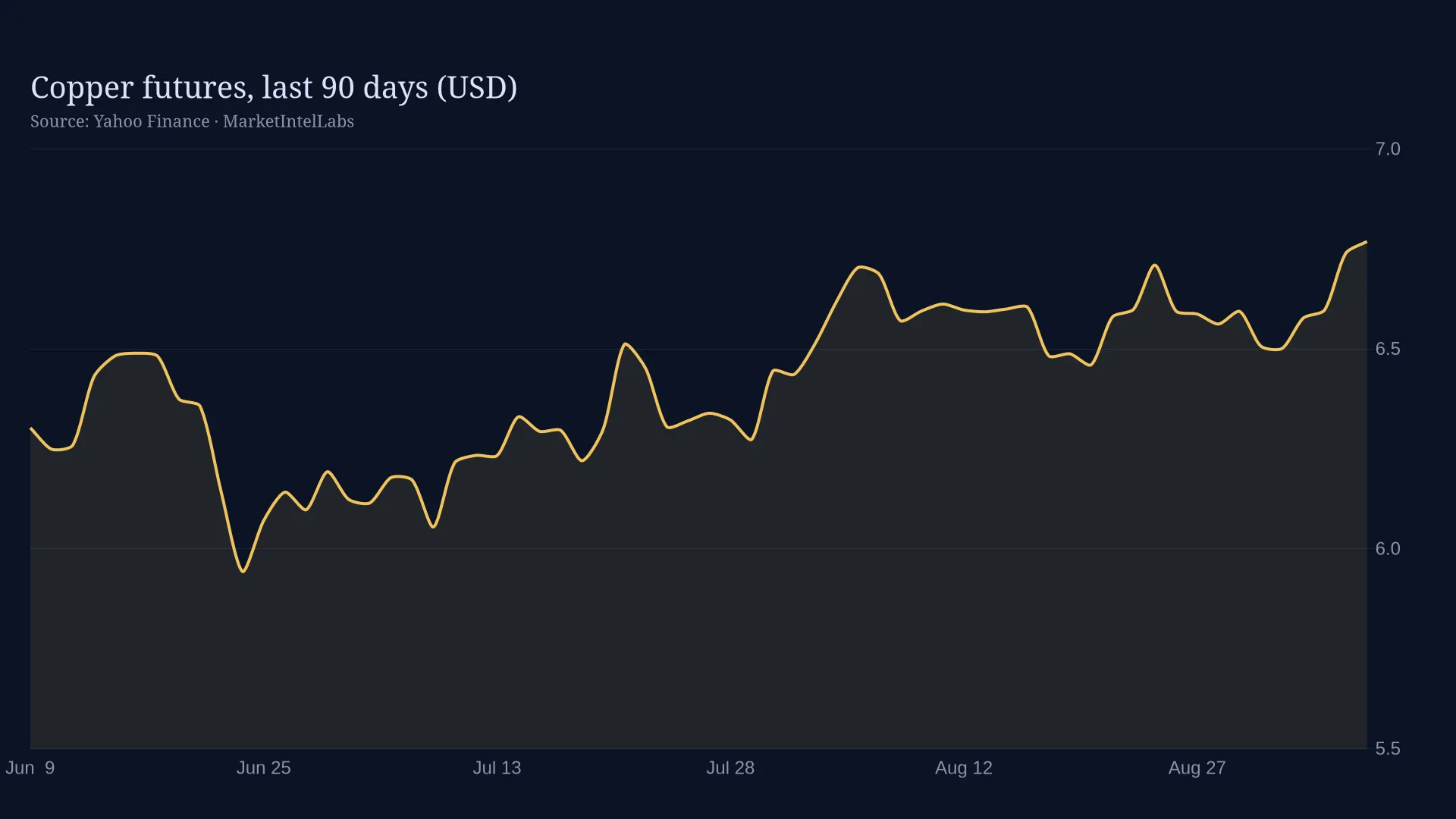
Copper slipped 0.78% to $6.77 on September 9 as Chinese demand fears resurfaced and global manufacturing data pointed to a broader slowdown. The industrial metal's decline follows a sharp 2.87% rally in oil and mixed price action in precious metals, suggesting commodities markets are grappling with divergent fundamentals.
Copper markets are sending a warning signal about global industrial demand. While gold and silver futures eked out modest gains, copper's decline stands out because of its tight correlation with manufacturing activity and infrastructure spending. China, which accounts for roughly half of global copper consumption, has shown signs of slowing economic momentum in recent weeks. This weakness is showing up in copper prices even as oil rallies on supply constraints.
Physical inventories tell an important story. Despite the price decline, copper inventories remain near multi-month lows. That suggests the selloff is driven by demand concerns rather than a glut of supply. When prices fall on weak demand with ample inventory, the market typically sees inventory accumulation. Current conditions look different. low stocks alongside falling prices is often a contrarian signal if buyers step in at key levels.
Support at $6.70 becomes the level to watch. That zone has held on multiple tests over the past two months. A break below $6.70 would likely trigger stop-loss selling and open the door to a test of $6.50. Below that, the technical picture would deteriorate quickly. Conversely, a bounce from $6.70 would indicate buyers are still present despite the negative sentiment. The metal's ability to hold that level will tell us whether this is a temporary dip or the start of a deeper correction.
Oil markets present a different dynamic. The United States Oil Fund (USO) jumped 2.87% to $146.03, reflecting tightening supply rather than broad-based demand. CFTC positioning data shows managed money net long positions declined 22% from the prior week to 16,365 contracts. That suggests traders are taking profits rather than establishing new bullish bets. Supply concerns around OPEC+ production constraints and geopolitical risks are driving oil higher, but the positioning data indicates some skepticism about how far the rally can run without demand support.
Gold and silver are showing the classic divergence between paper and physical markets. Gold futures edged up 0.11% to $4,443.70, but the gold ETF GLD dropped 1.73% to $399.72. That disconnect points to ETF-specific outflows rather than broad-based selling. Silver futures gained 0.57% to $67.38 while the silver ETF SLV fell 0.75%. The pattern is the same. investors are rotating out of ETF exposure while futures find support from physical buyers and commercial hedgers.
Positioning extremes in precious metals are notable. Managed money traders are net short 27,417 gold contracts, the most bearish stance in four months. That kind of extreme bearish positioning historically has preceded sharp rallies as shorts are forced to cover. Commercial traders, who represent physical market participants, remain net long 7,965 contracts. The combination of speculative bearishness and commercial bullishness is a classic contrarian setup. Silver positioning is more constructive, with managed money holding a net long position of 26,739 contracts.
What ties these markets together is the underlying theme of selective demand. Oil is rallying on supply, not demand. Gold is finding support from commercial buyers despite speculative selling. Copper is weakening because the demand side looks uncertain. That uneven backdrop suggests commodities investors need to be selective rather than assuming a broad-based rally or selloff.
The next few trading sessions will be critical for copper. Chinese stimulus measures, if announced, could provide a catalyst for a rebound. Manufacturing data from the U.S., Europe, and China will also matter. any signs of stabilization could lift the metal. Absent positive catalysts, copper remains vulnerable below $6.70. The physical inventory picture provides a potential floor, but sentiment is fragile and prone to overreaction to Chinese economic data.
The technical setup at $6.70 offers clear price signals. A hold at that level would confirm the contrarian case remains intact, suggesting buyers are absorbing supply despite negative sentiment. A break below $6.70 would shift the bias back to demand-driven selling, potentially opening the door to $6.50. The low-inventory backdrop amplifies both scenarios: surprise positive catalysts could spark sharp bounces, while continued weakness below support suggests further downside.
This content is for informational purposes only and does not constitute financial advice. Past performance is not indicative of future results. Consult a qualified financial advisor before making investment decisions.
Get daily intelligence delivered
Create a free account for the Daily Brief every weekday and The Week Ahead every Sunday. No card required.