Walmart Q2 FY2027 Earnings: What the Beat and the Selloff Both Mean


Walmart beat on every headline number Thursday morning and the stock still fell hard, and that gap is the story. Adjusted earnings per share came in at $0.81, well above the $0.74 to $0.76 range analysts had penciled in and above the company's own $0.72 to $0.74 guidance. Revenue reached $187.9 billion, up 5.9% year over year and inside the $186.2 billion to $188.9 billion consensus band. Shares still dropped roughly 6.9% in extended trading, from Wednesday's $114.30 close toward $106.46, because the quality of the beat matters as much as its size.
Related reading: Home Depot Q2 2026 Earnings: Retail Sector Outlook; Target Earnings 2026: Retail Margin Pressure; Consumer Spending Slowdown 2026: Retail Stocks at Risk.
Start with what actually drove the beat. Walmart's operating income rose 28.8% to $9.4 billion, but chief financial officer John David Rainey was direct about the source: a meaningful chunk came from tariff refunds received in the quarter, not from underlying retail momentum. Strip that impact out and adjusted operating income, measured in constant currency, grew 17.4%, which the company itself said landed at "the top end" of its prior guidance. That is still a strong number. It is also a smaller number than the headline, and traders who read past the first line of the release apparently decided the smaller number was the real one.
The mechanics matter here because Walmart flagged them explicitly rather than letting analysts discover them later. Rainey told investors to judge the second half of the year by looking at Q2 and Q3 together, since the company is deliberately routing "remaining tariff refunds into price investments" rather than banking them as pure profit. That is a company choosing to spend a one-time windfall on customer prices instead of booking it straight to profit, which is defensible strategy but complicates the read on organic earnings power. It also explains why a beat-and-raise quarter produced a selloff: investors priced the $0.81 print against a cleaner run-rate number, not the reported one.
Underneath the tariff noise, the operating business held up. Walmart U.S. comp sales grew 2.6%, driven by transaction growth rather than higher average tickets, and absorbed a 125 basis point headwind from pharmacy deflation tied to new maximum fair price drug regulation. eCommerce sales rose 24% domestically and 23% globally, extending a multi-year shift that CEO John Furner pointed to directly: "customers are choosing Walmart because we deliver price, speed, and convenience across a broad assortment." Advertising revenue, still Walmart's fastest-growing and highest-margin line, jumped 38% company-wide, with Walmart Connect up 43% excluding the Vizio acquisition. Sam's Club US comps rose 4.4% on a 7% jump in transactions, even as average ticket size fell 2.5%, a pattern consistent with shoppers trading down on individual purchases while shopping more often.
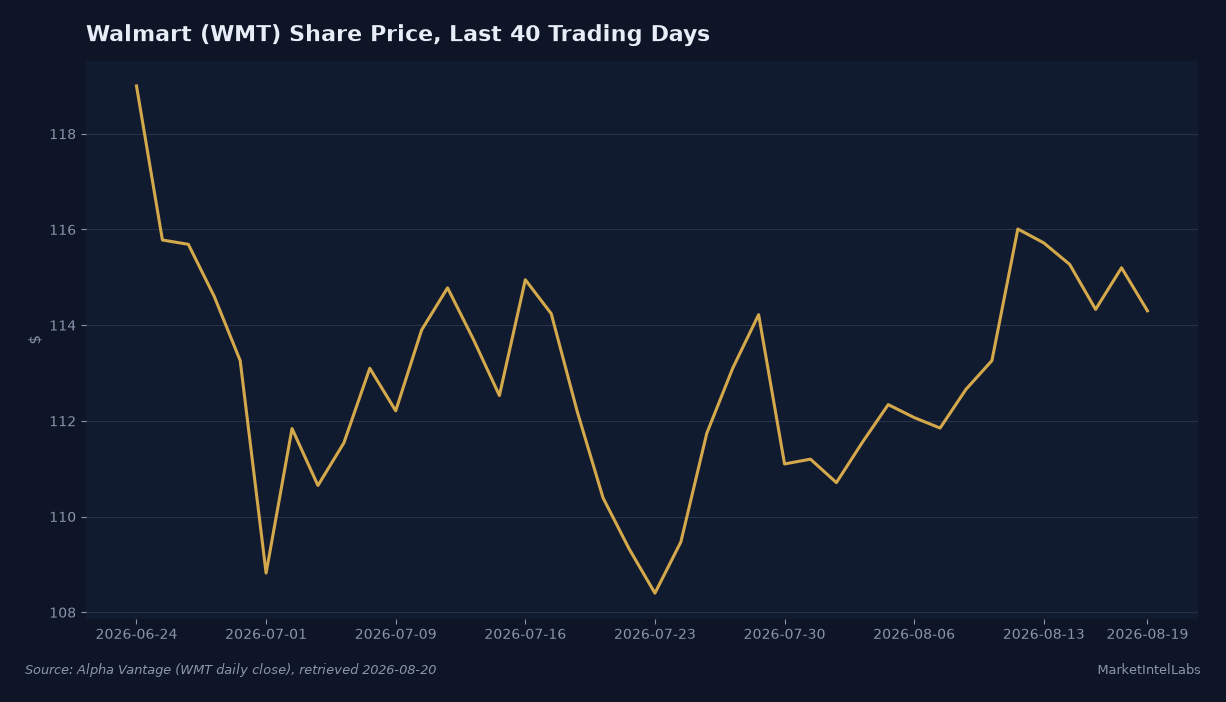
The chart below shows WMT's share price context heading into the print. The stock closed at $119.00 on June 24 and drifted down to $114.30 by Wednesday's close, a slide that started well before Thursday and sits well off the 52-week high near $135 set in May. Thursday's drop extends an existing trend rather than reversing a rally. That context matters for how much weight to put on a single earnings-day move: this was not a stock priced for perfection getting a rude surprise, it was a stock already discounting some margin pressure that then got confirmation the pressure is real.
Walmart's guidance update tells the more constructive part of the story, and it is easy to miss under the stock reaction. The company raised full-year net sales growth guidance to 4.0% to 5.0% in constant currency from 3.5% to 4.5%, lifted adjusted operating income growth guidance to 7.0% to 8.5% from 6.0% to 8.0%, and raised adjusted EPS guidance to $2.80 to $2.87 from $2.75 to $2.85. Capital expenditure guidance also moved up, to roughly 4.0% of net sales from 3.5%, signaling the company sees enough demand to justify accelerated investment in fulfillment and stores. A retailer does not raise capex plans and full-year profit guidance in the same release it is trying to obscure weakness in.
The bear case is straightforward and the market appears to be pricing it tonight: if tariff refunds are a one-time tailwind being spent down through price cuts, then the underlying margin trajectory into fiscal 2028 is less clear than the headline growth numbers suggest, and a stock trading near 30 times forward adjusted earnings needs that trajectory to hold. The bull case is that Walmart is using a temporary windfall exactly the way a durable low-price operator should: reinvesting it into the value proposition that drove 24% eCommerce growth and record second-quarter Walmart+ membership additions, rather than taking a one-quarter earnings win. Both readings are defensible from the same release, which is unusual and worth sitting with rather than resolving too quickly.
Walmart's print lands the same week as Home Depot, Target, and Lowe's, all reporting tariff refund benefits to varying degrees, and a day ahead of FOMC minutes that will shape how the market reads consumer resilience against Fed policy. Watch whether Thursday's selloff extends into Friday's session or fades as investors digest the raised guidance separately from the one-time items. A durable move below $110 would suggest the market is discounting Walmart's forward margin path more than the headline beat warrants; a stabilization near current levels would suggest tonight's reaction was mostly about digesting a complicated print, not a change in the long-term thesis.
This content is for informational purposes only and does not constitute financial advice. Past performance is not indicative of future results. Consult a qualified financial advisor before making investment decisions.
Get daily intelligence delivered
Create a free account for the Daily Brief every weekday and The Week Ahead every Sunday. No card required.